
“The Earth is blue.” This phenomenological observation by cosmonaut Yuri Gagarin, the first man to see the planet’s color from a different angle, inaugurated a new perception of space, inverting the directionality of human vision: no longer from inside out, but from outside in. This post-Copernicus inversion was a topic for the Sciences and the Arts in the 1960s. Onboard the Vostok,1 Gagarin also uttered a second sentence, which was lost to the dust of time but goes like this: “I was in the heavens and didn’t see God there.” Exactly forty-eight years ago (April 12th 1961,) the world moved from a first to a second dimension, setting Man up as the universe’s greatest achievement, or, if we want to use a different noun, as God. Gagarin’s journey has a special scientific meaning, but also great historical and cultural importance.
Later, another Russian—artist Ilia Kabakov—was to create an installation in reference to this great event in Soviet and universal history. The man who flew into space from his apartment, created in the 1980s, used for its support a room filled with Soviet-era posters in the official aesthetic promoted by the communist dictatorship, its room destroyed by a man who flew into space. For Kabakov, the man was able to make this jump using a self-made catapult because he knew how to use, among other sources, the energy accumulated on those posters representing, for instance, a moment of collective ecstasy and the triumph of Utopia in an era that dreamt of universal humanism through the lens of ideology. This ideology tumbled down at the end of the 1980s (on November 9, 1989, to be precise, with the fall of the Berlin wall), opening up a space for a new social, economic, and even aesthetic dimension. All facts are history, and in one way or another, they became paradigms for transformations promoted by human volition.
There is another, equally magical place, the Scrovegni Chapel, where Giotto (1266-1337) masterfully (re)configured the communion between celestial and terrestrial space and places Man at the center of this event. The narrative is presented in a deep, metaphysical blue, filled with immensity, silence, and the incommensurable. Giotto had already worked on a variety of churches —Assisi, Sienna, Rome; in Padua, he started painting the Chapel in 1302 and finished it in 1306. In his Decameron, filmmaker Pier Paolo Pasolini recalls this period, with himself in the role of Giotto. Giotto’s masterwork is the frescoes that cover the chapel’s walls in their entirety, narrating the biblical story of the Virgin Mary and Christ. At the back, there is a Judgment scene, framed by the heavenly dome. The intense realism of Giotto’s figures, surrounded by that phenomenological blue, opens up not only a new perspective for Mankind but also for European art.
Yves Klein’s cosmogonies and anthropometries belong to the same field. In his Chelsea Hotel Manifesto (1961), Klein writes: “Neither missiles nor rockets nor sputniks will render man the ‘conquistador’ of space. Those means derive only from the phantom of today's scientists who still live in the romantic and sentimental spirit of the XIX century. Man will only be able to take possession of space through the terrifying forces, the ones imprinted with peace and sensibility. He will be able to conquer space—truly his greatest desire—only after having realized the impregnation of space by his own sensibility. His sensibility can even read into the memory of nature, be it of the past, of the present, and of the future! It is our true extra-dimensional capacity for action!” Fascinated by the immensity of space, by the precedents of art—from Giotto to Delacroix—by fire, and by science, Klein created the last metaphysical version of the body inscribed in an unconditional space, especially in works like Escavatrice de l´espace (1958), Reliefs planétaires (1961), and Globe terrestre bleu (1962), as a transposition of infinitude into an artistic form.
We can lean on the Giotto-Klein-Kabakov triad to travel through some spaces by Sandra Cinto. It is like Ariadne’s thread that helps us move in the physico-temporal, historical, and mental space evoked by many of Cinto’s installations. The space of history, and of art history, is the preferred vantage to observe this artist’s posture and her profound respect for artistic precedent. “Space is extremely important for an understanding of my work. Drawing happens in space, which generates it. Usually, where I feel most secure is in installations where I combine architecture, drawing, painting and gesture, and those are the ones that work out best. Space is essential to the concept, as it amplifies my work. I make many models of my works in order to learn how they operate. When I work in real space, I follow the prior instructions for the project, combining them with the personal experience of living it.” 1 To see one of the artist’s installations as it is born is to be confronted with the pure evocation of the painstaking practice of drawing on giant surfaces. Like Giotto, Cinto spends hours concentrated on her silent drawings that evoke distant worlds, bridges, and mountains, physical and mnemonic spaces, a place for dreaming and solitude, not of experiences and experiments that must be conquered.
In this combinatory play of mental and manual activity, Cinto invokes her heroes in order to traverse a sea of influences: from Giotto to Klein, from Géricault to Kabakov, from Magritte to Leonilson, from Guignard to Louise Bourgeois, there is room in her boat for those artists who are most significant to her and to the history of mankind. Her invocations are epiphanies in that they are not always recognizable and in some cases are intentional. In this way, we see at times a formal approach, at times just the allusion to an idea or atmosphere. Let’s take as an example the installation (Untitled) presented by the artist to the São Paulo Biennial in 1997. There, Cinto drew on the building walls and on a photograph of her arm, thus appropriating architecture and the illusory game of flesh—the flesh of her arm on one of the arms of the building projected by Oscar Niemeyer. In this fusion of the space of the artist’s own body and the body that receives her, it is impossible not to be reminded of Klein’s anthropometric actions, and also Piero Manzoni’s “body signatures.”
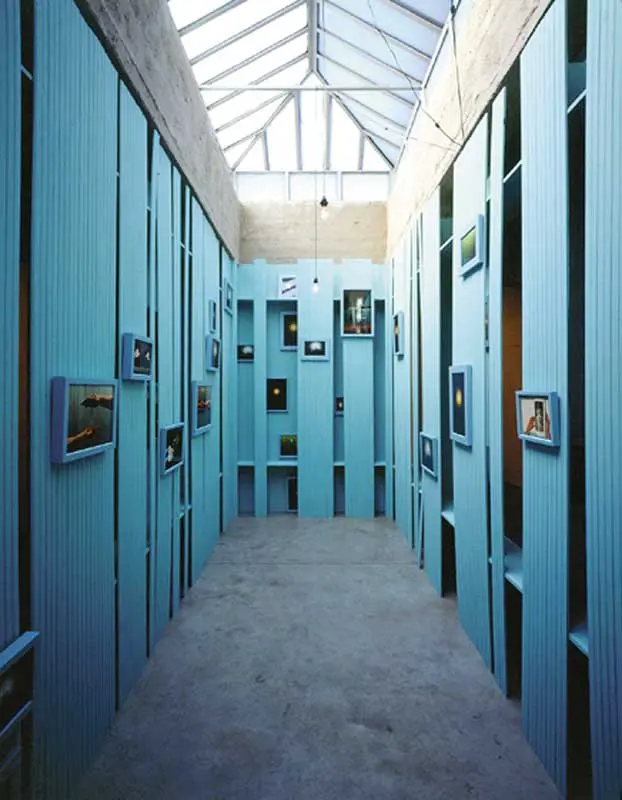
In many of her installations, Sandra Cinto creates spaces—workrooms, rooms for sleeping, rooms for dreaming—that are clearly inspired by Kabakov’s work. Under the sun and the stars (2004), presented at the Museu de Pampulha, in Belo Horizonte, once again appropriates Modernist utopian space (Oscar Niemeyer) in order to build an atemporal space filled with images of light (photographs and drawings), fragments of bodies (hands, arms), that recall the presence of the artist and her tenuous desire to freeze time (childhood? A visit to a work of art in an Italian church?, etc.) This work is, it turns out, her response to Kabakov’s The Man Who Flew Into Space From His Apartment, yet, contrary to the lone character who jumps from his home in Kabakov’s work, it is the artist herself who flies here, within the viewer’s mental space, since, as we enter this room, we are subjected to the image and pictorial impregnation offered by the artist.
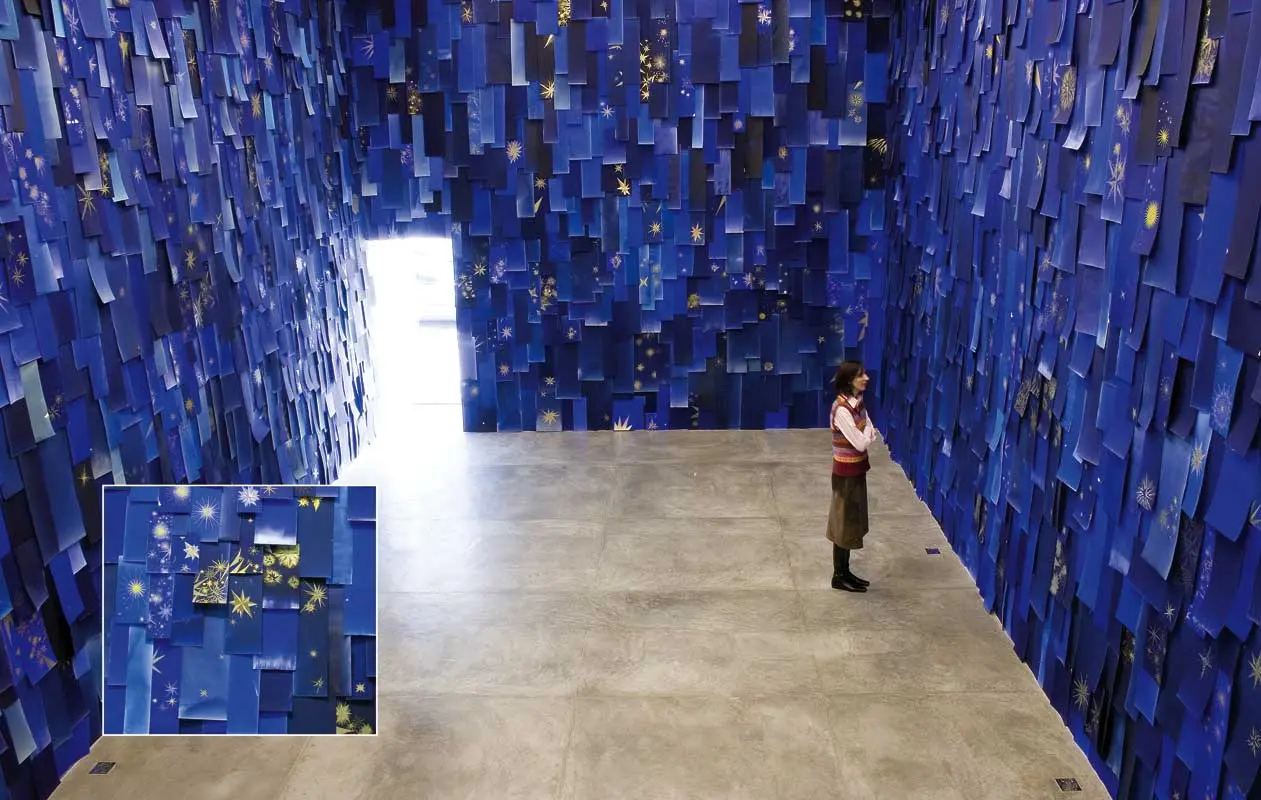
In Construction (2006), Cinto transformed the Casa Triángulo into her personal chapel and filled the space with myriad stars and celestial bodies hand-drawn and painted on little pieces of paper. The result was astonishingly similar to the visual and sensorial impregnation of Giotto’s chapel. This installation/occupation took us to a space of the deepest and most silent mystery, something religious and transcendent. Born out of the artist’s in loco experience during her visit to Padua, this installation made us traverse space in the direction of the site often quoted as one of the most enigmatic created by the Italian master of the Quattrocento, who so fascinated artists like Yves Klein, Bill Viola, and Cinto.
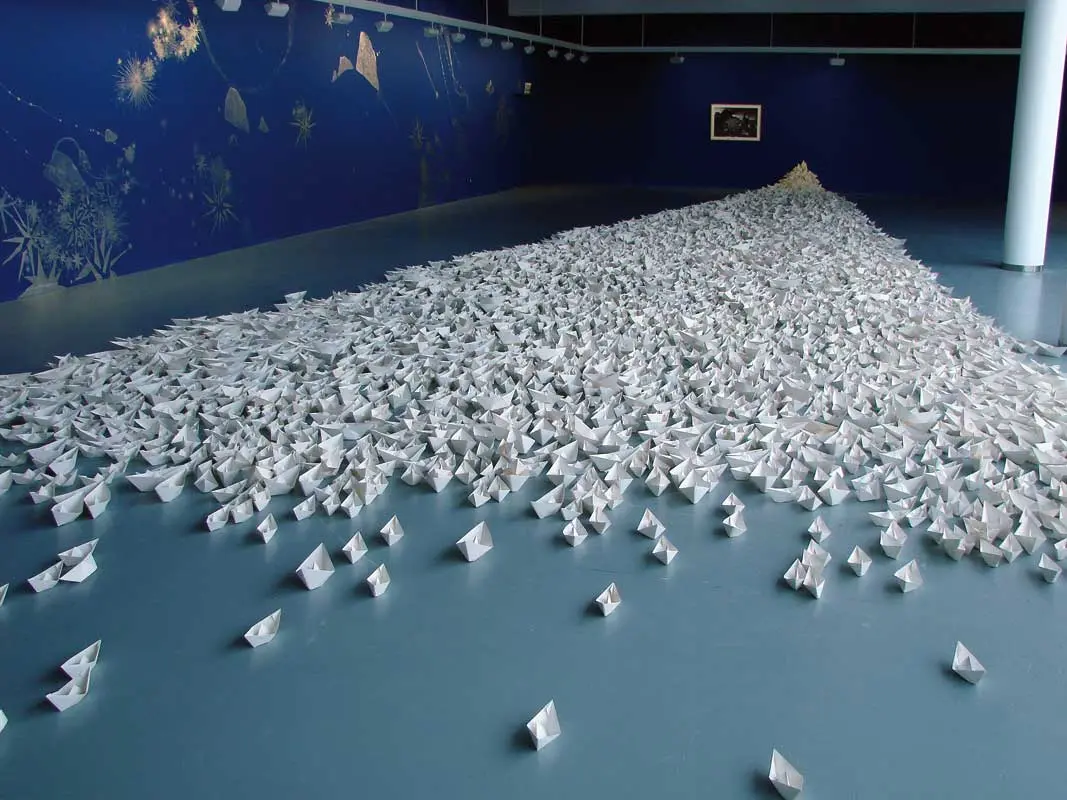
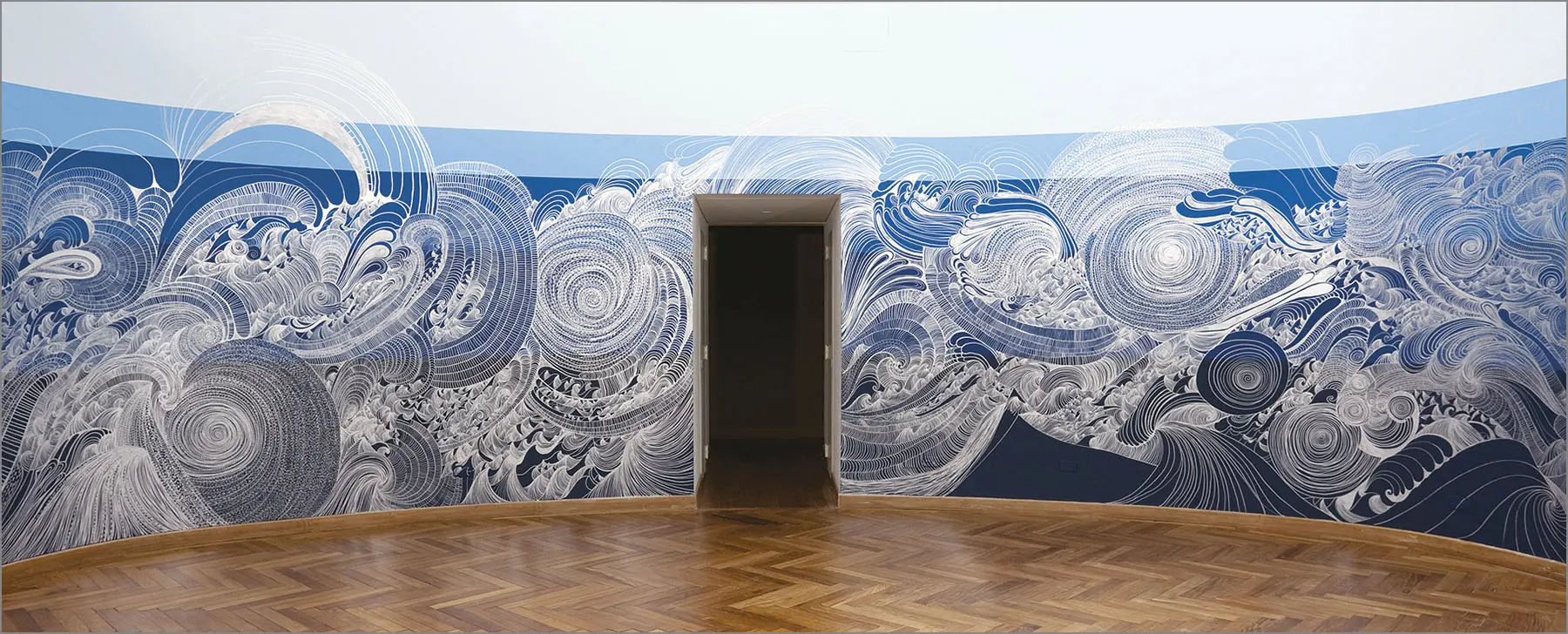
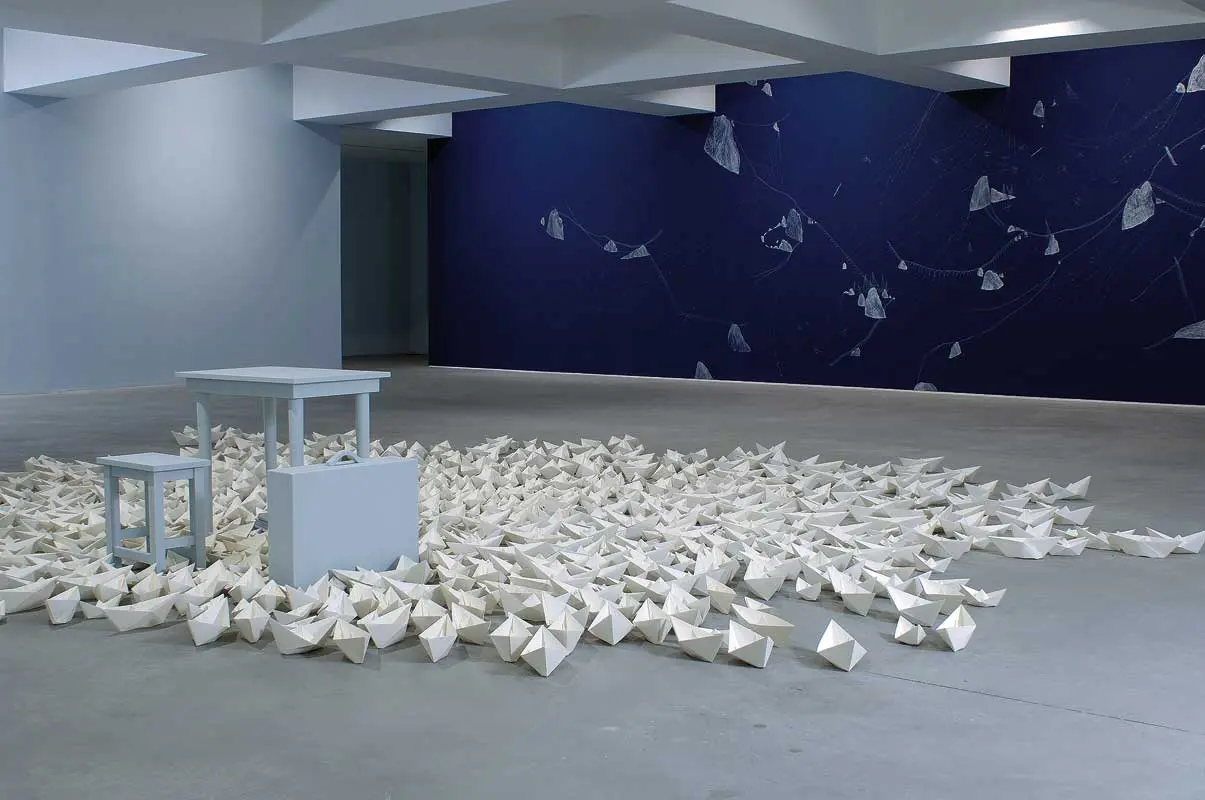
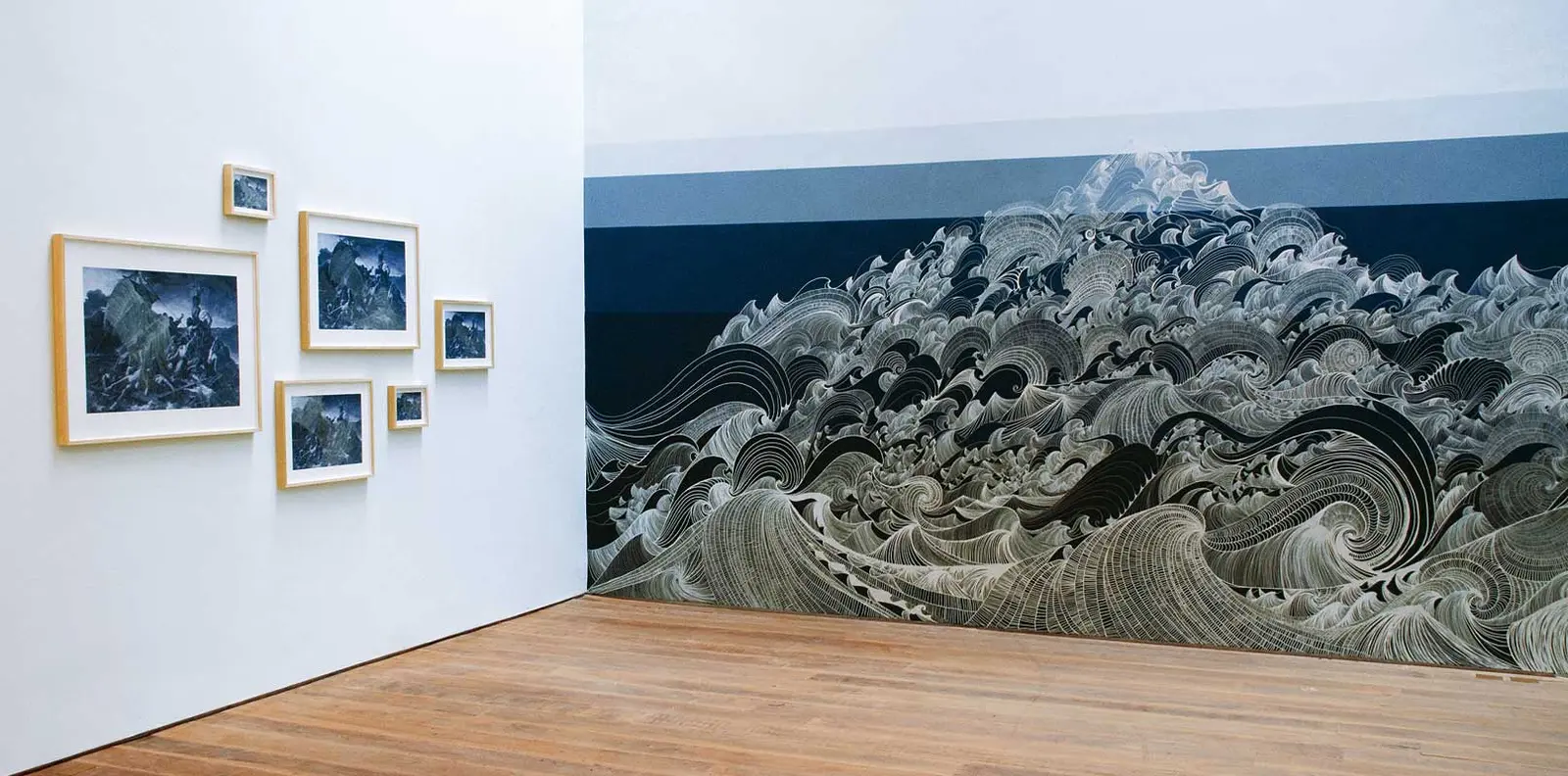
In the series The Difficult Journey (After Géricault) (2008), presented at Tanya Bonakdar in New York, and at the MACUF Museum in La Coruña, Spain (2007), the artist takes Géricault’s romantic icon and lovingly deconstructs it. Appropriating the sinuous lines of the bodies in motion created by the painter, Cinto produces a space that evokes the effectiveness of sinuosity in that painting. Sandra Cinto’s difficult pathway is built with the fervor of observing the sinuosity of the bodies and the raft, which originated in the motion of maritime space. Previously, at the Carlos Carvalho Gallery, in Lisbon, the artist had presented her installation The Difficult Journey (2006), where she drew a thick sea on the walls and placed at the center of the gallery a table, a valise, and thousands of paper boats, in remembrance of the thousands of souls lost at sea, and also her own Italian ancestors who migrated across the globe carrying with them just a few personal belongings.
It is always a difficult journey, but the journey is also knowledge, a leaving behind of oneself, of one’s values, of people and places. Thus, the installation Seven Seas, presented at Progetti Gallery in Rio de Janeiro, belongs to the series of difficult journeys. In this work, Cinto takes over space’s large wall as a sea in motion, perhaps in order to remind us that the terrain, here the gallery stand, was also a sea. This space is now a “raft” holding sacred art. It is never otiose to remember the connection between Brazilian art and the French Academy, when, in the Nineteenth Century, the Academy’s teachings and the thinking that motivated Géricault and other French Romantics were brought to Rio de Janeiro —we would have to explore here the domain of Jungian synchrony, but that is beyond the purview of this article.
Sandra Cinto’s visual glossary works as a communicating thread that reveals what happens in her creative genesis, by mixing her travels in the history of art with personal journeys, storied that end up being collective. In her installations, the idea of the journey is always intertwined in the space of representation as well as the theme, as we are submerged in the immensity of the heavens and the sea, of ships and of personal travel items—valises, bag holders, tables, beds, portraits, notebooks, sheets of paper, pencil—the solitary memorabilia of Man-the-artist who travels around the vast world.
Cinto’s drawings stand out especially for occupying supports that are combined in unpredictable ways, sometimes associated with photographs, pictures of her childhood or of her present, in turn, connected with other objects such as wooden sculptures simulating books, tables, armoires, and beds. We understand that all these supports, or elements, are a point for the encounter and diffusion of an infinitude of narratives, narratives that are never closed, and they are generally configured as solutions for specific spaces. In the early days, Cinto’s work seemed to claim a stake for a complacent painting of the world. But the painting’s great tameness, paradoxically their humility, imposed itself with inescapable force. Little by little, the tone shifted from blues and grays, and the impromptu redness of the clouds could very well allude to the waves of a turbulent sea, a sign of our fear of the incommensurable in nature.
Sandra Cinto’s generous gaze guides our own eyes towards an intense sky as a metaphor for human achievement, showing us a future. The artist’s skies, which before would fit in boxes, coffers, armoires, are now enlarged on gallery and museum walls, warehouses, castles, occupying architectural space in an attempt to return the painting to its origins: the sublime condition of light and color. This coherent vocabulary of the sublime is populated by filigrees, dream-like, ethereal shapes evoked through the painstaking and patient effort of taking over space on the basis of the artist’s stoic process, day after day of covering the skin of space.
For Cinto, the work of art emerges from an existential necessity, and it is a spiritual necessity. This is why the gallery’s or museum’s (sacred) space is her favored site. Sandra Cinto is the kind of artist whose governing premise is the promotion of space, be it intimate or universal, as the site for the expression of her aesthetic and humanistic yearnings, whose greatest desire is to turn art into a place for aesthetic and psychological experiences, evoking everything from childhood memories to mature life. Art, as she understands it, is the place of wisdom, of education, of gentleness, of sharing: these are art’s ontological features.2 Parodying Gagarin’s observation, we could say that “the Earth is blue like the work of Giotto, Klein, and Cinto,” and that “we were in the heavens, and we didn’t see God there,” but we can find Him in supreme art, because art is the communion of science and magic, in the words of Gaston Bachelard.
NOTES
1. Artist’s statement.
2. Reis, Paulo. “Construcción contra la disipación del mundo o la epifanía en la obra de Sandra Cinto.” In Sandra Cinto: Construcción. Santiago de Compostela: Dardo Ds, 2006.
PAULO REIS
Curator and Professor of Aesthetics and Contemporary Art History. He currently directs Carpe Diem — Arte e Pesquisa, a space for artistic interventions in Lisbon, and is co-director and Editor of Dardo magazine.