
The exhibition Virus includes a group of recent works by Tomás Ochoa that are the result of his lasting interest in the representation of collective matters. Sad Co-The Blind Castle, the ambitious video installation he presented at the 2003 Venice Biennale, became the first of his works to point in this direction. It consisted of a very sophisticated set of video projections, photographs, and period documents that attempted to recuperate and restitute to their rightful place the memories of miners who had survived the harsh experience of working inside a U.S.-owned gold mine whose name – Sad Co. – is part of the title of the exhibition in question.
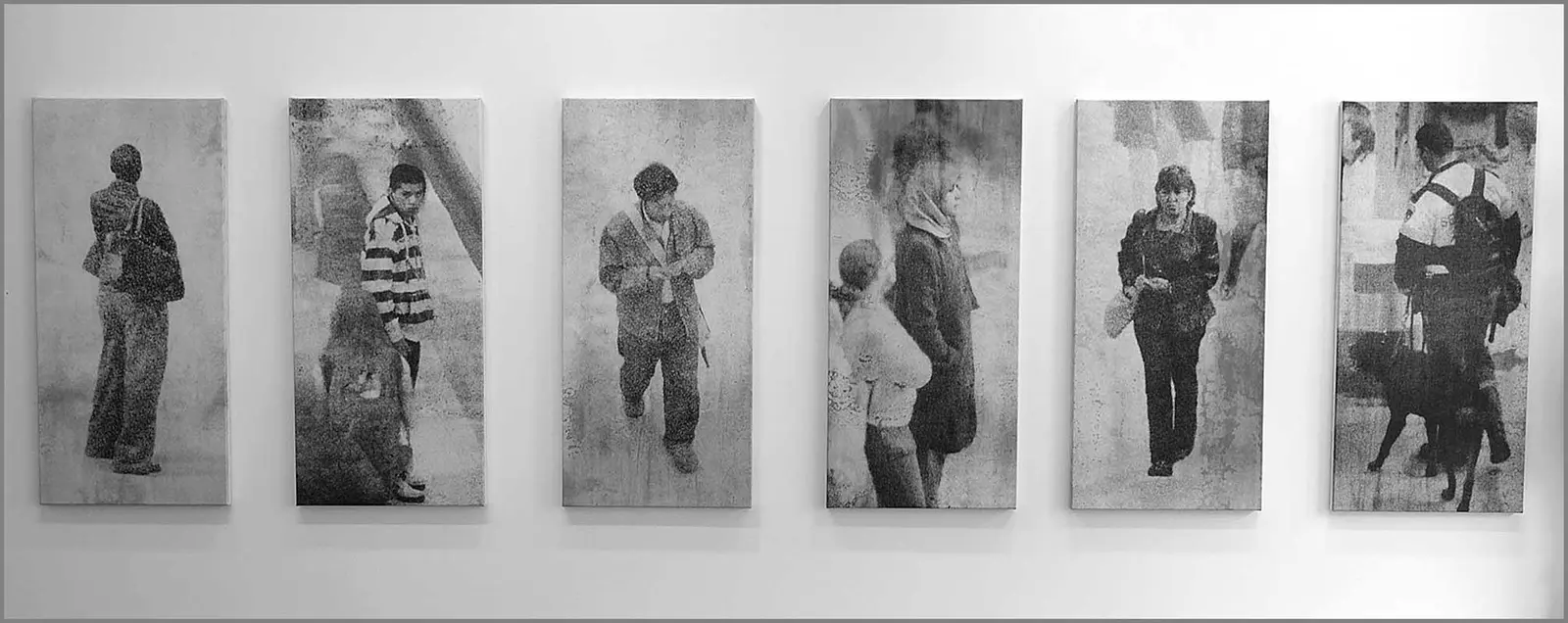
Subsequently, the interest of this Ecuadorian artist moved from company workers to the representation of the multitudes that at present flow in the most varied environment around the world. I purposely refer to “multitudes,” and not “masses,” of people because Tomás Ochoa has subscribed to the re-evaluation of the “multitude” concept developed by Italian political philosophers Toni Negri and Paolo Virno, to whom the term – formerly applied in a pejorative manner – designates a form of sociability that is now a characteristic of modern society, in which individuals are not merged or sublimated as they would be within the masses of the Fordist society. Their concept anticipates a turbulent form of political sovereignty destined to replace the traditional popular sovereignty that, according to these philosophers, has become completely obsolete. Tomás Ochoa’s gaze has discovered these multitudes in environments as dissimilar as the Atocha Railroad Station in Madrid and the Art Basel Fair in Basel, Switzerland. He has transposed these visions into images created from photographs he took in situ that always maintain gray metallic tones, similar to unpolished matte steel. The juxtaposition of sceneries and figures in the canvases, their collage structure, is unfailingly neutralized by that omnipresent waxed grey that absorbs and subsumes everything and renders a flat space with no discontinuities or fissures.
In the paintings forming part of the Virus series, the theme of the multitudes reappears, along with the waxed gray and the flat space. This time, however, they are also subjected to two contortions. The first is of a formal nature, as the works are pointillist and each point contains a minuscule photograph that disappears as we move away to observe, instead, the image covering the entire frame. The second is conceptual: Ochoa converts multitudes into viral multitudes, as the conduct of their members is equivalent to the behavior of viruses, and because their forms – mimicking those that exist in virus colonies – can be best represented by fractals.
CARLOS JIMÉNEZ