
This is Tonel’s first solo exhibition in Miami and he chose to present a group of pieces that combines a few of the themes he has been working on for the past few years. The title of the exhibition plays with this connective idea: from the lack of gravity in the cosmos to the pressing ‘gravity’ on earth and its problems; how the state of affairs on earth has turned our concentration from the cosmic program, which at some point captured world attention. Today the financial crisis, the ecological problems, and many other social situations have definitely taken over. Walking on the moon or placing a satellite in orbit is no longer news; however, the financial crisis makes every morning’s first edition. Tonel is subtly pointing out the need for ‘putting order in our own house’ before getting into other places, a process that is hopefully taking place by itself.
The exhibition could be divided into three parts: cosmos, earth, and personal. Tonel moves from one to another, from a universal perspective to a private. In a sense, we can perceive this connective action as his way to analyze the external elements that conditioned, directly or indirectly, his personal situation.
Faithful to his previous work, he continues inciting double meanings with provocative and ironic remarks. Tonel brings to his oeuvre the longstanding humoristic tradition in Cuba, resulting in a witty, but at the same time, cerebral type of work. If we compare these latest pieces with his mature ones from the eighties we can clearly see the shift towards more universal concerns, leaving aside the intricacy of Cuban politics, social life, and also his early interest in erotica.
Formally the works keep in sync with the preceding, taking elements from American cartoons. This was for him a logical development since he made cartoons in the early eighties. He also continues keeping the scale of the works relatively smaller; avoiding the temptation of magnifying the image as other artists do who also base their works on comics, such as Lichtenstein. However, when it comes to objects he abandons the concern for the scale and makes bigger pieces. A good example of it is the only assemblage on exhibition: Footnote, which is of the larger size. The piece consists of a giant foot that has inserted at the bottom a small figure resembling the artist. This assemblage is related to other tridimensional works by him, especially to his iconic El Bloqueo, made of construction bricks.
Taking advantage of his background as a historian he searched for supporting documentation. That’s how he ended up using iconic images such as the extinct lunakhod to illustrate the past glorious momentum that all outer space matters had a couple of years ago. These mechanical devices marked the highest point of competition between the two major players back them: the Soviet Union and the United States. This cosmic dominance was the expression of the global order in those days. Today the hegemonic place of the Russian power seems to have diminished considerably, giving passage to a new world order reflected in people’s interests: golf has taken over the cosmos.
Baltic Dry Index is one of the pieces where the artist makes sarcastic observations about the current state of affairs in the financial sector. This is a guide that dictates the cost of moving the most important raw materials by sea. It fluctuates daily and it is calculated by the London Baltic Exchange. Tonel represents it as a ship on a dry lake.
Another piece that reflects his political view in a satirical way is History (always wraps itself in red fabric). The three characters in the image are Little Red Riding Hood, Stalin, and Superman. He is placing in the same context three levels of ideals: the childhood, the teen, and the adult. Tonel is making a parallel between the fairytales that support the two imaginary characters and the one behind the real-life, as utopist and unreal as the others.
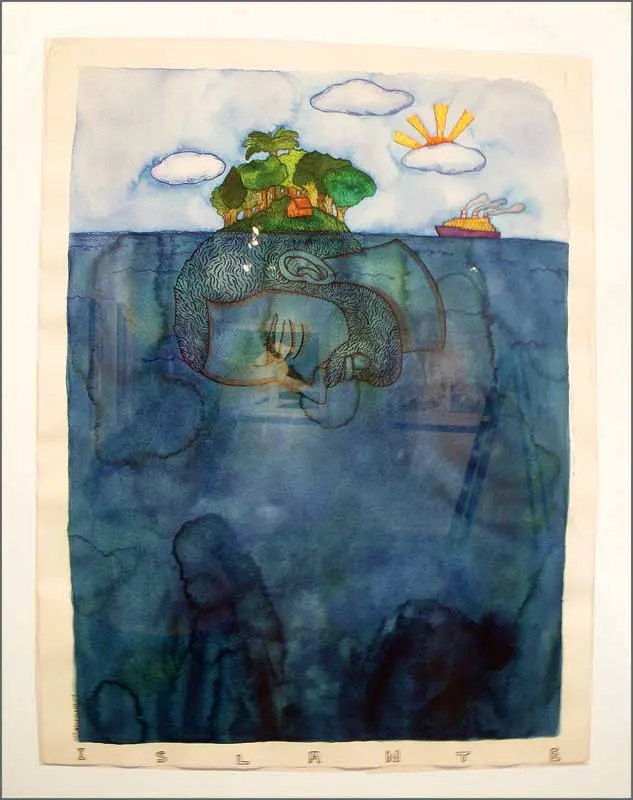
The more intimate aspects of the exhibition revolve around his personal anxieties, clearly visible in two pieces: Tonel as a bridge and Islante No.2. In the first one, he is a bridge between two lands; in the second an island is growing on top of his head. This is perhaps a reflection of his current state of mind, after living most of the time outside Cuba.
Tonel goes from reflecting a global perspective to his most private anguishes. In a sense this is like the cosmos and earth simile, he is bringing into the same room the lunakhod, the Baltic index, the interest in golf, and his seemingly displaced view of himself. This exhibition can be considered as a closing chapter for Tonel, or the beginning of a new one in his oeuvre. It seems to be in a transition from the work that he is known for. Still within his style and very personal imprint we can see how he is leaving the enclosed Cuban social atmosphere to move towards a broader and more universal thematic. Although it might seem as if there were many themes going on there is a connective thread that unifies them all. Tonel is showing that sometimes things and events that look totally unrelated can open a Pandora box and initiate a chain reaction; in this case, he is showing us the thread between the cosmos and his own gravity, firmly anchored to the earth.
IRINA LEYVA