
From October 28, 2009 through January 31, 2010, the Corp Banca Cultural Center in Caracas presented La Noche, an exhibition of works by Palma de Mallorca-born Venezuelan artist Adrián Pujol (1948). The show, curated by Lorena González, comprises 16 graphic works and 35 paintings produced between 1987 and 2009; in that sense, it functions as a kind of two-decade-plus anthology for a painter who, throughout a celebrated career creating tropical, luminous nature landscapes, has also engaged what he himself calls “the other side of the day,” which is also the other side of the painting, full of new nuances and revelations.
The landscape has undoubtedly been a privileged genre in Venezuelan painting; it was through landscapes that Venezuelan painting asserted its earliest entry into modernity in the early Twentieth Century, and revealed the genius of Armando Reverón (who, by the way, was the author of the first night painting in the history of the nation’s art: Procesión de la Virgen en El Valle, 1920.) These days, landscape art tends to be understood as a stronghold of tradition, and perhaps the meaning of a body of work such as Pujol’s and the singular and prominent place it occupies in today’s Venezuelan art is indeed connected to its capacity to help that tradition endure while making it contemporary.
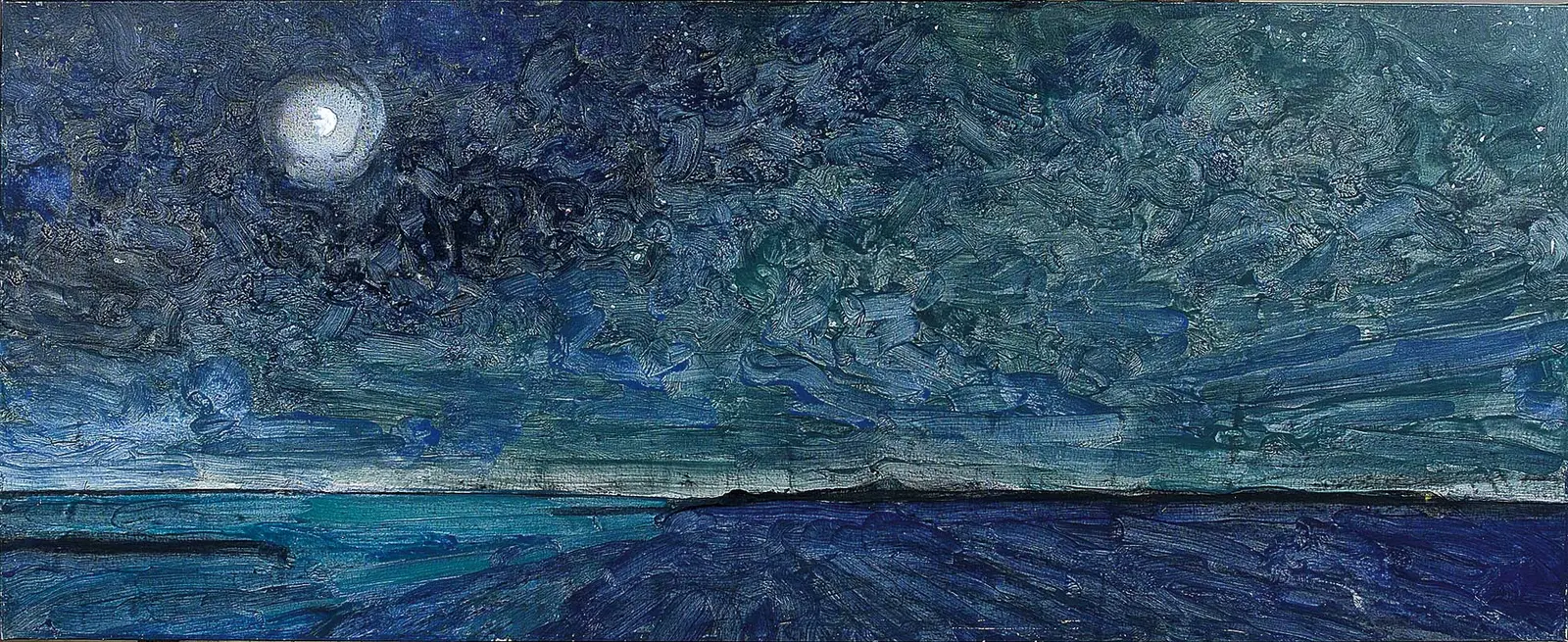
Tradition (not only in Venezuelan art, but within the history of Western art as a whole) is reasserted by Pujol through his assumption of the landscape as a selected section of nature and, from there, of the genre’s conventions—frame, horizon, plane sequence—as well as his expression of an appropriation of place, an intimate relationship with the theme, that which Lorena González describes as “the compression of painting from the standpoint of a dialoguing gesture, as a series of exchanges with the other rather than a linear representation of what lies outside.” And the genuine contemporariness of his proposal is revealed (besides his lack of concern about appearing, to the dogma-colored eyes of some, as “traditional”) by his abandonment of any avant-garde presumption in order to accumulate, in an eclectic fashion, romantic echoes (a certain exaltation and feverishness when confronted with natural grandeur and the Kantian terribilità of the nightscape), a sensibility that touches on impressionism’s as it captures the shifting, unstable and subjective character of his motifs, and the recycling of abstract-expressionist pictorial techniques with their emphasis on gesture, dripping, and materiality. To this we can add a performance-art attitude in his painting, based on his working blindly in the dark, and even a wink to Surrealism in the portions left to chance that such an intuitive method implies. These premises can be summarized as the instrumental use and adaptation of the opportunities made available to the artist by the history of past and present art, beyond any quest for “originality.” But it is also possible that the contemporariness of Pujol’s painting is transmitted by his complete acceptance not only of a sentimental expressiveness but also of a narrative load of suggestive atmospheres that transforms the landscape into the stage for experiences and passions of his own or offered to the imagination and the universe of references (even literary ones) of their viewers. In that sense, Pujol’s sensitive and sensual painting is also a “high-culture” one.
For Pujol, the nightscape includes dawn and dusk, and this is why his palette also encompasses white, gray, and greenish hues, and becomes diffused as it deconstructs solid elements to the limits of their recognizability, capturing a flash of light or transparency appearing in the opacity of his shadows. In his urban vistas (Caracas, Venice, Istanbul), the chromatic struggle between natural darkness and artificial light provokes phantasmagoric effects.
All the variations produced by the artist’s unique approach to the “dark clarity” of the nightscape are dramatized by the attention he pays to weather incidences on the landscape, captured and even experienced, as in Cape Cod Light, Boston, a work that has suffered the battering of storms.
While allowing us to discover a different facet of Adrián Pujol’s work, this show also confirms that his place is among the masters of today’s Venezuelan art, as the selection on exhibit reveals a mastery of technical means is surpassed only by his ability to swathe us in his atmospheres, to make us participants in his world, and to time and again move us with nature’s beauty of and art’s power of metamorphosis.
FEDERICA PALOMERO