
The revelatory space between the perfect and the ideal — that’s the transfigurative turf that Alejandro Corujeira claims in his abstract, pseudo-minimalist paintings. Expansive and rippling lines play across a backdrop of tentative forms. Meditative in nature, the compositions riff on botanic impressions and geometric matrices to become animated portals inviting us in.
Corujeira creates a handsome signature look throughout the show while referencing late DeKooning, Agnes Martin, and Brice Marden. Marden’s famous homage to the Chinese poet Han Shan’s Cold Mountain poems resonates in the calligraphic dance of Corujeira’s Aire de oriente.
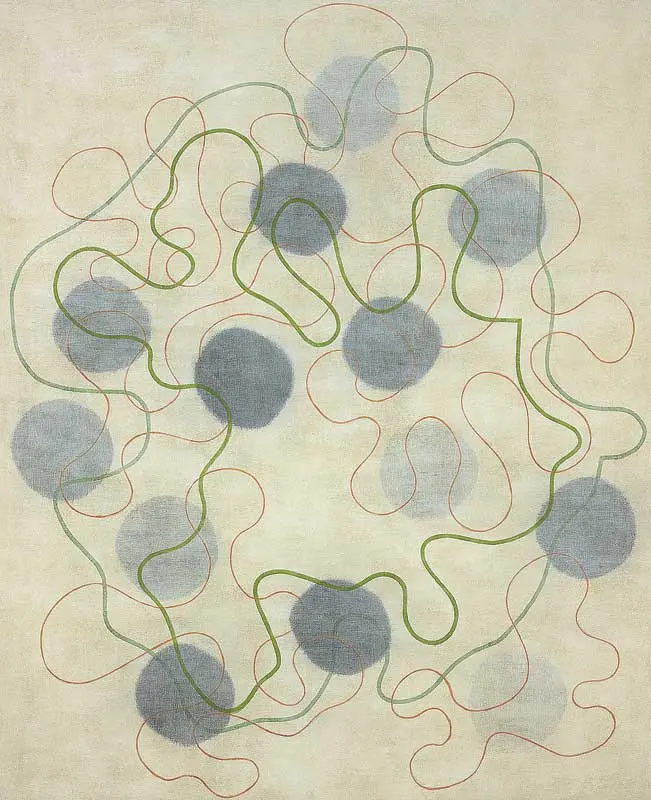
On an opal gray, amorphous background, ribbons of color navigate, becoming paths and demarcating zones or passages. Running beneath the entire composition like stones submerged in a stream or footprints in the snow, oblong shapes appear fixed within a framework of flux.
The two tiers work independently of each other, heightening the illusory tension. Associations abound. Topographical, biological, oneiric — the marks could read as contour maps, seeds, or throbbing puzzles. Corujeira’s strategy proposes a deliberate conundrum — a contemplative space where there is no resting place for the eye.
For example, the looping green line appears to lie on the surface while the others are recessed to varying degrees. The simultaneous interpolation of shapes and weights, of positive and negative space, causes the overall image to flicker slightly as the foreground and background continuously negotiate.
There is a delayed and muffled vibrato effect as the incisive lines contrast with the field of dark, pellucid shapes half-emerged in deep space. The subsequent dialog that arises from this binary code deposits self-referencing marks while integrating erasures.
The passage of time is evoked by the washy, foundational tint of each painting. This light staining mimics the natural buildup of particles we might find on an aging canvas or a dirty window. Complementing the compressed sense of elapsed time, the subjects remain suspended in a spatial medium, yet potentially fluid and capable of transport.
In Melodias inventadas suffused, shadowy blobs float in a substratum. Different registers of gray push them back or pull them forward. Anchorless, the simple circles intimate kinetic mutability. Bisecting these forms, sinuous interlocking lines connect the dots, so to speak. The lines resemble animated amoebas or wavering haloes, eventually drawing our gaze to avoid at the center of the canvas.
Argentinean-born, the artist now resides in Madrid and he shares an affinity with the Spanish painter Luis Gordillo. Gordillo (who also shows at Marlborough) is known for his bifurcated, cellular, and ropey compositions. Additionally, Corujeira’s study of plant illustrations are key in the development of his resolute, yet transitional lines and the underlying forms that create his own unique lexicon.
The title of the show (which includes 20 paintings and nine drawings) The Accessible, Dressed in Salts connotes a marine subtext. In this world of supple, winding lines and tentative, translucent objects, the artist has recreated his own inspiration in images that appear like respiration. They seem to rise and fall, to expand and contract — in other words, to breathe.
Margarita is a lively, celebratory image. Restless and robust, the six lines do indeed flutter with life. The intimate motion and seem to balloon and deflate like leisurely jellyfish working their way toward an indeterminate surface above.
An array of leaf shapes and random rows of circles bob and sway behind. Several hollow ovals counter the solid leaves and fronds while mirroring the skeined lines’ squiggles. They also suggest human heads, adding ghostly humor and lightness to the equation.
The drawings are more direct. Collectively called Suite, un jardín para Agnes, they lack the lush ambiance of the canvases, making the shapes more definitive. Stripped down, at times they resemble fossilized flora deposits.
In an insightful and fascinating interview with Kevin Power in the exhibition catalog, Corujeira actually refers to his images as deposits originating in the external world (rather than the internal). He is interested in finding sleeping forms and seeing how they manifest when they awaken. Everything that “delights me or upsets me, seems to store itself deep in the back of my eyes from where, at some later time, images are driven forth.”
The philosopher Martha Nussbaum has written about “rationality whose nature it is not to attempt to seize, hold, trap, and control, in whose values openness, receptivity, and wonder play an important part.” Corujeira’s paintings successfully embody this vantage.
Determined and receptive, he’s fashioning abstract paintings that remain vital. Paintings in which information is uncertain…borders elusive. Where impulse is bound to gesture in rigorous compaction.
At first blush, Corujeira’s works may seem lulling — inviting you to an anticipated repose in their apparently passive attractiveness. But there is no lull in the activity-packed into each piece. The dynamic artworks are like never-ending perpetual motion machines. Be advised: Alchemy at work.
JEFFREY CYPHERS WRIGHT