
During the end of the 1990s and while working on her essay titled En el Sexto Día (On the Sixth Day) – in the countryside of Buenos Aires province – photographer Alessandra Sanguinetti met Guillermina and Belinda, two nine-year-old cousins who would become the protagonists in one of the most famous artistic sagas in the entire history of Argentine photography. Decisively photogenic, the girls accepted the game Alessandra proposed and participated in a series of sessions in which the photographer was able to capture them with the level of proximity and depth that only great artists can achieve. Exhibited and published in diverse contexts, this edition, which records their passage from childhood to adolescence, was titled Las Aventuras de Guille y Belinda y el Enigmático Significado de sus Sueños (The Adventures of Guille and Belinda and the Enigmatic Meaning of their Dreams). Today, ten years after the beginning of these adventures, Sanguinetti adds to the original title the coda, Y el Devenir de sus Días (And the Coming About of Their Days), refocuses on the girls and transforms them into women. The result is remarkable.
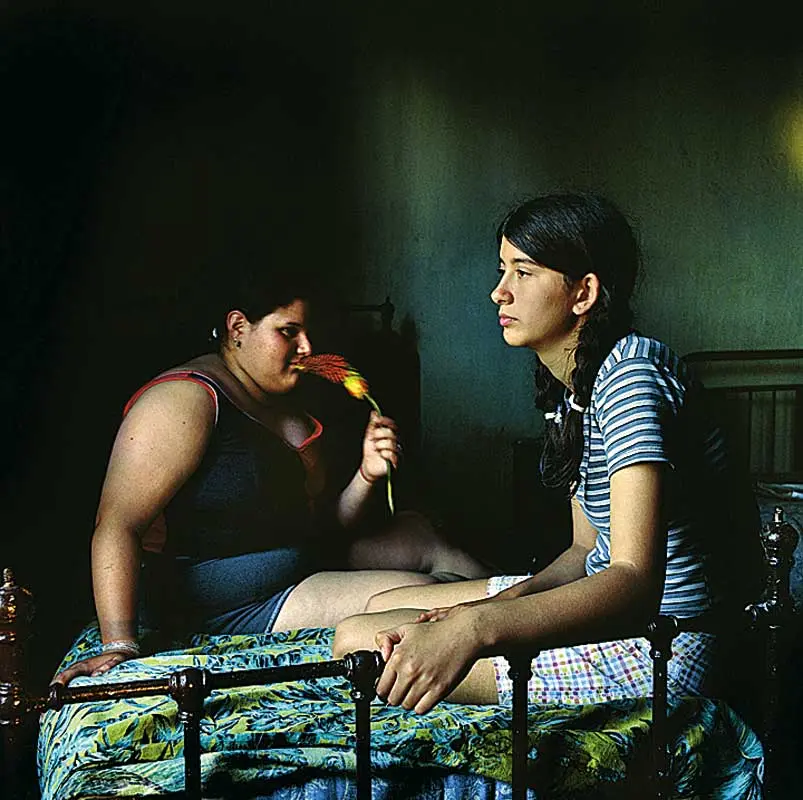
Nothing and yet everything changed in the provincial lives of Guille and Belinda. Their bodies grew, and one of them is even a young mother now: her body thickened as a result of the pregnancy, and this diminishing is the notable contrast that formerly existed between the two cousins. Childhood fantasies appear to have given way to resignation, to the acceptance of an everyday life that is far from the dreams they would narrate in the past by dressing up and role-playing before the photographic camera. There are no costumes anymore, only their still, child-like faces remain, and a slightly listless or monotonous timbre that appears to cloud over their future days.
One of the essential inclusions by Sanguinetti in this new presentation is the use of video, a good medium to continue recording an eminently narrative saga. The video consists of brief fragments recorded during these last ten years that appear to be separated by sober titles that successfully introduce the theme, and that are similar in this aspect to the names in the pictures, simple, yet accurate. The recordings do not hide their homemade nature, and by means of their freshness and spontaneity, succeed in weaving together the years that have passed, from the first images and up to the last. The video constitutes a framework for the photos, making some details more explicit and disregarding others that only the photographic image can capture. A complement to the photographic proposal, it offers short interviews in which – and these are just two moments among many – the girls narrate, without great enthusiasm, what a regular day is for them, or where they like to go dancing to try to catch some contagious rhythm from someplace.
From a technical standpoint, this essay takes advantage of the attributes of inkjet printing, which confers upon the images of their refined qualities. Their shared 60 by 60 format – which unifies the series and accentuates the project’s homogeneity beyond its logical time leaps – is ideal for observing an image that does away with any formal stridency in order to fulfill its purpose; Sanguinetti's emphasis, despite what a biased reading could detect, is not on pamphleteering. The humble, rural conditions that the girls live in, the fact that they are women, and the generational question are barely background music for the actual world they live in and do not theme to analyze. Such an approach removes Sanguinetti from the common places visited in dispute-ridden or conceptual photography. Born in 1968, Sanguinetti studied at the International Center of Photography in New York and now works for the prestigious Magnum agency. She has a distinctive personal style that confirms her, once again, by her portrayal of the passage of time with exquisite delicacy. Her photographs convey painful, disturbing, and uncomfortable themes that are, nevertheless, presented with sweet straightforwardness.
EVA GRINSTEIN