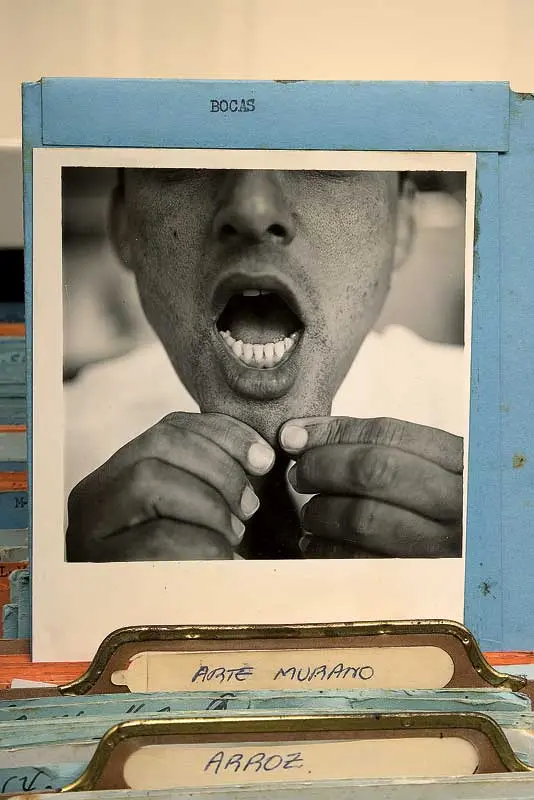
Hannah Arendt said, speaking of Walter Benjamin, that as a collector he salvaged the objects of everyday life. In his personal archive, objects (or things) previously defined by their utility were transfigured, their function, and existence acquiring a different kind of value. Something similar happened in Las personas y las cosas, an exhibition of works by Ángela Bonadies (Caracas, 1970) at Periférico Caracas / Arte Contemporáneo’s gallery 1. The show’s main topic was the archive, its employees, its content, and the warehousing mechanisms that organize the legacy in order to shape memory and write history. The show included more than 80 photographs of a variety of archives and public and private collections such as the Colección Mercantil, the Museo de Ciencias, the Archivo Fílmico, and the Banco Municipal de Sangre de Caracas. The photographs—on film, printed in various sizes—were grouped and exhibited according to sub-themes established by the artist, such as Things seen and heard; Things that grow; Things on stage, Leaning things; Exterior vistas, and Framed landscapes. Among the images were portraits of the employees or collectors in the archive’s habitat, shelves, lockers, and other pieces of furniture found backstage from the exhibition space. Instead of displaying the space’s architecture, the photographs alluded to the way the artist was able to browse archives and record how archive workers “tamed” their environment.
The artist confesses her show and the categorization of her images to be motivated by a personal interest that she herself defines as a whim. Given that one could understand whims as a territory of comfort, non-commitment, and a denial of criticism, the viewer is left to wonder whether those seemingly inconsequential themes like Things on stage or Leaning things will be capable of organizing a critical edge to the show, in turn, able to say more about the archive as part of an architecture of local knowledge and to connect it in significant ways to contemporary concerns in the cultural field. Moreover, the international and local critical landscape do invite critical reflection, and at times a contestation, of the way the archive is handled, its ideological use, and its impervious architecture of authority. There are cases in Venezuela where “things” are useful —and they are seen, exhibited, acquired, or protected by institutions— when they serve an ideological purpose, and today many archives, museums, and collections ran by the Venezuelan state suffer under policies of non-acquisition of new content and a dearth of available funds. Thus, it is rather jarring to encounter an art show dealing with such a political and politicized topic, such as the archive, from a self-declared “whimsical” standpoint.
Bonadies’ reference to Michel Foucault in the title of her show seems nothing more than a wink of knowingness. In fact, the repetition of the word “thing” (a generalization of the first order) in her tale of the archives she visited seems to indicate a denial of specific narratives to approach a documentary record of the everyday life of the archival legacy. Bonadies doesn’t record scandals, doesn’t cite the political biases that are the usual references of local critics, but seeks the most general title for a register that doesn’t argue or contest. In the documentary domain, photography here works as a traditional souvenir recording a valid curiosity, showing how an archive actually is. Yet, in its re-organization and categorization (techniques that are, in fact, characteristic of the archive), Bonadies’ document touches on the conceptual as it interweaves a narrative that emphasizes the humanization of the archive space and its “domestication.” Moreover, the way the show is arranged (more than a passing reference to the typical visual organization of the cabinets of curiosities belonging to rich owners of private museums) has echoes of the typical décor of so many Venezuelan households with “personal collections” of paintings, photographs, and ornaments assembled in groups that respond to categories that are indeed whimsical but not unable to tell a story, usually the story of one family. In this way, and occupying a space in between the documentary and the conceptual, in Las personas y las cosas Bonadies reconstructs the space of the archive not as an ideological apparatus but from an inquiry more closely aligned with her own anthropological interests. In that sense, leaving behind the more macro scale of national politics and its heroic narratives allows her to approach the archive as a space inhabited by the simple individuals identified in the show’s portraits.
LISA BLACKMORE