
This past October and November, Galería El Museo presented two exhibitions of the highest quality: Condenados, by Spanish artist Germán Gómez, and Abecedario emocional, by Catalina Ortiz, from Colombia. The former, winner of the Revelación award at FotoEspaña 2008, uses color photography as his support, but breaks—and we must assume this word literally—with “the promise of the frame,” to use a beautiful expression coined by my colleague Pablo Acosta. We often encounter photographs that circumscribe themselves to the boundaries of the frame; it is so obvious, we don’t even notice. However, whenever photography breaks through those boundaries, when it crosses them, it acquires different materiality, one I have called photogenesis. Photogenia turns the photograph’s subject and objects into a specular space where reflections generate new places, new forms, new identities.
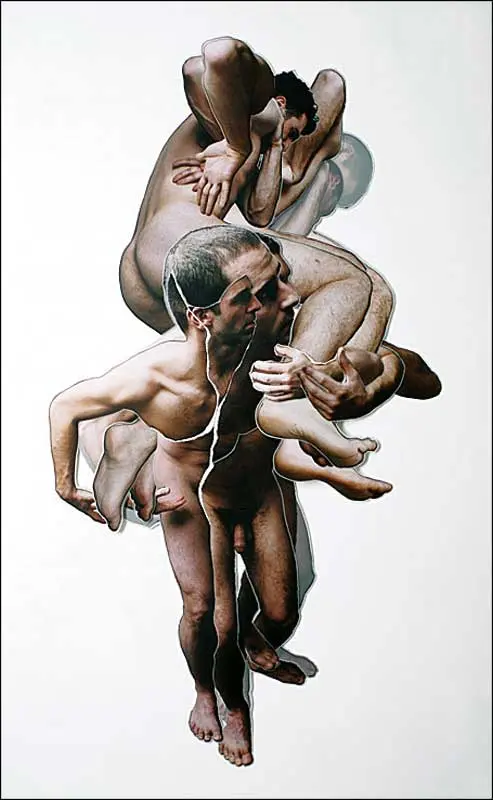
In Gómez’s work, we see how the form is disarticulated, broken, fragmented, only to be reconstituted and reshaped. His condenados are an exploration of the nude body, of his own body at times mixing promiscuously with others, as if attempting to form a different identity. These portraits present us with a different way to approach the issue of identity. In psychoanalysis, identity is formed through the mirror stage. In this case, the mirror has shattered to pieces. The artist must recompose the image, joining the fragments like pieces of a puzzle. The result is an image where seams, tears, rips are on display, like carefully sewn wounds.
The nude body appears to float in a deep emptiness as if that were the only possible place for the condemned after Judgment Day. There emerges here an important reference in the history of art: Michelangelo and his marble “slaves” for Jules II’s funerary monument and the fragment of the Judgment at the Sistine Chapel, which undoubtedly inspired Gómez during his time at the Spanish Academy in Rome. Michelangelo’s bodies are always contorted, perennially suffering as a result of the struggle between the fleeting flesh and the immortal soul. Germán Gómez’s photogenic bodies, as in Condenado II, are certainly connected to Michelangelo’s condemned ones, still, muscular bodies clawed at by demons and taken to the underworld. Gómez insists, masterfully, on the fact that the condemned are all of us mortals, who remain, in essence, flesh.
This reference is reinforced at the formal level: those of us who know firsthand Michelangelo’s fresco can corroborate that the figure’s outlines come together gradually, allowing us to discern the boundaries. Gómez’s goes further, making these boundaries—these tears in the photographic paper—obvious and conjoining them with the form, creating a surface where the thread and cuts produce a new image.
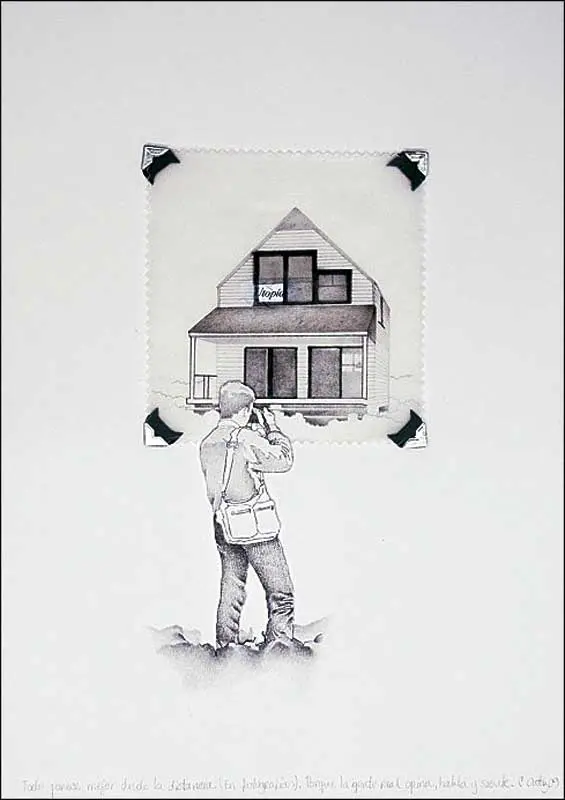
The work of Catalina Ortiz tends to exalt drawing and collage within a conceptual framework. It is truly comforting to encounter works of this kind, impeccably realized with outstanding technique and complex conceptual content that turns each one of them into a complex visual space: for instance, Utopía, where we see a character turning away from the lens, photographing, in turn, a photographic image that opens in front of him as if it were a painting. The photographic image in question reveals a wooden, two-story house; in one of the second-story windows, there is a sign of the kind used to advertise a building’s sale, reading Utopía.
This enigmatic image surely generates in the viewer questions that, far from being immediately answerable, open up avenues for reflection. This reflection, of course, takes place away from our understanding. The meaning of the work seems to be anchored on its lower section, where we read the following hand-written sentence: “Everything looks better from a distance. Because real people speak, have opinions, feel.” Indeed, Ortiz’s works insist on reality and on what is built on it by images and words.
In these small-format works, images, words, and objects such as threads create a hyper-real atmosphere that interrogates reality. In Aferrado/Aterrado we find a character who, sitting at the edge of a precipice, looks down with a certain apprehension; once again in the lower section Ortiz writes: “Fear is a habit and it is not only learned (it is also taught).” Speaking about her method, the artist says: “Initially I collect images from magazines, advertisements, scientific articles, online encyclopedias, and photography books. Then I allow a new image to emerge on the basis of the interaction between those other ones, and finally, the process ends with the renaming of the new image based on an emotional concept (‘I,’ ‘Transition,’ ‘Domination,’ ‘Terrified’…) that is complemented with a sentence that questions its conventional meaning. In this way, I try to relativize the viewer’s canons so as to have them open up their senses and reformulate the way in which they relate to what’s around them.”
In this renaming of the image with different words, the artist insists on what we are seeing, unafraid of non-evidence and not attempting to dilute the relationship between words and images, as ancient as Horace’s famous dictum Ut pictura poiesis: as is painting, so is poetry; as is poetry, so is painting.
In sum, these two exhibitions offered two contemporary perspectives and reminded us that contemporariness is not determined by a given technique, but by an attitude towards time and the world around us.
RICARDO ARCOS-PALMA