
The Eduardo Costa (1940) Retrospective at Ideobox Art Space in Miami revisits the artistic trajectory of this Argentine creator who entered into the vanguard of conceptualism in New York during the latter half of the 1960s, in the midst of an atmosphere of "dematerialization of art" that was concomitant with the vision of a global village. This was a vision that three decades later led to a revolution that, to a certain extent, ended as the opposite of the original idea. Costa was the first artist to endow painting with a volumetric matter capable of transferring the representation of the world to its pictorial duplication: a parallel world made of paint.
The long title of the exhibit, Eduardo Costa. Mid Career Survey Fashion Fictions, Names of Friends, & the Painting/Object, responds to the vast spectrum of inquiries by this artist, who was capable of swaying in the extremes from his Talking Paintings, with loudspeakers that narrated on these, to the film A Poem for the Dead-Mute, in which the mouth pronounces the inaudible names of friends and obtains the most improbable fusions.
In his creation of fictitious events such as the inexistent Happening for a Deceased Boar – jointly created with Roberto Jacoby and Raúl Escari, which he inserted in reality through the media, or other works able to merge the most sophisticated fashion with criticism of its system, and the intense materiality of his volumetric paintings – whether these are nearly hyperrealist or geometrical abstractions, there is not only a continuous reflection on the limits of representation but also on about the fragile consistency of its reality as well.
The retrospective includes a reproduction of the iconic page in Vogue, published in 1968, with a profile on Marisa Berenson with the gold ear "designed" by Costa as an extension of the body that duplicated that of Berenson granddaughter of Elsa Schiaparelli and great-granddaughter of art expert Bernard Berenson. If the ear was a critical artifact that had originated from reflections by Barthes on the structural analysis of fashion, it is also true that Costa’s aesthetic pleasure rendered in this Fashion Fiction I – capable of connecting the funeral rituals by the pharaohs with the pulp cult to the ephemeral – remains intact. This false piece of jewelry (welcomed by the world of high fashion) was, as he has affirmed, "a prop, a generative object."
The covering of the body with a material such as gold – later, he also created on gold hair and fingers – presupposed "a zero degree of design" and the notion that "the duplication of the form was a beauty." In 1994, the accident of acrylic that formed a cylinder after being removed from a jar pointed Costa in the direction of his first volumetric paintings. He saw in this duplication the fulfillment of "the renaissance utopia." It was no longer about imitating the three-dimensionality of the world, but the possibility of remaking the object, in layer upon layer of paint, in such a way that it would be impossible to see it from multiple sides. Reduplication also entailed an essentially honest gesture: to build the object from the invisible, from within, so that there would be a yolk inside the egg – that in the performance where he breaks the eggshell, the yolk falls like fresh paint – and inside the watermelon, the red meat, and the seeds. Whoever observes the heavy fruit in the exhibition "knows" that they were also constructed in their interior.
This meticulous duplication of the real embodies the idea of the platonic archetypes in the pictorial realm – there is no representation without parallel creation – as well as the artist’s enjoyment of a certain material – acrylic – that, as Acosta notes, "is younger than I." It allows us to "reproduce not only what you can see, but also what you know” and is intense materiality that makes fiction vanish. Thus, the painting emerges as a truth that requires no other demonstration than its own matter, whether it creates figurative or abstract objects. It could very well be a vase with flowers, a Triángulo Amarillo (Yellow Triangle), or an intensely blue fragment with irregular borders called Pequeño Pedazo de Mar Azul (Small Piece of Blue Ocean). The idea of inserting the text of the title into an interaction with a work that is more poetic than literal mentally expands the overflow of the pictorial plane in a manner that is parallel to that carried out physically with the spatial dimensions. This is one of the expanded paintings that ventures beyond the limits of the canvas and expands with irregular borders: it is perpendicularly exposed over an irregular wall that projects a shadow "with movement and dramatic value," according to Costa.
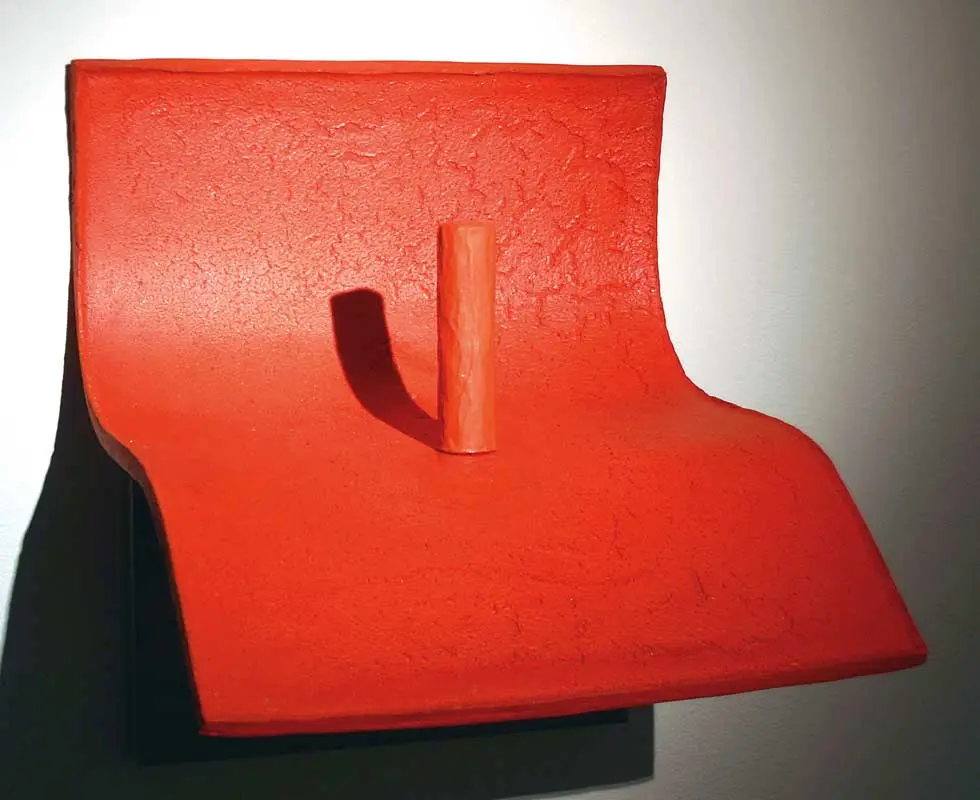
In his "fluid planes" where there is no duplication of the existent objects per se - but rather a ludic dialogue with geometrical abstraction, a sort of staging of this chapter in the history of art in which Costa takes notions, such as the rupture of the frame, to unthinkable limits – the effect is even more surprising. The canvas, completely overtaken by the spreading paint, detaches from the wall and undulates, flapping. In Encuentro Accidental de un Cilindro Rojo con un Plano Fluido (Accidental Encounter of a Red Cylinder with a Fluid Plane), the geometrical object shares the same tone with the plane and is constructed with a thick layering of acrylic; it is elevated perpendicularly, in such a way that it is able to throw its shadow, nearly like the column of a sundial, over the plane that, in turn, darkens the wall as it detaches from it and moves forward.
In Pintura Enrollable Amarilla (Yellow Roll-Up Paint), the "canvas" without a stretcher rolls up on itself in an affirmation of the tremendous materiality of paint that presupposes the possibility of imagining the extended form of the fluid plane. Costa plays with the properties of acrylic, a material that is capable of "supporting itself and growing from within" in solidified volumes to the point of conferring these abstract "paintings" with an effect of weightlessness or of merely suggestive powers – as in the case of the circular disk in Cuña Gris con Exterior Plateado (Gray Wedge with Silver Exterior). In this work, which becomes a meditative exercise, the eye guesses that the other invisible half of the piece is on the other side of the wall.
La Rueda Duchamp/Costa (The Duchamp/Costa Wheel), fashioned of metal, rubber, and wood, is the only work in this retrospective to which Costa alludes to his connection with someone, who like the artist, searched in many directions and "took plenty of time for each turn of the screw," but making sure every turn was radical. Instead of spokes, Costa's modified wheel has a spiral – central to Duchampian thinking – painted in red that intensifies the abstraction effect inserted in the figurative object. It is not only homage but a key to the reconciliations among opposing traditions that Costa has been producing along his artistic journey.
ADRIANA HERRERA