Horacio Coppola (Buenos Aires, 1906) is part of the Buenos Aires tradition he so uncannily captured as early as 1936 when the famous Obelisk was under construction in the heart of the city. But this artist is much more than the great “photographer of Buenos Aires" and the surprising images found in the Horacio Coppola. Los Viajes exhibition at the Jorge Mara-La Ruche Gallery, attests to this. The exhibit consists of one hundred photographs – the majority never before shown – of Brazilian and European cities taken during the 1930s.
Coppola is, along with Grete Stern, one of the first modern photographers of Argentina. Even before he signed a contract with the Bauhaus in Germany, he had already published some photos of Buenos Aires in Sur (Number 4 and 5, 1931-32), the magazine owned by Victoria Ocampo that depicted fragmented, nearly abstract, urban scenes with an unconventional point of view and no apparent theme.
Italian immigrants, the Coppola family built a family in which everyone studied, painted, played music, or engaged in various crafts. This rich and diverse cultural environment expanded the horizons of the young Coppola, who befriended writers and philosophers, attended law school, and was taught there by his own brother, Armando, twenty years his senior, who introduced him to the world of films. Inquisitive and attentive, in 1928 Horacio attended 10 conferences given by Le Corbusier, inspiration "basis for [his] future photographs" of Buenos Aires. Horacio assimilated from the Swiss photographic artist his passion for forms, the transformation of the concept of architecture, and its relationship to the urban space.
The year 1927 represented to Coppola the “initial date of his calendar." It was when he realized that photography was the “instrument” he needed to display his vision, to persevere in his “revealed vocation as an author of images.” He was nevertheless "aware of the essential value of words," as he indicated in the autobiographical outline included in his book Imagema. Antología Fotográfica 1927-1994 (Fondo Nacional para la Cultura y las Artes, Ediciones de la Llanura), which was published concurrently with a retrospective of his work at the National Museum of Fine Arts (Argentina) in 1994.
The exhibition at the Jorge Mara-La Ruche Gallery is a survey of the photos he captured with his first Leica during the port stops on the boat during his return trip to Buenos Aires in 1931, back from his academic trip to Europe – painters would usually do that – that began at the end of 1930.
The European images were captured after another trip – inspired by his passion for the cinema – in 1932 to study art history at the University of Marburg, which was closed when he arrived. It was a bad time to arrive in a turbulent Germany, less than a year before Hitler’s ascent to power in 1933. It was in Berlin where he first met Stern, who was already working with Ellen Auerbach (in a team known as Ringl + Pit), and attended Walter Peterhans’ courses at the Bauhaus (eventually closed by the Nazis in 1933). Coppola would also become, nearly by accident, immersed in those same classes.
It was in Europe that Coppola definitely assumed his identity as a photographer. The photos of Berlin were taken between 1923 and 1933. These reveal Peterhans’ teachings and are technically perfect. Coppola played with shadows and textures as he sought to "see photographically" (the point of camera had to be decided upon before framing the viewfinder). The Royal Castle and the bridges over the Danube are among his urban landscapes of Budapest, years prior to the Nazi occupation and the Soviet bombardment.
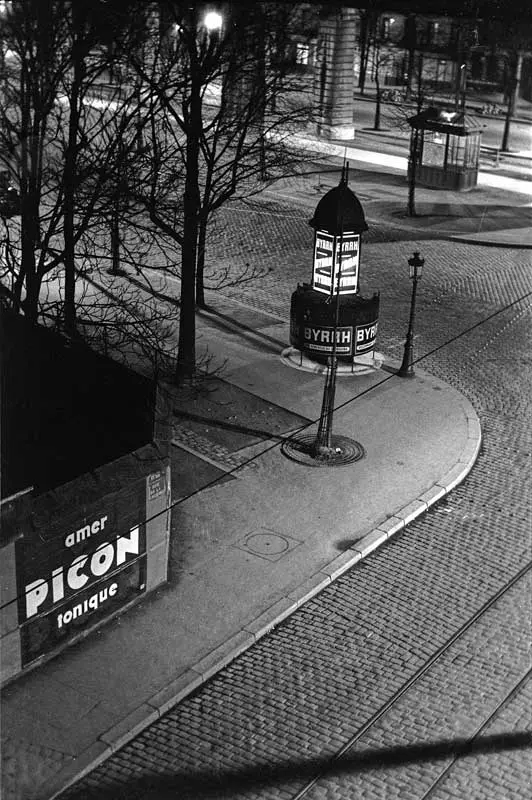
In the prints of the photographs taken in the winter of 1934, the city of Paris appears cold and desolated, and in some photos, even dull. But Paris has always had some beautiful or surprising images around the corner; Coppola's eye understood the innovative configurations that revealed the magical corners, walls with romantic graffiti, and circus acts that contrasted with the spiritually grim atmosphere. The photos he took of London – where he married Stern, who had been living there because of the anti-Semitism in Berlin – are among the less “constructed,” and almost constitute a survey of the moment. It was 1935, and the international economic crisis has taken a devastating toll. Coppola's sensitive eye captured a universe that notably privileges architectonic elements, somber faces, and the abundant window displays of storefronts.
With no intention of being a witness, Coppola essentially captures surprising geometries and unusual angles both in the architecture as well as in the impoverished and/or elegant locals. He explores aspects of the modern city that with bicycles and wheels bring the spectator closer to a world that no longer exists. Seen from a current vantage point, these photographs captured with an original perspective and an apparently objective gaze – that is, in fact, interpretative – are charged with contrasts and nostalgia, abstractions, and signs.
Horacio Coppola. Los Viajes is also a 250-page catalog jointly published by the Jorge Mara-La Ruche Gallery and Círculo de Bellas Artes in Madrid – where the exhibition will be presented next – along with a DVD containing four movies filmed by the artist.
VICTORIA VERLICHAK