
The most recent exhibition of works by Icaro Zorbar at Bogotá’s Casas Riegner Gallery confirms that the linking of technology to the contemporary is not always felicitous. Rather on the contrary, for Zorbar technological problems as such are not the concern, but the humanization of technology is. The aesthetic value of his machines, which he dubs “small monsters,” is anchored on their simplicity and their evident resemblance to toys. Moreover, the visual paradigm represents moves between the work of art, machine, and game. Zorbar's intelligent, constructive, and positive work insists on the resilience of life in the face of an incessant technological frenzy that erodes our enjoyment of simple things.
Estuvimos ahí, which opened in November 2009, comprises seven difficult-to-define works that revalue, among other things, romance, with suggestive titles like Víspera o Canción para un amor imposible. They function as twin proposals, as they share the power of subtlety and the perspicacity of that which seems alike but isn’t. Estuvimos ahí asks to be read as an integral proposal, under cover of words, balance, enigma, and poetry. Complementary, similar, and seemingly inseparable, the works here have the virtue of seduction and the amazing quality of being perfectly adjusted to each other. No one element is the protagonist, nothing stands unduly out to overwhelm the visitor’s memory; in fact, this series of objects ratify the sovereignty of human values such as justice and respect and demand a sharpened gaze in order to reveal their differences.
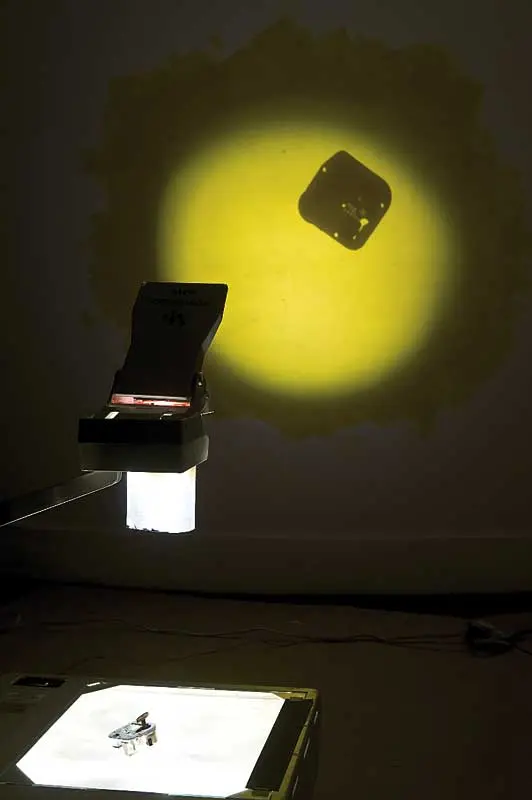
As individual entities, Zorbar’s works here can be described as willful ruses. They are constructions that combine mismatched materials and actively partake of the aesthetic of the disarmed toy: a little music box accompanying the movement of a motor that rotates a plastic lid on which a carrot germinates; an acetate projector working exactly like that, on which the mechanism of a music box is activated to vibrate and emit sounds, and to be projected on a wall; a toy organ placed at the end of the gallery, which, like a solitary monster, invites viewers to press keys highlighted with small colorful ribbons and to peruse the notebook left on top. Two intercom devices make it possible for unadvised visitors to activate the work and for others to be surprised by the sounds made by a small toy instrument at the end of the space.
Borderland inhabitants, these small monsters tell unique and unrepeatable stories; the carrots, inserted in this series into a mechanical mini-world, represent hope beyond incredulity. They germinate even if we believe they won’t, and their sprouts represent that small being’s last hope for life. Light, watching over them like a tiny sun, orbits around them and witnesses the process. Assuming the role of founder, Zorbar is able to correlate the components using a powerful adhesive —his ingenuity—and in that way collects and connects a multiplicity of interpretations that turn all of this poetics into reality.
Scale and proportion are determining factors in Zorbar’s installations, and in turn, become a seal of identity. The artist has us crouch, kneel, and roll around in order to negotiate the hallucinatory creatures that took over Casas Reigner Gallery. As he points out, his installations are “attended,” meaning they are activated, wound up, moved, watched over, and other things, triggering a series of effects—both in sound and movement—that complete the work of art. And just as the scale is important in Zorbar’s work, so is time. In the same way, the frame outlines the canvas, the duration of the mechanics of these works is short and limited. Their rhythm and frequency, directly related to the audience’s intervention, become reality as we activate the music box, play the organ, or press a button.
As enigmatic as the process is that derived in a combination as paradigmatic as peanut butter and jelly, Zorbar is able to establish a starting point by deploying in an exemplar way cable, speakers, amps, and projectors, which like entities belonging to the same family engaged in a dialog with plastic toys, lids, notebooks, and pieces of beer cans.
Icaro Zorbar’s works fascinate and captivate even within the framework of aesthetics that is not easily understood, one where broken-apart machines, displaying their entrails in the open, become objects of desire and of deep admiration.
ESTEFANÍA SOKOLOFF