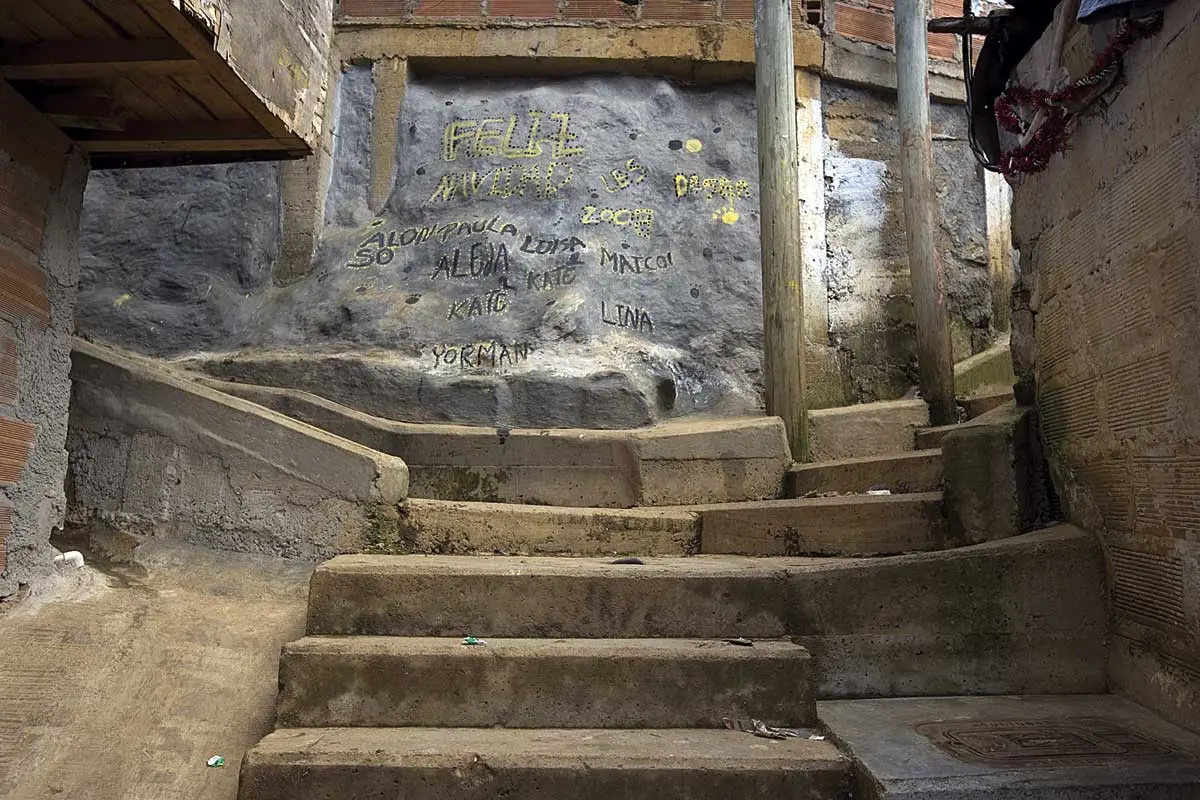
From the gallery’s street-facing windows we can see a series of photographs of landscapes with green mountains crisscrossed by yellow snakes. Next to them is the image of a structure resembling an archaeological excavation. The landscapes entice us to enter the gallery, and up-close we discover that those yellow snakes are staircases on a hillside, access built by the invading inhabitants of an outlying area somewhere in Latin America. These images are part of the result of the Escalas project by Colombian artist Juan Fernando Herrán, exhibited at Magda Bellotti gallery.
Escalas developed from a residential fellowship the artist had in Medellín in 2007, where his interest was piqued by the large number of sculptures found in the city, after an initiative at urban renewal by the local government in the 1980s (during a decade of the fictional economy generated by the illicit enrichment fostered by drug trafficking). However, Herrán decided to seek out a different kind of sculpture process not belonging to the hegemonic and excluding projects promoted from the centers of power. The “sculptures” he found were precisely those entropic tracings on grass, generated as accessways to the outlying areas of Medellín, where he encountered alternative readings of the urban space.
Herrán produced a series of photographs by way of recording these access mechanisms, of a precarious nature as urban planning but indeed functional. Their vulnerability is symptomatic of social vulnerability, and their presence points toward a failure of modernization, which paradoxically seems to be celebrated in the city’s sterile, clean, and vigilant public squares.
The first three photographs in the series Itinerarios reveal how the inhabitants of Medellín’s comunas (shanties) located on the hills that surround the city invade and appropriate the territory, creating informal living spaces and generating an organic urban weave.
The material staircases that give access to these kinds of lodgings are portrayed with a certain degree of contemplativeness, in an attempt to point towards their symbolic meaning: the beginning of an uncertain future home, the hope for advancement and belonging in a city that keeps them in its periphery.
Accompanying this series is Morada, an image of a narrow home, whose minimal space, habitable by a single person, is the home for an entire family. Yet the photograph documenting this precarious, ramshackle structure reveals how it rises proudly on some columns, acquiring a certain status relative to the houses around it. Materials such as brick and mortar, connected to the city’s architectural language, link these marginal neighborhoods to the official city, but at the same time generate a class division, since brick structures confer status compared to wooden ones. Like Morada, the photographs titled Horizontes presents an eclectic home, made of a mix of materials. A brick structure at the bottom of a kind of wooden scaffold on top, signaling the construction of a second story. The illusion of better future intermixes with the creativity displaying in setting up the structures and we once again encounter the staircase, which, being presents in the plans for the second floor, indicates the dream of a third one. It is common for these buildings, also known as "rocket-homes", to accommodate extended families with children, parents, grandparents, siblings, etc., who distribute themselves around the space as new levels are built and the families expand through marriages and births.
Lugar propio and Noel are photographs that approach the private life of the residents, showing the home’s interior and its distribution. Herrán points out the ways in which space is appropriated for the establishment of a home, with the achievement of a minimal order and cleanliness for life as dignified as possible given the circumstances. In one of the photographs, we see a Christmas ornament created using discarded materials, with Santa Claus ascending a staircase. The appropriation of North American symbols is joined to the local symbolism of the staircase as an aspirational element.
Located on the gallery’s lower level were two photographs that at first sight appear as paintings and fuse with the wall’s texture. They show how the access ways functioned within the neighborhood, a tangle of stairs and beginnings of stairs coupled into the terrain; the fact of being built in concrete gives them a certain official reading, rather than the fragility of the staircases at the beginning of the exhibition. Like the houses, the stairs in the gallery progressively adapt to the terrain.
Lastly, the image next to it is almost a monument to the staircase. Sculpted in stone, it reveals the features of the object, captured in the diversity of sixes for the steps and its painstaking execution.
The group of images presented by Herrán retains a critical language with respect to the conditions in these peripheral, invaded territories, where human beings survive and progress against a hostile terrain. Where day after daydreams are built and illusions tumble down, but which remain alive and active as part of the big city.
MAYA GUERRERO