
Today, our nearly total access to reality is mediated by a screen. Awareness within this dynamic is often produced under conditions of scarcity. For instance, it is common to observe persons carrying cell phones that they only use to receive calls, because a person cannot generally afford to pay for a service of that type. It is a game of “appearances” in which perception is more important than reality.
Unforthcoming about any social connections that may exist in his work, Raúl Cordero focuses on the evocative qualities of his visual adventure. He proposes a ludic essay that is defined through its own rudiments, contraptions, functions, limitations, and the liberties that belong to this field. Recently, during the month of November, the Servando Gallery presented the exhibition titled Hendrickje.
A graduate of the Higher Institute of Industrial Design (ISDI), Cordero also attended the Academy to acquire experience at the Higher Institute of Art (ISA), where he spent some time studying and to which he later returned as a professor. His work has always maintained a personal approach. While he attained a convincing artistic production in the field of video art, from the 1970s and well into the beginning of this millennium, the opportunity to be awarded a scholarship at Rijksakademie van Beeldende Kunsten became an offer too good to pass up, and he decided to return to painting.
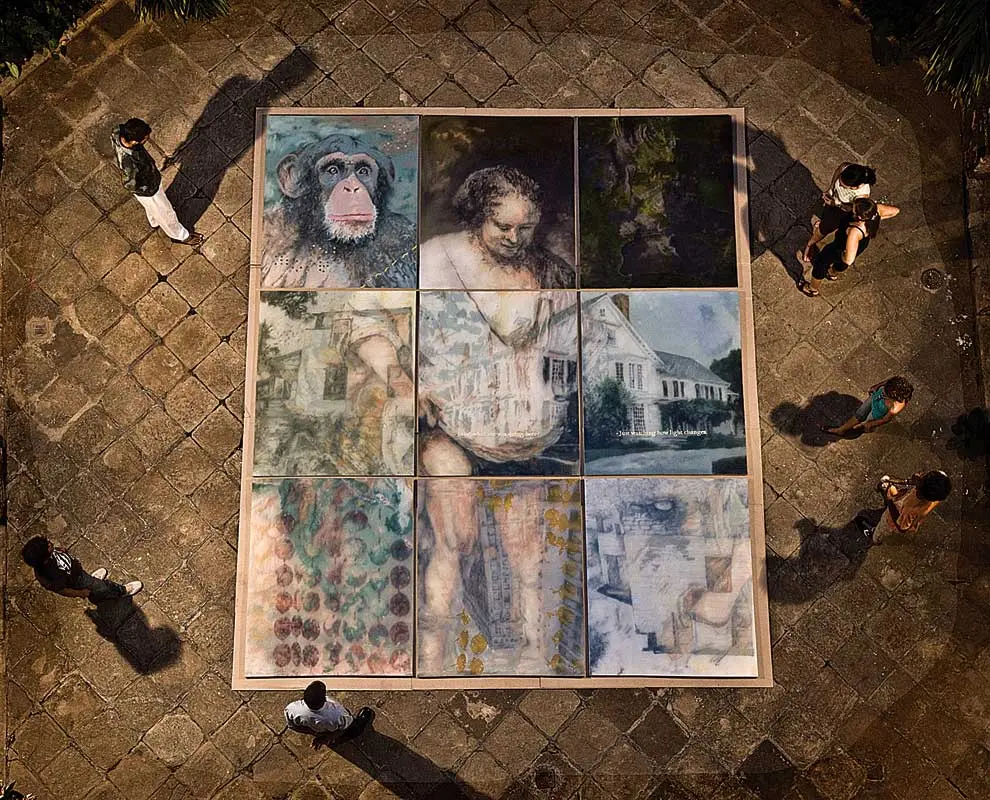
This exhibition stems from the admiration and surprises Rembrandt – who spent a good part of his life with Hendrickje Stoffels – produced in Cordero. Stoffels was initially Rembrandt’s maid, who then became his model, and subsequently, his lover. She assumed with exemplary stoicism and abnegation the economic and moral bankruptcy to which the greatest genius of Dutch painting was exposed. In October 2009, Cordero began working on nine paintings of the same size, all of these very different but inspired by the classic genres from the history of painting: portraiture; landscape; still life; abstraction, etc. The sole element that establishes a connection among these works is the fact that all contain in the elements of their composition of the painting by Rembrandt titled Hendrickje Stoffels, Badend in Een Rivier (Hendrickje Stoffels, Bathing in a River, 1654). The nine paintings were arranged in such a way that when an aerial photo of the group was taken, it was possible to see the image of Hendrickje painted by Rembrandt by combining the elements of this painting, which included each of the nine works by Cordero. Is he expressing his conviction with regard to the role that appearances play in the world of media?
Raúl Cordero then decided to try portraiture, and his laconic and cynical attitude gives him away when he affirms, “I had the desire to paint a monkey.” It is too innocuous to be true, more so when in this version he does not draw connections to any artist or celebrity. He simply has fun painting a primate fair and square. And if as its omnipresence were to bother the artists, he disdainfully decided to name the piece, No Más.../ No More... Coming from a Cuban, one cannot but reflect on the irony, especially as we know that our social process has not succeeded in erasing racial discrimination.
One of Cordero’s favorite things is films, and he wastes no opportunity to allude to this art form. In Julie's Diptych, he incorporates elements from the film Down by Law (1986), directed by U.S. director Jim Jarmusch, a film that received rave reviews from movie critics because it experimented with a minimalist language. In both canvases, Cordero introduces part of the dialogue in the film. The text is printed above a diffuse background in which elements of architecture and illumination coexist, both controversial subjects within the Cuban context.
Plata y Oro/Silver and Gold is the other diptych where he takes advantage of the intervention of buildings referred to as “Cuttings,” represent a process made famous by U.S. artist Gordon Matta-Clark. Likewise, Cordero references Gordon’s Photoglyphs – that consisted of photographic series of graffiti captured in the New York trains – as well as his well-known work Split House, a two-level home carefully sliced in half. While Cordero is always trying to avoid having anything to do with social or political commentary, he nevertheless often pays homage to artists before him in works that would delve into utopian concepts.
Cordero’s entire artistic exercise involves a sort of test to question our knowledge, to comment on the intertextual character of every creative act (although his intentions are not narrative). He believes in the possibilities that painting offers, as he is convinced that the most important thing is not the “why” but rather, the “how." Let us understand Hendrickje as an homage to the most experimental and subversive attitudes of the Twentieth Century, as we take as a guide the painting by an artist who makes us believe in the infinite power of creativity.
AMALINA BOMNIN