Gender-bending is one of the symptoms of the contemporary, and it brings with it a large number of situations that generate questions regarding the fate of humanity. Whatever the end maybe, what is important is for men, women, or androgynous beings to move in the world without duplicity and without proclaiming an emperor-has-no-clothes kind of morality. Ethical or spiritual disorientation, irrationality, moral repressiveness, and alienation maybe the other side of the coin, to be dealt with by sociologists, psychologists, psychiatrists, and all of those engaged with the behavior of the individual in society.
Rocío García is among the artists who inspire the greatest respect in the Cuban context, due to the honesty with which she confronts the creative act, precisely by taking as her premise the possible consequences of an alienated and unreflective attitude. Those who read her discourse in a superficial way only see concupiscence and libertinism; those who stop and explore it beyond the forms of her painterly excellence will encounter the most dissimilar facets of human behavior, focalized on a free zone where what we experience is a faithfulness towards our own selves.
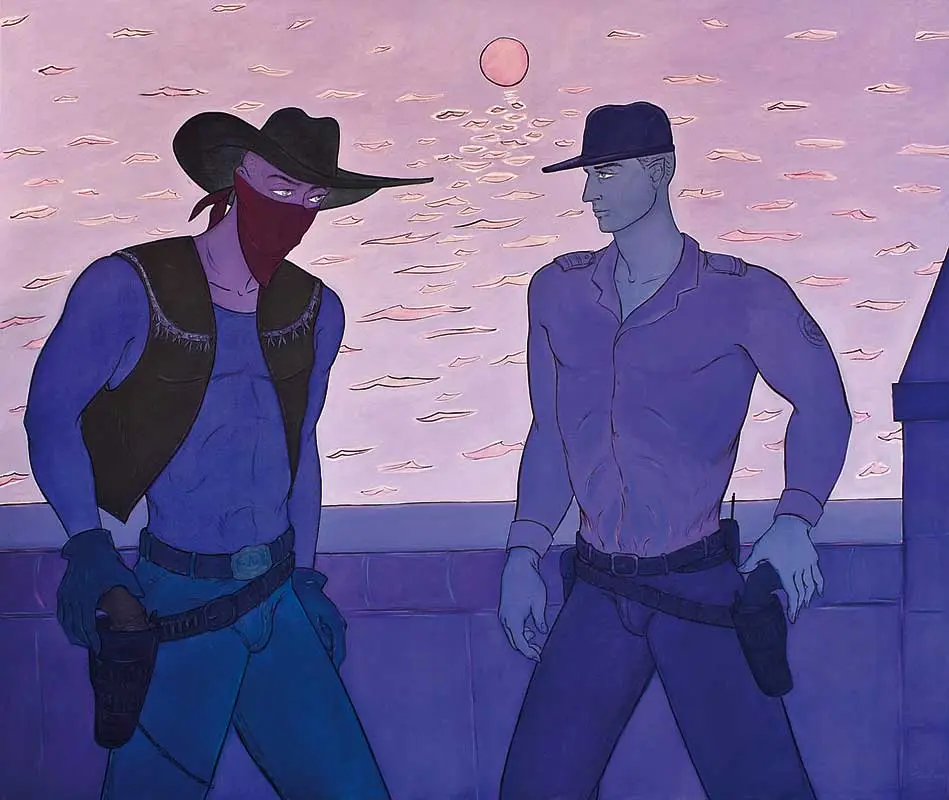
Between January 8th and February 8th, La Casona gallery presented García’s most recent work in the show Very, very Light… and very oscuro (Un policía con Alzheimer), a “staging” where mental deterioration becomes a ubiquitous metaphor for the frenzy of the contemporary world. This group of twelve large-format paintings, resolved in oil and acrylic on canvas, was distributed in space’s two contiguous rooms. In the first room, appropriately lit, one part of the story was presented in pastel colors, with a predominance of blues and violets; it attempted a softened ambiance to allude to the world of appearances. The second segment, dimly lit and set against black walls, represented the so-called “low passions,” our inner world, perhaps closer to the true face of human nature. In general, it was simplified towards shades of gray and tonal variations of black.
Those who know Rocío García know her attachment to a language anchored on strong colors and precise drawings. In her proposal, themes become pure provocation, and titles ensure a linguistic interplay encompassing deliriums and the disarrangement of identity. What does the author want by threading a story through a timeless character who has broken with reality? How many times do we not experience nonsense, absurdity, paranoia, without having been diagnosed with a mental illness?
The range of characters and their outfits vary according to the stage in which the plot unfolds. Thus, in Chiva’s bar or La dama de Zurich no play, with casino or bar environments, the characters involved dress in period costume, and in the former only the policeman appears as an anachronistic element. The same happens when Lin Cheng and Borishka arrive in this intercultural space.
The temporal and ethnic diversity of the figures responds to the hybrid nature of our times: we can find faces with Asian, Latin, Slavic features, and the environment may remind us of the 1930s, the 1950s, the 2000s and beyond; if we pay attention to the metaphor of the loss of memory, people with Alzheimer’s forget recent events but recall long-ago periods with greater lucidity. The social subjects can be “chic” folks, Emos, or “destroyers” (the latter seen here wearing black, leather, metal), even comic-book heroes.
Havana’s malecón is the favored meeting ground for the city’s gay community, and the “Bad Cowboy” is a common fixture. The covering of his face with a bandanna is part of the game of veiling in which the author engages. In a straightforward sense, there aren’t that many differences between this character and the policeman: barrel chest, well-defined muscles, a defensive attitude. Is this an exercise in power or seduction? The artist masters such subtleties, giving us only scant clues.
By the penultimate scene, the main character begins to appear shrunken in the face of his circumstance after imbibing large amounts of beer (Mucha, mucha Beck’s). Finding himself alone in the toilet, the victim of his desires or hallucinations, he is stalked from behind by a horse or another tall animal, which the artist has arranged in an almost pornographic attitude.
There could be as many interpretations of these works as individuals observing them. Therein lies one of their achievements: in the distension, they induce in our subconscious, capable of assimilating the policeman not only as a representative of repressive power but also as the victim of human rigidity and human foibles. That is why he is unable to pursue that woman who could be his wife, or to maintain any other kind of emotional connection, to the point of committing a crime when he finds her in the company of her lover.
The works included in the second section don’t have independent titles, they all belong to the series Very oscuro, characterized by the beam from the flashlight the policeman used when making his rounds. Seen together, these canvases suggest the moving hands of a clock. Surprised, agitated, pleased, hallucinating, lost? Many emotions could be experienced by this representative of power turned by chance or irrationality into a voyeur of many orgies. The canvases show multifarious characters captured in the midst of sexual enjoyment or agony (there are aggressions with blades): women, men, others whose sex remains undefined, as defining it is not García’s intention. Is he then a simple policeman, or the epitome of double morality? Does he want to cross-dress? In one scene, the officer masturbates watching what is perhaps his own desire, and appears at a smaller size than the other characters. Is he our conscience, or our subconscious? Are we the judge or the accused?
I note that these scenes are freed from the violence present in García’s previous work. It is now more veiled like the show’s title suggests. This universe, halfway between reality and fable, extensible to a discotheque, a stripper bar, a brothel, or any other place where human passions are encouraged, transports me in some way to the worlds and characters created by Henry Miller, Proust, or Kundera, where the twists of inner human life become our allies. García creates a territory of simulations, and the leitmotiv is mental illness. While she applies it, there occur in real-time similar situations, or even graver ones, where disguises are once again the protagonists.
AMALINA BOMNIN