Photography is always a question of power, with all the meanings that this word implies. Ruvén Afanador demonstrates that he has access to the worlds of high society, fashion, documentaries, roguery, theater, creating new values, technical freedom, and many other situations that made it possible to tell the story of his latest exhibition titled Mil Besos (One Thousand kisses) through more than one thousand photographs. Once again, photography focuses on fame. Here, the author connects different time periods and areas of society that are well-known and who aspire to stardom. Our knowledge of Flamenco includes music and dance, and Afanador's photographs include both of these expressions of the Romany people. His photographic gesticulations reveal sounds. Having taken the pictures in Andalucía, out in the open against the rocky landscape, enables Afanador to add a powerful and original gaze to its portfolio.
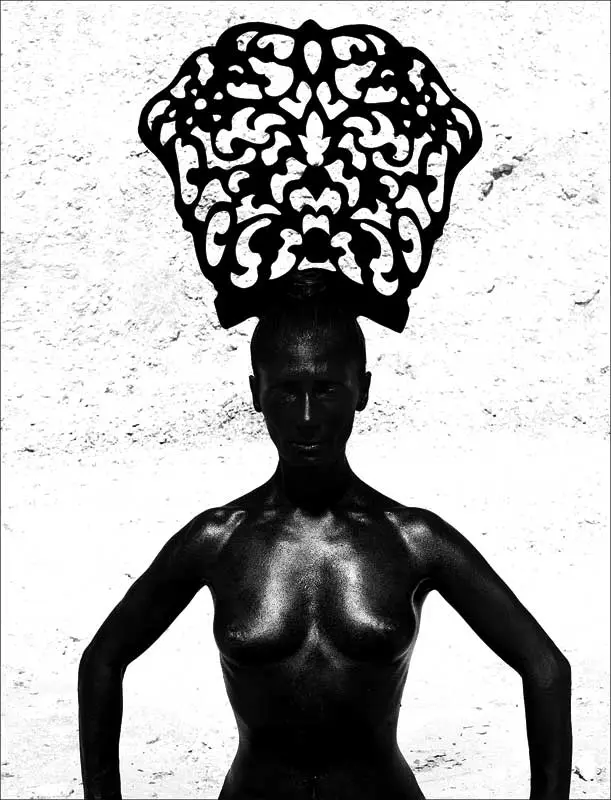
Having already mentioned the first two characteristics, let us delve into the second of the two in order to understand how Afanador achieves the tension that proceeds from his images. He asks all the bailaoras (flamenco dancers) to use black makeup and clothes. He obtains a contrast in black and white that is like lace, like the ornamental combs the models use, or the flounces, and arabesques on the clothes set against the emphatic whiteness that the sun bestows on the stones. Relying on the great presence of flamenco – which originated in the Eighteenth century in this region of Spain – Afanador works with women of various ages. Each photograph states the name of the model portrayed, as well as the place where the picture was taken, for example, Concha Vargas-Torres en Sevilla, Rossy de Palma en París, and “Antonia la del Pipa” en las afueras de Jerez de la Frontera. The majority of the pictures only show one figure, although there are interesting groups of two or of more than twenty dancers, Estudio de Baile de Alicia Márquez en Cantera, en las Afueras de Sevilla.
Latin America is a frequent theme in the art world. Mil Besos achieves one of the better executed encounters between Spain and Latin America through humor, confrontation, a slight narrative naivety, and Ruvén Afanador's ironic freedom. He left the Port of Palos looking for spices, without ever arriving in India, but he found pre-Columbian cultures instead – the intense indigenous cultures and hot peppers that have been around since seven thousand years before Christ. These women in their neo-realist portraits offer the spectators the desplante (defiant stance) – the cockiness or insolence as it is usually expressed – of flamenco, in their dance as well as in their gypsy personality. The audacity of this Colombian photographer captures from his continent the vision of an expressionistic and intensely theatrical Europe.
The exhibition at the Throckmorton includes 34 photographs in three sizes. The thematic and energy of the images require this variety. As a traveling exhibition, it adjusts the selection of the works to the venue. To better understand the magnitude of the show, Rizzoli has published Mil Besos in a hardcover edition containing more than 179 photographs, a foreword by John Galliano, and texts from several prominent women in the fashion world. The book will be enjoyed just as much as the framed photographs. Entering the exhibition offers a reenergizing option. In the exhibition room, several visitors have caught each other attempting certain postures and facial expressions in imitation of those in the worlds. Ruvén Afanador succeeded in convincing the subjects not to think about ridicule. On gelatin silver prints, he created images that expand the communication and the notions of femininity and beauty. While the elements that constitute flamenco are baile (dance), canto (song), and toque (music), Afanador relied on the contrasted presences and on the arabesque positions to emphasize the toque, even as the guitar is absent. He also uses different options of floors on which to dance. There are portraits and full-body images that have a snapshot feeling to them – such as that of Concha Vargas-Torres running – and there are also photographs depicting private "poses." Braids, loose hair, flamenco dresses, and buñuelian and almodovarian situations embroider the labyrinths of creation.
GRACIELA KARTOFEL