
I agree with Teresita Fernández’s own characterization of the central problem in her work: “Oftentimes…works almost start out as a cliché in my mind. Sometimes it takes years to figure out a form that kind of harnesses the idea that doesn’t seem like a cliché.” When you select your themes such as elemental (not to mention polarized or dyadic) concepts as water, fire, air, and even landscape, and incorporate the beauty of surface effects, you are bound to run into this problem. You can easily be dismissed as a romantic and even a modernist because the themes are generalized while the physical means used are aesthetic.
Then there is the problem of “taste”, by which I mean that one person’s profundity may well be another’s cliché. But the problem with using your “tastes” as a critical tool is that it boils down to merely opinion, which quickly becomes a matter of power. And in the power of opinion Fernández’s works have been widely acclaimed.
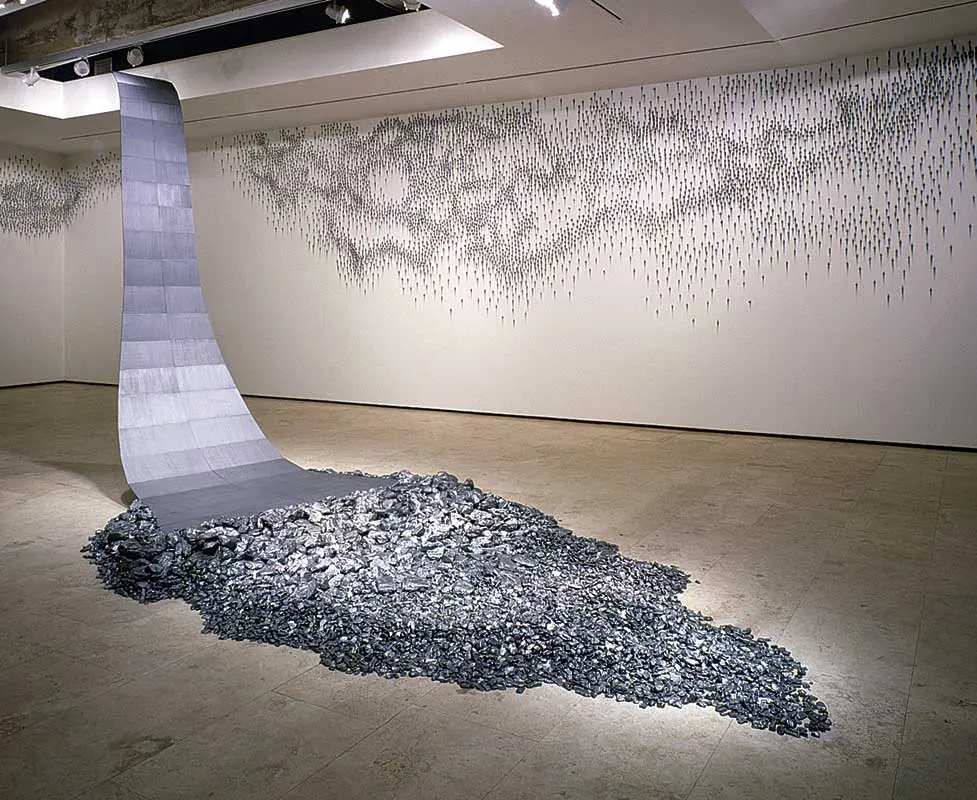
The exhibition at Lehman Maupin Gallery is a reduced version of her summer 2009 retrospective at the University of South Florida Contemporary Art Museum in Tampa, which was complete with a catalog and essays under the title Blind Landscape. Some familiar pieces or variations of them are here, especially the beautiful swarm formations she creates across gallery walls by mounting numerous, small pieces of graphite, with titles such as Epic and Sfumato, each of which is “shadowed” by gray graphite smudges “drawn” beneath each small piece, and the group arranged in organic swirls or sprawls that appear to cast shadows. They remind me of the various flocking software programs that we saw in the late 80s (“non-linear distributed behavioral models”) and now widely used among architects, city planners, and especially the computer graphics crowd for group renderings in films, games, and what we currently call “real-world simulation,” not to mention bioinformatics and complexity science, all of which emerged a bit earlier. And maybe that is a way of recognizing what we already know about Fernández’s work—as organized disorganization meant to invoke the dynamics of nature—but in a slightly different way.
In terms of science and graphics, it’s old hat, but in terms of the historical moment, admittedly a moment defined fairly broadly across several decades of time but nevertheless an important period for the emergence of a defining set of ideas, she is involved in the real-life simulation. As she has remarked several times, she “pictures” the world in stop action, the dynamics of life—she mentions photography and cinema, but I argue for something broader—frozen but with the implication of continued movement. Of course, I like my argument better because recognizing parallels in “science” helps rescue the concept of beauty from its association with romanticism (a bad word for many), and from Latinism, itself a cliché, to place its use into a field where the concept has always played a large and critical role. Just ask a physicist which equation is best and they answer the one that is most beautiful!
In the center of the room, surrounded by the wall flockings as its “natural” environment, sits a frozen cascade of water, or so the form and title imply Drawn Waters. A ten-foot (308 cm) tall steel armature in the shape of a curved water slide starts at the ceiling—or is taken from the sky since there is no end to it; it hangs suspended in the air from an unstated but implied source—and terminates on the floor embedded in a rock pile of silver-gray graphite, which is also the color of the steel cascade. The graphite is intended to add to the implication of the ephemeral and temporary condition, that this large sculptural form has been drawn in space, just as water is drawn from somewhere. In that sense, one of the issues is not simply frozen motion but the ephemeral conditions of the world, which carry not only the whiff of vanitas but the cachet of environmental foreboding.
That’s the nice thing about such open-endedness, all the implications you can pile into it. And Fernández has said she is happy to have the audience interpret and locate issues of their own in her work. In her encouragement of audience relations, she is of the moment; well, the late 90s anyway. So what could be problematic? Do I have to ask what is the nature of this relationship? To me, they remain beautiful, highly crafted, objectified, and generalized abstractions of nature. There is much of it out there, and many people love it. If we look to Nicolas Bourriaud, the author of Relational Aesthetics, we find a counter to the current award-winning and beautiful ephemera. (Richard Wright’s gold-leafed fresco of an abstract design won the 2009 Turner Prize, and it was erased after the exhibition). Bourriaud defines engagement in contrast to his characterization of post-WWII art as one of luxury goods and as we’ve all witnessed, and unwillingly engaged, wealth too can be ephemeral. So is this art and aesthetic an end or a beginning?
RICHARD LESLIE