
For his fifth exhibition at Galerie Xippas, Vik Muniz (São Paulo, 1961) presented two sets of photographs created using different techniques: one set referred to several masterworks of Western painting (by Da Vinci, Picasso, and Seurat), and the other one to an interrogation of photographic light in some of its greatest interpreters, such as Brassaï, André Kertesz, or Robert Frank (in Black and White). Here we will talk mostly about the first group, which was designed expressly for the gallery.
It would be a mistake to see Muniz solely as a photographer. He is much more than that, inasmuch as he is an inquisitive and inventive artist but also an artisan in the noblest sense, curious about technique and about forms that develop from the innovative use of materials. The process of creating his photographic “object,” which the artist organizes when he assumes other techniques, is complex. New modus operandi is possible for Muniz because of his deep expertise in the field of painting, a genre for which he feels, in his own words, “true fascination”; it is on the basis of this fascination that he builds the material universes that will be the foundation for his photography, its artistic culmination.
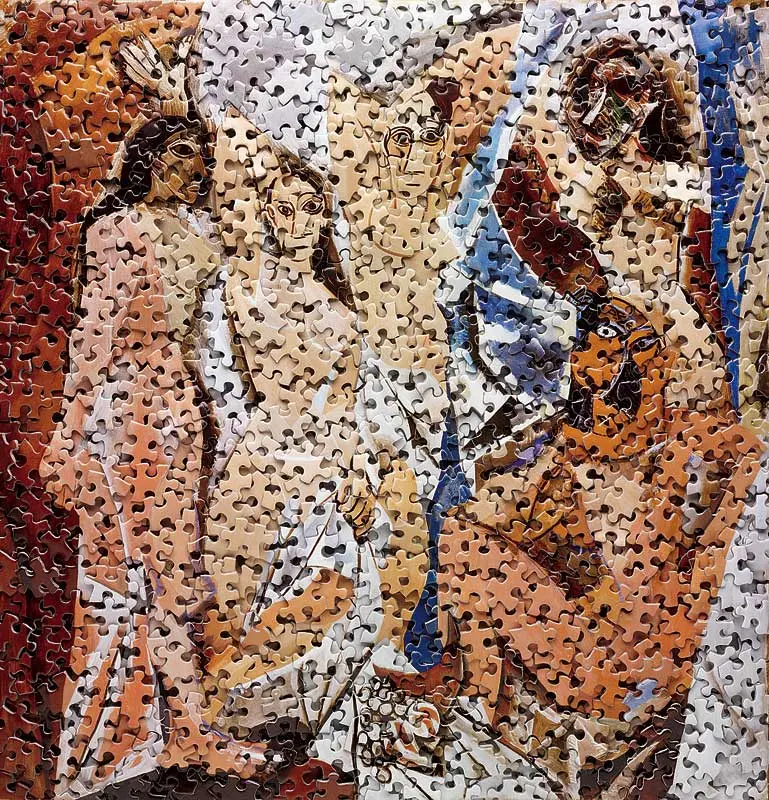
Vik Muniz’s most recent photographs, created from puzzles, present us with color versions of Leonardo Da Vinci’s Mona Lisa, Seurat’s La Grande Jatte, Picasso’s Guernica, and Demoiselles d’Avignon, all of them very famous and well-known works of art, which means that we bring with us a more or less precise memory of them, as we have many times seen them reproduced in art history books or used in advertising. Duchamp’s iconoclastic vision of 1919 and Boris Vian’s humorous short film La Démystification1 (1958) are in everybody’s memory. Vik Muniz explains,2 like an artisan would, his work around the puzzles and the de-composition of his “gestures.” He begins by “fractioning” the original image into a series of fictional formal “zones,” separated by a few millimeters. Then, he has them industrially reproduced into the same number of puzzles (sometimes up to thirty) on the basis of which he reorganizes the multiplied pieces and reconstructs an image faithful to the original. The result is a virtuosic work of art that evokes Futurism’s cut-ups and Pointillism’s colorful, luminous fragmentations, with a wink towards Arcimboldo's portraits. In this observant, painstaking labor, another dimension is invoked that gives Muniz’s photographs an unexpected “texture”: relief. Indeed, the accumulation of puzzle pieces creates a material effect and, even beyond it, a kinetic one, whose tactile presence is not “flattened out” by photography. The originality of Muniz’s most recent “montages” finds here one of its specificities.
It is the same decodification work that Muniz executes for his photographs —models to recreate an image, also in relief, with the help of black, white, and gray paper pieces. The close relationship established between light and shadow zones creates a somewhat more dramatic climate, accentuating the “animated” character of the still image and thus opening it up to a filmic dimension.
From his landscapes in sewing thread (1999), his images in chocolate, and his “dust paintings,” through the Caviar Monsters (Galerie Xippas 2004), Muniz develops a kind of conceptual and material “mirror effect” of the image. He never stops interrogating representation and devouring with multiple gazes the paintings that are his inspiration. He questions and analyzes with passion the smallest secrets of their composition, bringing to light the color contrasts, the oppositions of light and shadow; he notes the lines of force, the determining details, etc., and re-transcribes them, inventing a different technique for the new images that are his photographs. For him, “technique inspires the theme and each series of techniques generates an experience with a different dynamic,” as he places capital importance on “the tension that exists between object and image.” What Vik Muniz offers his viewers is a reading of the work of art based on its constitutive elements, revised and corrected. In this recomposition that puts into play reality and fiction, the Brazilian artist reveals himself somewhat of a Platonist in that the illusion created becomes what is real. His various proposals of de-construction and construction always take us to the original work, since the created image, despite its mimesis, always sends us back to the starting point. While there is a deviation of the image, there is also recovery and new creation. In this way, this is faithful and innovative recycling, a “bringing to the open: of the artwork’s structure, with a great sense of humor and imagination, forcing our eyes into new aesthetic emotions, pushing our visual memory towards new challenges, opening up the work to new readings, and enriching it with new meanings.
In the purest Brazilian spirit, Vik Muniz engages, to our true delight, in iconographic “anthropophagy.” “Picasso or not Picasso, that is the question,” one could write regarding this artist, paraphrasing Oswald de Andrade…
NOTES
1. La Démystification of the Gioconda, 1957, won the International Grand Prix for short films at the Tours Film Festival in 1957 and the Palme D’Or at Cannes in 1958. Director: Henri Gruel (Eastmancolor). Writer: Jean Suyeux. Commentary by Boris Vian. With: Edmond Tamiz and Boris Vian (the smiling professor). “Argos Films,” Paris. 20 minutes.
2. Passing through Paris for the opening of his show, the Brazilian artist, who divides his time between Rio and New York, gave us a few moments and was able to explain, in a very spontaneous and unreserved way, and without revealing any manufacturing secrets, the “hidden” mechanisms of his process.
CHRISTINE FRÉROT