
Recognized for her larger-than-life jerked beef works, Portuguese-tile-design-inspired pieces, and most recently a series of sauna and swimming pool paintings, Adriana Varejão surprised viewers with a small and fresh solo show in São Paulo at Fortes Vilaça Gallery. A total of 5 large-scale deep plates inspired by the 19th-century work of Bordal Pinheiro, hung on the stark white walls of the gallery, resembling an oversize ornamental domestic collection. At the end of the 19th century, Pinheiro had a factory in Caldas da Rainha, Portugal, which is still in business today and where all his ceramic designs were produced and for which the region became renowned. Returning to her inspirational source in Portuguese ceramics, instead of magnifying the traditional blue and white tile designs, these fiberglass dishes, 1.5m in diameter, each have a different design inspired by mythology and reference Pinheiro’s iconic use of three-dimensional ornamentation of his ceramics. Varejão filled her deep plates with organic references amongst which are small portions of fruit, mollusks, sand, and what appears to be a large egg yolk. All the motifs were carefully hand-painted in oils, which especially in the case of the fruit, results in an erotic glistening sheen. From the depth of a pale blue sea-bed on one of the dishes, Drunken Mermaids, rises a selection of succulent three-dimensional fig slices, which sit immobile surrounded by images of mermaids, mussels, and shells painted onto the inside of the plate which faces the center of the room. The back of each dish was also customized with patterns inspired by Ming, Song, Catalan, and Brazilian marajoara designs which, although not completely visible due to hanging, intrigued viewers to approach the piece and spy around the gap between the rim and the wall to try and make out the patterns underneath. Behind the mermaids, pale blue foliage and floral pattern on a glistening white surface.
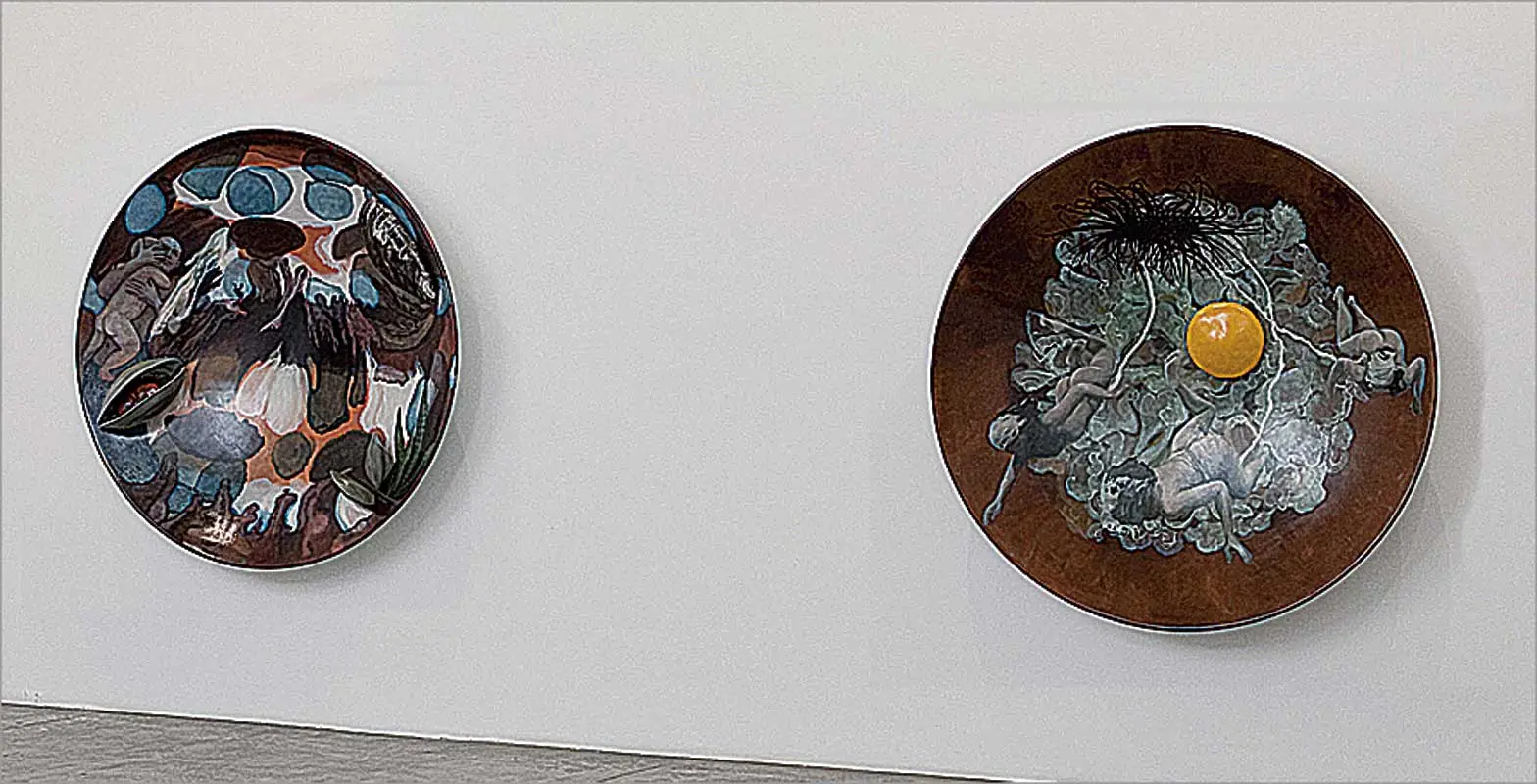
On another plate, Water Deity, a deep tempestuous sea-blue backdrop houses fish, a ray, anemones, and starfish towards the edges, while the center is occupied by furious waves which seem to be in the process of engulfing a boy of African descent with pigment discoloration on two-thirds of his body while his piercing eyes stare upwards to a mother figure, who seems to rise from the crest of the wave staring straight out into the horizon. The three-dimensional jaboticaba fruit hovering above the waves, some oozing a white flesh but otherwise seemingly unaffected by them, reverts the imagery to Brazil, perhaps to Iemanjá the candomblé goddess of the sea revered especially in Bahia. On the back, beige and brown primitive design after Brazilian marajoara ceramics. A rockier seascape on the third dish, Birth of Ondine, with encrusted mollusks shows a mermaid holding a human child while she looks over its shoulder. Below, one of the protruding mollusks is split open, which reveals an orange embryonic being inside, while on the back, a delicate floral print in pale blue contrasts with the savage iconography that confronts the viewer. In The Imperfect Pearl, the bright yellow egg yolk steals viewers’ attention until, while eyes travel away from the central iconic fertility reference, blind-folded nymphs float away from a large black sea-urchin-like form to which they remain connected by umbilical cords. With Little Castle, themes move away from sexuality, fertility, birth, and destruction towards a disconcertingly quiet scene of a sandcastle above which stands alone a black leafless tree, balancing poetically atop the fragile “construction.” The edges evoke an enlarged wooden peephole through which the scene reveals itself and on the back, a crackled plain white surface. Throughout this series, a dreamlike tone permeates all the iconographic scenes which seen as a body of work, seems to allude to a continuous re-interpretation overtime of the stories and cultures bestowed to the plainly shaped and globally recognized enlarged domestic utensils, which like any other piece of design or art, tells stories of its time(s) and context(s).
CAMILA BELCHOIR