Alberto Cavalieri’s sculptures connect his work with the discipline’s traditions, with techniques in the handling and transformation of metal—forging, foundry, welding—tasks that besides guaranteeing the desired result in the objects created by the artist, add the pedigree of a millennia-long experience, a custom linked to the world’s metalworkers and the founders of humanity, to the Gods of antiquity.
Creating three-dimensional works of art implies a particular discipline, demanding willpower and focus, skills that are needed to imagine and resolve them in structural terms; they require amplitude of vision to achieve a balance between the materiality and the shape that configures them while allowing the artist to reach the goal common to any creator: a response that coheres with his aesthetic notions. Confronted with the diversity of impulses present in contemporary art and the variety of materials and techniques deployed by artists today, this statement could refer to sculpture in any other historical period. However, it remains valid for a large number of artists who today work on volumetric form.
This brief reference characterizes the work of Cavalieri, a young contemporary sculptor who presents his viewers with an oeuvre that is dominant from the standpoint of its materiality and suggestive in its formalism, with the creative energy of the sculptors of the past. His most recent exhibition, Hierros y Epifanías—October-November 2009, at Freites Gallery in Caracas—makes evident that potential, the creative will that transfigures an idea into an artistic object.
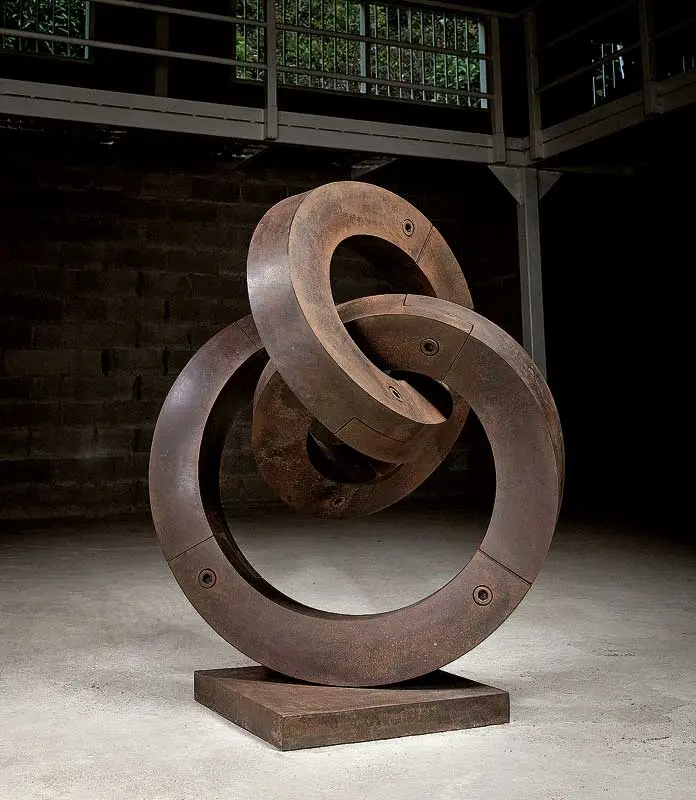
The title chosen by the artist for this group of works is not irrelevant here—an intention revealed in its design, in its tangible elements. Yet, beyond the mastery of craft and the support of the tradition, there is in Cavalieri’s proposal something of the organic element we find in the work of Jean Arp and also the three-dimensional creations of Max Bill, resolved like enveloping planes, like double-curvature surfaces; but, above all, there is something of the acting potency of Eduardo Chillida’s work in the 1960s, of those vigorous curvatures subjected to the will of a forced encounter that emerged from his twisted iron tubes. However, beyond formal references, what really connects Cavalieri with the work of these artists is a “theme,” a quest that belongs to modern art as it becomes contemporary, but is of particular interest to creators of three-dimensional shapes: the relationship between space and matter.
From that perspective, Cavalieri’s work responds to the trilogy of modeling notions in Twentieth-Century art: form and its interrelation with space as a response to a concept, and matter as support and expressive resource, three essential factors in our visual discourse starting with the avant-garde, three sets of issues connected by a single intent. Cavalieri’s iron works assume the organic as an identity despite their being non-figurative; they are defined by a starting point that appears simple, a knot, the formal difficulty that in the artist’s proposal becomes complex. From that articulation, the series radiates energy, a character forged in the alliance between spirit and matter and the way in which that intentionality and that physical reality combine, interact, and harmonize to conform an oeuvre where spatial values assume an equally central role in the configuration of the empty spaces that surround and penetrate it to mold its three-dimensionality.
Between those components there develops an intense relationship where each attempts to become dominant, an encounter that is almost a struggle, from which there evolves an autonomous objectuality, a totalizing solution that brings its parts into conciliation. The result, a series of artistic objects articulated by precise and cleanly finished pieces of cast iron, is characterized by its complex formality of elaborate curvatures, tense twists, and complicated knots, assembled until they give meaning to sculpture as an aesthetic phenomenon.
In the exhibition, alongside the “undecipherable” knots, the viewer is presented with other knotted works, static figures that however seem animated by an inner impulse. At times they are primitive reptiles dragging their heavy bodies with unexpected speed; at times, they seem to rise in the hope of ascending like gracile birds, but it is just an intention. Yet this failure of the will does not impact their appeal, concentrated on the ascending purpose of their conception. In other instances, the design prefigures movement, a growing need for space, a will to act that, without coming to fruition, is perceived by the viewer as such. Alberto Cavalieri’s work is significant already at the level of its concept, powerful yet friendly, structured and balanced as sculptural construction, beautiful and full of vitality as a visual object.
FREDDY CARREÑO