
Besides two prominent painters from the famous 1950s Generation who are still working today, Domingo García and Francisco Rodon, besides the phenomenal erotic/three-dimensional paintings by Cuban-Puerto Rican Zilia Sánchez and besides some works by Noemí Ruiz and Myrna Báex, it is this art critic's opinion that Arnaldo Roche-Rabell and José Morales are by far the two most important painters working in Puerto Rico at this time (Morales lives in New York). Why? Because of the power, the originality, the provoking images they capture in their works; because even as their works make no references to the many moments and/or artists from the history of classical, renaissance, modern, and contemporary art, their works are nevertheless unique, filled with visual possibilities and existential readings about the local – Puerto Rican culture/experience – and international life.
Arnaldo Roche-Rabell (b. 1955) displayed these qualities with his first important drawings and paintings from the mid-1980s. At that time, the young student of architecture was already more interested in the magic of the human figure, the male in particular, and in creating his own “mythologies” – fascinating and intelligent syncretic combinations in which he had already demonstrated an enormous aesthetic and ethical boldness and an innate desire/fearlessness to achieve with his paintings what he did not dare to carry out in reality: the erotic transgression in which skin/body/desire was always accompanied by nostalgia and nihilism very much his own. Roche-Rabell approached controversial themes in subtle but clear ways – racial, sexual, class, religious, and political themes.
Although many of us regard this period in Roche-Rabell’s work as one of the most original and interesting of his career, his work suddenly – always containing self-reverential elements in them – becomes a powerful and enigmatic reflection of itself. It is then that the artist paints two of his ten most important works: Hay que Sonar Azul (also known as Blue Eyes, 1986, Belk-Serapión collection), and Azabache (also from 1986, from the Collection Reyes-Veray).
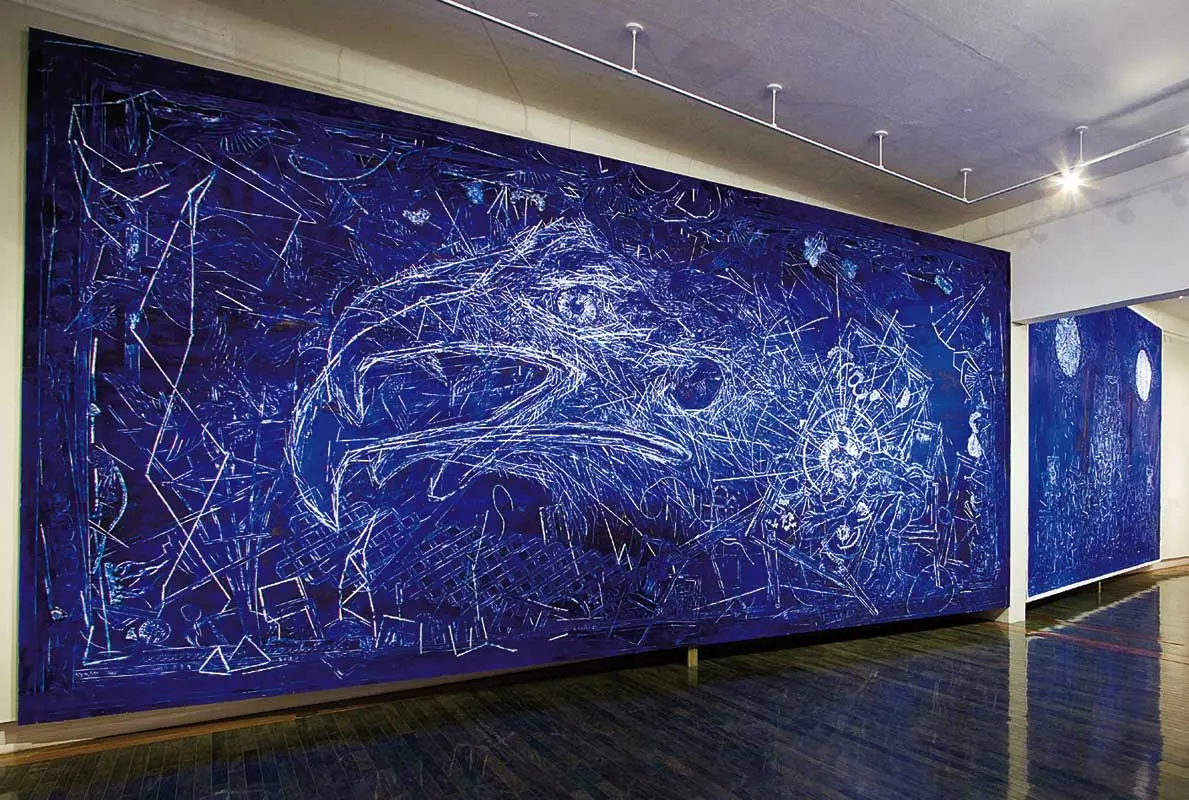
The exhibition – a quite poor and arbitrarily curated sort of retrospective that expects that we will come away understanding Roche-Rabell's brilliant career – begins with these two masterful works of art. The exhibition's central purpose – and a valid one – is to present to the public his "Blue Period," in which one is able to find the majority of the achievements, and misses of the most important themes, of that enviable artistic trajectory. Here we can observe his phenomenal mythologies to his flowers and more decorative organic works, his appreciation of Van Gogh to his political work, in which he attempts to capture both the Puerto Rico under Luis Muños-Marín and the other, the most terrible of dissolutions within this paradoxical society.
Although it is always gratifying and delightful to see Roche-Rabell’s work, after seeing the exhibition many times, to me, Azul appears to be an excuse to present the most recent works by the artist; that is, what he has been doing for the last four years: painting in blues, on white paper or canvas, the figures of his models, complex allegories, faces (coins?), eagles, and other images that immediately remind us of Ruben Darío’s Blue poems, Picasso's Blue Period, and even Yves Klein’s work. Nonetheless, we never forget that the images are distinctively his own – something any great artist desires.
An artist so well-known for the depths of his creative periods, Roche-Rabell would appear to be saying in this exhibition that he, too, can emulate what he has seen – or been told about, artistic endeavors presented as cutting-edge art across various biennials and important art fairs that are part of the globalized world. This does not mean Azul by Roche-Rabell is not, technically speaking, masterfully executed and that his boundless imagination does not play a leading role. But there are followers of Latin American art who question whether these “whims of fancy" are truly necessary for someone whose place in the history of Latin American art is already ensured. The works may remind some, aside from young artists in search of notoriety in order to become famous early in their careers, of the paintings of Iraqi prisoners by Botero, or the playful works that Liliana Porter has successfully been doing the past few years. But Roche-Rabell’s latest creations certainly cannot compete with the last period of Matisse's artistic life, when he was physically unable to paint and notwithstanding this revolutionized art more at that time than at any other time in his life.
Many of these works are original and attractive and achieve what any great painter wants: that his pictorial discourse becomes poetry. But an artist such as Roche-Rabell, who has already been at the same level – technically and thematically – as Van Gogh could not think that these new projections of the self that he presents in Azul – and there are good ones in the exhibit – could lead certain experts of Latin American art and of his career to wonder why the artist is painting only with blue, because they do not attempt to understand that perhaps these series represent another of the many mirrors Roche-Rabell has invented in his career – although not to such an extent in this exhibition. I think these works represent a transition or a search to find once again the painful/joyful autobiographical self, a transition that intelligently combines playfulness with the contemporary and the trendy. My words to those who wonder about this new direction: Roche-Rabell is able to accept/translate/redefine the ever-increasing freedoms of contemporary art and because of his great talent, we look back at this period of his career as an important one.
MANUEL ÁLVAREZ LEZAMA