
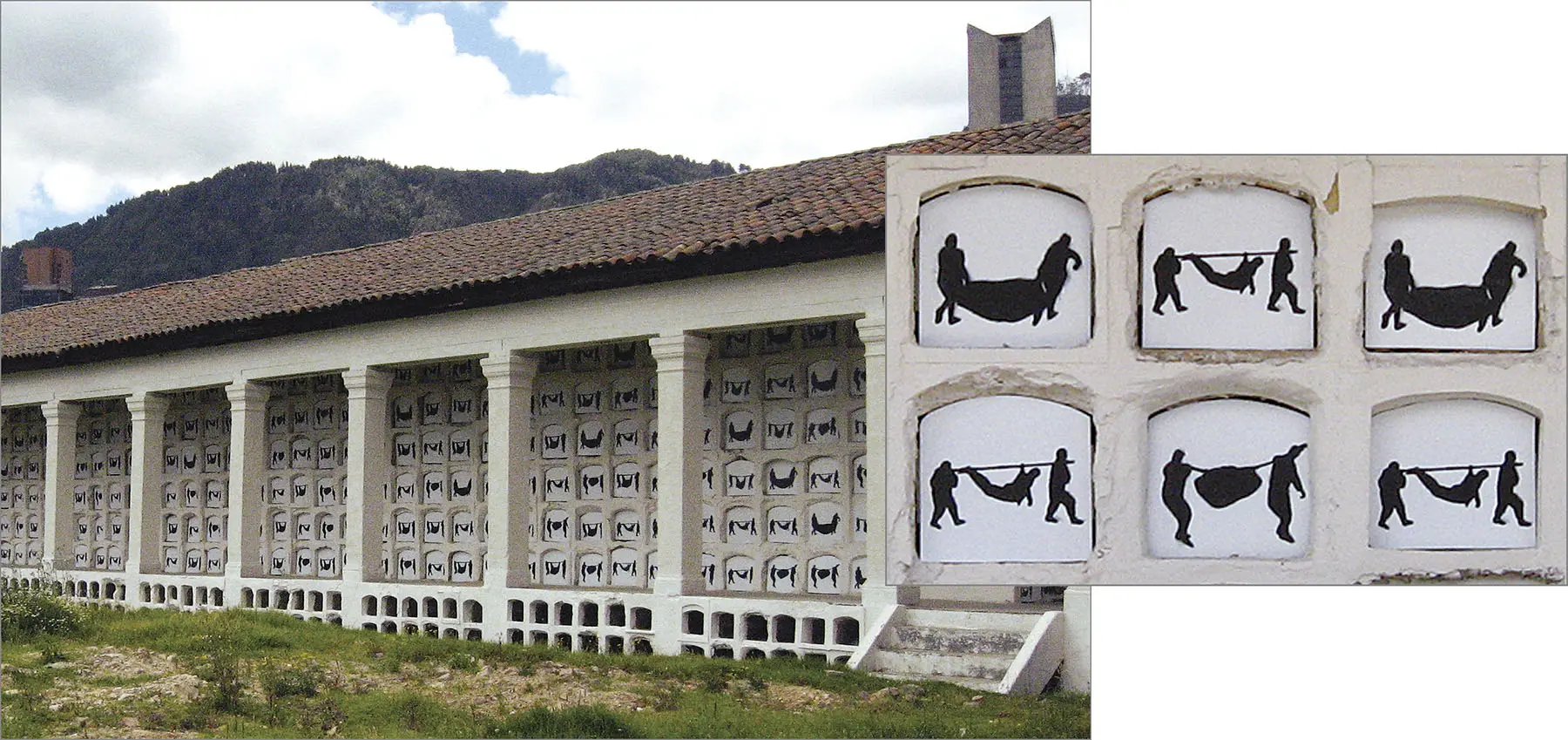
At the Bogotá’s Central Cemetery, specifically in the buildings known as Columbarios, Beatriz González has covered the spaces once occupied by gravesites with images that refer to the people charged with picking up the corpses of the war dead in various Colombian municipalities. The artist had already explored these images, which have circulated in the mass media, in a previous series of paintings and drawings. There she analyzed the features that could make them visual icons of Colombia’s historical present.
Close to 9,000 former graves in the old cemetery are now covered with those iconic images. When it was active, the cemetery held the dead from the lowest social classes, which connects its story, in social and political terms, to the corpses that today are picked up and carried—using hammocks, sticks, or plastic sheets—by peasants throughout Colombia. Beatriz González created eight matrixes that repeat numerous times to cover the 8,057 empty niches of the four Columbarios still standing in the Central Cemetery (in recent years, the city demolished two similar structures right next to the surviving ones). For the artist, infinite repetition is a way of updating things, bringing them more evidently into the present. The works installed in the Columbarios are silk-screens and the printed surface imitates granite of the kind used for tombstones. The images vary in size because the spaces occupied by the graves were not homogeneous: some were designed for adults, others for children, and others for mere bones. During the many years in which it functioned as a cemetery, the site was filled with rituals of grief on the face of death, and this intensifies the connection between González’s work and the historical context from which it emerges.
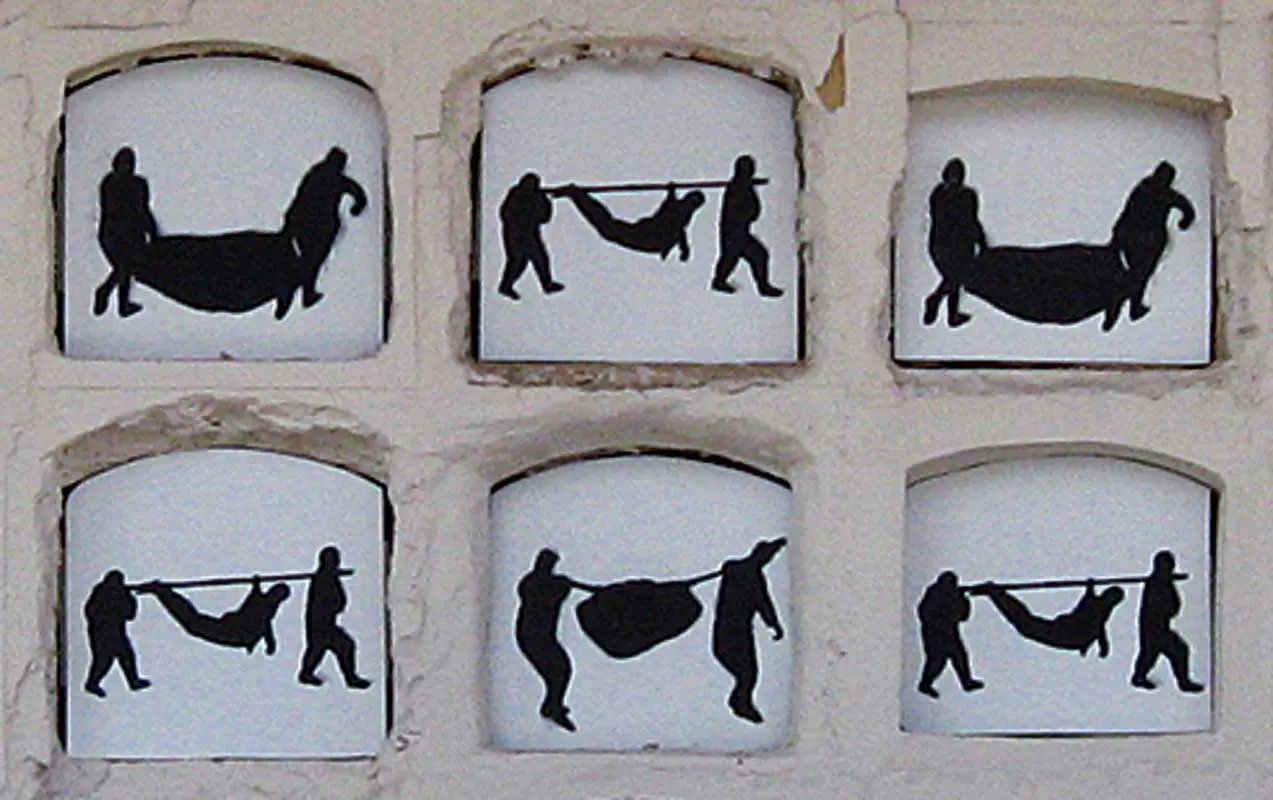
In this project, Beatriz González is interested in connecting the character of the print media graphic record with the preservation of an “aura”; for her, the “aura” is the trace of a person’s presence, which remains in place for as long as someone remembers them. This is why she wanted to use these iconic images to seal an empty site where absence meets presence. The title Auras Anónimas originates in this idea.
The linkage of artistic practices and the function of memory have had large repercussions in the contemporary art field, especially in the kinds of situations that some theorists, such as James Young, have called counter-monuments. The conventional relationship between art and memory was for centuries tied to the practice of erecting monuments, which basically consisted of delegating the task of remembering on an inert object. Monuments were situated in a specific place within a city and attempted to demarcate this place by making symbolic allusions to an event that could be connected to its meaning or use. They tended to be vertical and descriptive and were placed atop pedestals in order to emphasize the distance between the physical space and the space of representation.
Shifts in the meaning or use of cities themselves gradually eroded the meaning of monuments; in the case of Bogotá, this has resulted in a condition of nomadism for many of them. As a consequence, we could say that the conceptual dysfunction of monuments has fostered forgetting.
Given this, the question that arises regarding the relationship between art and memory is whether it makes sense for a cultural signifier commemorating human events to remain immutable. The category of the counter-monument is an answer to that question. It attempts to negate the illusion of permanent memory that monuments prefigure and implies a logical inversion of their mechanism so that works are posited, from their foundations, as activators of memory rather than its replacement. This is why they don’t tell subjects “what” and “how” to remember, but simply propose a situation that allows them to establish a transversal link with events of which they may already possess a shard of memory. As Beatriz González points out about Auras Anónimas, it is not a question of explaining the “truth” of the past, but to unveil the gap between that past and the present it informs. It is with that purpose that she uses the strategy of repetition, mentioned before. The traumatizing experience of witnessing an infinitely repeating episode is complemented and intensified by the experience of traversing the elongated, narrow pathways that surround the four structures on which the work is placed. The movement of viewers in the installation seems to echo the silent march of peasants endlessly carrying the dead, imaginarily projected from the icons that form it.
The political direction of a type of art that seeks to respond to and repair the symbolic effects of the use of power is expressed, on the one hand, in the confrontational terms with which the practice is often identified (such as the very idea of counter-monument), and, on the other, in the interest for expanding the present so that it evinces a reflection about its own occurrence (as Beatriz González proposes in Auras Anónimas). Counter-monuments bear cultural witness to events that cannot be narrated, or at least not in the way they came to pass. They function only as mechanisms for people to act, remember, and take a position.
A key issue in Auras Anónimas, derived from its activation as a counter-monument, is the historical and cultural significance of the site, a cemetery for over 100 years and now long-debated in terms of its future function in the city. Beyond its architectural or patrimonial value (in the conventional sense), what seems most important is to revisit the grieving that has accumulated there, and the symbolic traces such grieving has left behind.
In 2003, the Bogotá municipal government held a seminar titled Arte, memoria y ciudad, proposed by Doris Salcedo and Beatriz González, where the future options for this site were debated; the notion was presented of creating site-specific art projects, temporary in duration, that could explore its meaning. That seminar, whose participants included Carlos Basualdo and Salcedo herself, is the most important precedent for Auras Anónimas. The intervention has been open to visitors since September 22nd and will remain open for three years.
JAIME CERÓN
Art Critic.