
Along with Aaron Salabarrías, Ada Bobonis, José Jorge Román – and joined later on by Allora & Calzadilla, Chemi Rosado-Seijo, Ignacio Lang, Arnaldo Morales, Rabindranat Díaz, Ramón Berrios, Javier Cambré, and Jesús “BUBU” Negrón, to mention only a few – Carlos Rivera-Villafañe (Ponce, 1966) is one of the original artists of what would come to be the very important 90s Generation, a movement that truly internationalized Puerto Rican Contemporary art. But aside from being the "founder" of an artistic current, Rivera-Villafañe is also one of the best and most respected artists in Puerto Rico. From very early in his career – by the end of the 1980s – he became the true visual chronicler of the constant violence on the island that we call "The Island of Enchantment."
Rivera-Villafañe was raised by a family of veterans from the Korean and Vietnam wars – as U.S. citizens, Puerto Ricans must fight in any war in which the U.S. is involved – and has been surrounded by violence of all types: drug-related, domestic violence, and the verbal/existential political violence stemming from the radicalized internal divisions deriving from Puerto Rico's status as a U.S. colony. Puerto Rico’s status as a U.S. "free associated state" – an invention of Luis Muñoz-Marín – is nothing more than a Disney-like fantasy that ceased to work decades ago.
From his years as a student at the Escuela de Artes Plásticas de Puerto Rico, Rivera-Villafañe began to combine, through his art, his existential reality, his horror-filled surroundings. He accomplished this by relying on (what later on became to be known as) a Postmo-Pop filled with pain, irony, and parody that create a very provocative brand of dark humor.
As expected, his discourse at first was rejected by visual art lovers and rich collectors – one collector was forced by her husband to return Cristo Aterrizando, one of Rivera’s best works from the 1990s. But later, people began to take note of his talent, originality, and daring, and understood that Rivera-Villafañe created incredible radiographies/scenarios about what had become a daily reality in Puerto Rico. The young artist had demonstrated to them that art, creation, and the aesthetic and ethical discourses are a way of life. At that moment, his role was to open the eyes of people who began to remove themselves from reality and live in gated communities and neighborhoods with limited access.
Rivera-Villafañe’s first important exhibition was in 1990. Titled Pintura Local, it included a very dramatic series named Relatos de Delincuentes y Víctimas (Accounts by Delinquents and Victims). Then, he presented the exhibition that would transform him into one of the most important artists of his generation: De Cacería (Hunting), where he showed paintings as important as El Punto (The Point), a depiction of a "duel" between a blue and a red demon at a drug pick-up point; Descenso de Cristo (Descent of Christ) and La Casa en Llamas (The Burning House) – all of which deserve to be in a museum. Then came his incredibly original installations, one of which was exhibited at the Museum of Contemporary Art in Puerto Rico and later, taken – by this critic – to the Lima Biennial; it consisted of an interactive installation in which one would take a snapshot with a Polaroid and would then shoot oneself with a real gun in order to "kill" oneself. In 2001, in another installation, Bullet and Trajectory (2000-2001), he used an entire exhibition room at the Museum of Art in Puerto Rico to present gunned down "dolls" filled with bullet holes. He also does highly crafted engravings – xylographies – such as the image titled Pecado Clásico (Classic Sin, 1997).
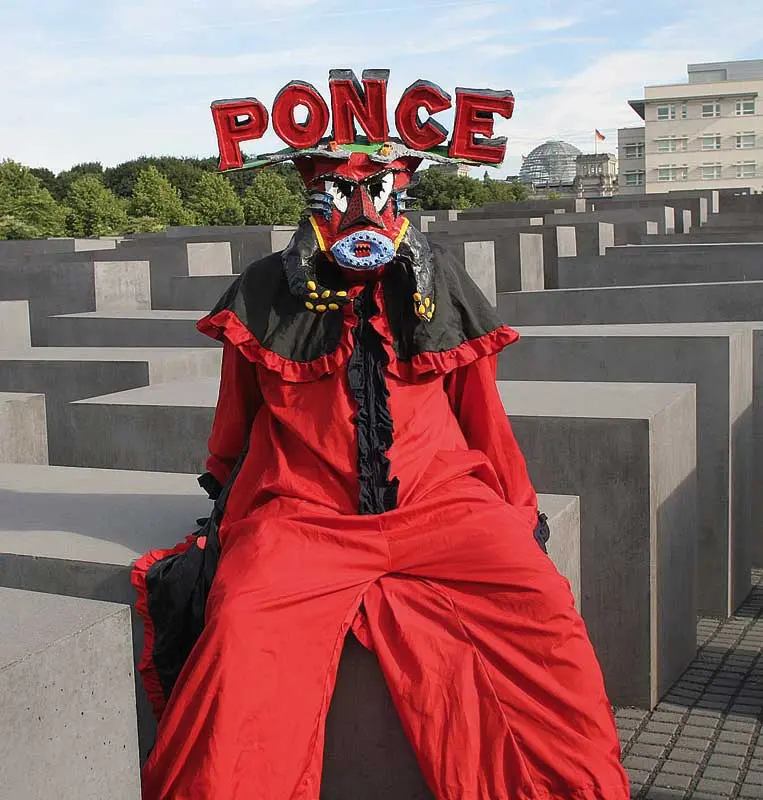
The recent exhibition by Rivera-Villafañe titled De Ponce a San Juan, which was first shown in San Juan and will soon travel to Ponce, contains an interesting group of paintings, mixed media, three-dimensional pieces, and/or installations and photographs in which the artist effectively combines the iconography that has defined his career since the end of the 1980s. For one, this is an excellent exhibition because Rivera-Villafañe has been able to utilize "new" media, such as graffiti and the cutting-edge Pop, in a new, eloquent, and provocative manner. In this exhibition, he would appear to be saying to the public: this is part of who we are, a country filled of wonders, but one that is also plagued by injustice and contradictions; a rich country if compared with the remainder of Latin America, but sometimes spiritually poor and desolated by consumerism; a country that never stops partying but one that is eager to understand its identity. It is not that this artist, who has spent 21 years of his life teaching art in public schools in Puerto Rico, does not believe in his people, but it pains him to see them suffering, lost, and completely alienated. There are three "new" elements in these works: The Virgin of Guadalupe; the Letters that spell Ponce – the artist gained great notoriety with this public art project because he created a huge, Hollywood-style sign with the name of the second largest city of Puerto Rico written on it; this project gave a new an identity to Ponce, as well as something to be proud of and happy about – and last, a Vejigante, a carnival character of Spanish and African origins that is very dark at times, but that also becomes kind-hearted and generous. This creation appears in photographs in the least likely places and physically inserts Rivera-Villafañe in the middle of his work– à la Hitchcock.
A good artist does not completely recreate reality; a good artist communicates the essence that surrounds him, interprets it, gives it new life. In fact, a good artist is an inventor of realities that already exist, and Carlos Rivera-Villafañe is an excellent artist.
MANUEL ÁLVAREZ LEZAMA