
Early in his career, Diego Fernández (1973) immigrated to New York. After living there for ten years, many achievements, and an artistic language so dynamic and unsettling that carries a gamut of meanings, he continues to look back at his place of origin. He constantly refers to Chile, like spying through a keyhole. In his last solo exhibition in Chile, his humorous and perverse approach can even be read in the title: Two More Tumors.
Video, performance, music, drawing, painting, sculpture, photography, and collage: Everything fits into a proposal also characterized by its duchampian and surrealist strategies, by its sarcasm, anti-sophistication, and a certain punk spirit. With all of these epithets, he cannot avoid conducting an ongoing dialogue with the endogamic, academized, and individualist Chilean art scene, to which he owes his rebelliousness.
Fernández has always reacted to the state of Chilean art. From the time he emerged as an artist within a context of market and recent democratic aperture during the mid-1990s until, during that same decade, he relocated and established a Chilean outpost in Brooklyn, along with other recognized authors from his generation, including Iván Navarro, Ian Szydlowski, and Felipe Mujica. Before leaving Chile, he founded the Galería Chilena with Mujica and Joe Villablanca, a nomad, autosuggestive, and marginal project; a response to the fragile cultural institutionalism. With his colleagues in New York, he runs Instituto Divorciado (ID), a collective artistic initiative to support "pseudo-ephemeral art events and their discussion."
I have with me a "book" printed on copy paper and loose pages, titled Miroslav Holub. Síndrome del Pulmón Evanescente, which Fernández reissued without permission. It contains poems by a Czech immunologist who died in 1998 at the age of 75, and who was well-known for his wit and irony. Developed at ID, the book integrates photo/graphic images from guest artists. Fernández gives away copies at events such as the 7th Mercosur Biennial in Porto Alegre, Brazil. Some of this same choreza (defiant attitude) – as we would say in Chile to describe a way of barging in and making oneself noticed – also exists in this exhibition that opened between December and January.
At the inauguration, Fernández performed Generación de Mierda (Generation of Merde), in which – to the rhythm of an electric guitar and a fist striking the chest – his hair and beard were cut by two gallerists with sharp scissors, which had some people smiling nervously. There are two exhibition rooms with a series of "paintings" or drawings populated by a human, animal, and objectual forms that are intertwined, such as cultural, social, religious, and mythological symbols that emerge from a sort of automata line, in scenes worthy of a delirious comic. The caricatures – photocopied, colored, and enlarged to reveal the failures of the system – were also veiled with flat colors and varnishes to give the effect of poor lamination. This is how Fernández addressed the fears that "move history forward" to the edge of what is archetypical in Chile: the fear of oneself, of being discredited, fired, exposed to new things, to sex, and to the origin.
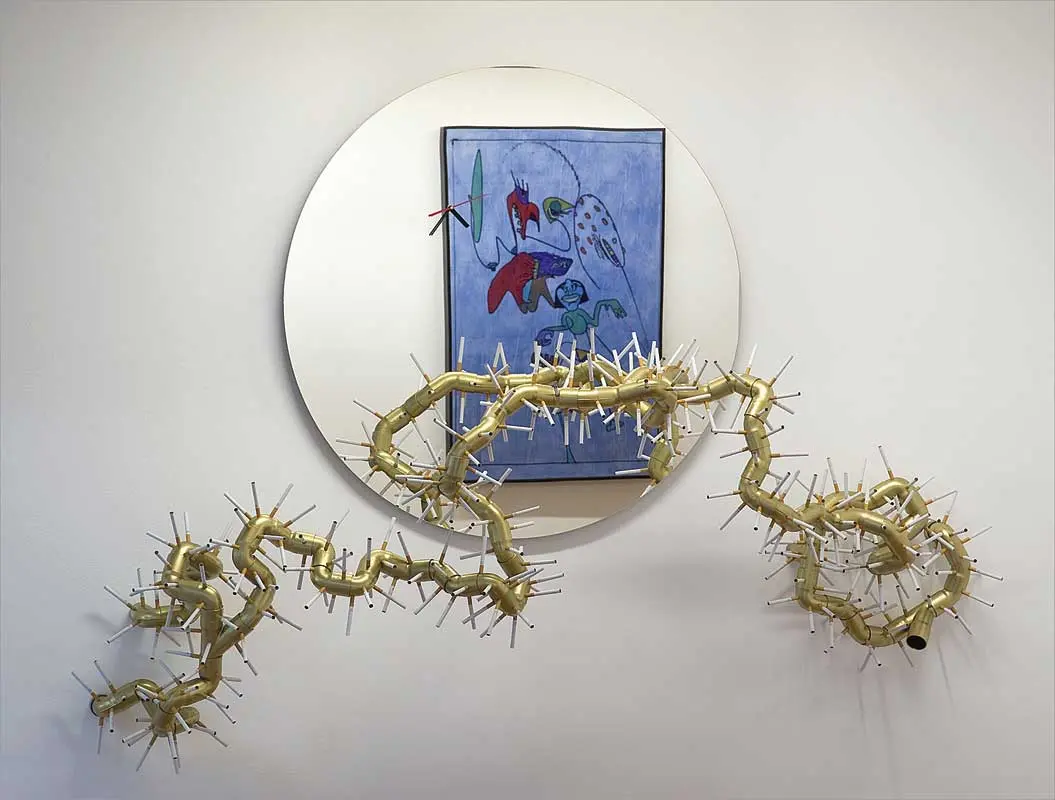
The exhibition also includes a wall sculpture, a large round mirror with two small hands that do not tell the time but that do mark the passing of time. Muscling in between this metaphysical contraption and the viewer is a sort of organic conduct fashioned with golden PVC tubes and 400 cigarettes inserted.
In another exhibition room, a mobile sculpture that reminds us of Duchamp’s onanist machine and represents a geometrically designed bird that bends down repeatedly to peck at something unattainable. It has a large, round, and transparent head that contains a black liquid. At the other end of the room, there is a video showing a pair of busy hands breaking eggs in a loop. There is also a series of snapshots that connect tasteless homemade photographs with superimposed objects such as nails, a cookie, a broken ampoule, and even spit. In the meanwhile, two collages, one with clippings of Lady Diana’s face and the other with legends from cigarette packs hanging in the office of the gallery, forming a cross that states in many languages: "Smoking Kills."
Fernández throws everything at you; his disturbing side and his ludic facet, a certain Eighties audacity, the memory of his dead father, a look at art, the cultural tensions of his time, rage, mockery, the fear of pain, and the desire for redemption. What appears to be a difficult encounter between different – or rather disparate – elements is an attempt at order after the chaos, but, a personal order. This sensation of homemade ingenuity that manages to avoid the incongruity of signs creates an even more skeptical space after the anarchic scream within the context of a country silenced by the powers controlling its history and that has surrendered to a "toxic" lifestyle, a situation that after all could very well be global. If (Chilean) art cannot express more, do more, extend from its enthroned cubicle, then this explains the furious outburst of the surrealist punk expression – and the absurdity of the attempt – in which fear and desire go hand in hand.
CAROLINA LARA