The work of Enrique Martínez Celaya is like a prophecy that burrows into the past in order to, from the hiddenmost corners of the soul, discover the future. The artist prefigures this and as such accepts his mission in the face of the creative act. A mission that implies an essential social commitment inasmuch as the revealer of anchorings for his contemporaries.
And in good measure, this is what art is. At the bottom, there are but two basic aptitudes regarding the creative act. The first, arrogant, centered exclusively on the self, seek an affirmation of the ego and the validation of the supposed genius from a platform of romantic complacency. The second, of a philanthropic filiation, rids itself of the limit-blindness represented by the egocentric gaze and focuses on Man as an ontological and social being. In this second creative line, we find emblematic figures in contemporary art like Joseph Beuys, Martin Kippenberger, or Hans Haacke, whose works have become an indispensable legacy.
Enrique Martínez Celaya’s approach to the creative act breaks through as an essential necessity that becomes catharsis, a purge that the artist uses as learning and reification. In this way, the existential reference rises as a symbol and starting point for a quest that transcends personal experience in order to embody the human and delineate new pathways.
When we contemplate Celaya’s oeuvre, we have the impression of witnessing an intimate confession whose profound sensibility provokes empathy in the viewer, demanding our most authentic feelings. Celaya’s enigmatic universe seduces the viewer who, captured by an unsettling dream-like world, ventures through new thresholds: fierce guardians of unsuspected passageways, not devoid of risk.
This past winter, the Boca Raton Museum, in southern Florida, gave us An Unfinished Conversation: Collecting Enrique Martínez Celaya. The show originated from the private collection of filmmaker Martin Brest, reveals the versatility of an artist whose multi-disciplinary focus implies the use of literature, philosophy, installation, photography, sculpture, and painting, all in the service of the singular cosmogony that is his proposal.
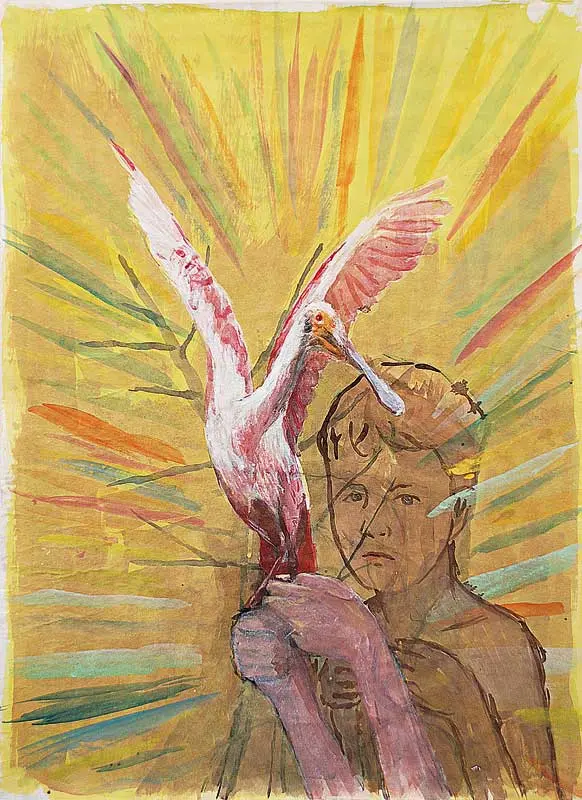
The show comprises nineteen works, representative of his production in recent years. In it, the viewer will be able to enjoy the epic dimension that distinguishes the artist’s paintings, as well the subtle, almost intimate dimension of his watercolors, and even one of his emblematic works in bronze. The show explores essential topics such as memory, childhood, travel, exile, isolation, loneliness, and oblivion. These key topics have been a leitmotif in Celaya’s art, always interested in a desire to understand the human soul.
Perhaps this is what drives the artist through his exploration of the cycle. All of his works, conceiver as participative elements, are connected to a complex intuitive system where the ideas of cycle and interdependence are key. Celaya’s production partakes of a kind of echo: painting is only fully understandable through poetry; poetry, in turn, through photography; photography, through sculpture; sculpture, through his books; and so forth.
This chain of causalities connects to the philosophical notion that animates the artist in his perpetual quest for pathways and alternatives for Man. An ascending and recursive chain, one of whose ends meets the viewer who threads here and there, while the other goes further and further back in time—a promoter of new meanings—and comes to rest on the artist’s own biography.
Born in Palos Cuba, in 1964, Enrique Martínez Celaya left his native country while still a child. Feelings of abandonment and loneliness mark then his path as an artist, obsessing him when confronted with the creative act. Uncertainty thus becomes a kind of metaphysical meditation on the self—that accurate mirror of the other, embodied in the viewer.
Space acquires protagonic dimension in Celaya’s work. Open, giant, desolate, it rises as the essential location for his characters: always absent, like some kind of beings thrown into nothingness, in full existential recognition. We invariably witness a solitary figure whose age could be located in the transit between childhood and adulthood—that defining period of the search for an identity. The wide-open, astonished eyes flee into the distance, more interested in searching within than without.
The peaceable exterior becomes the antithesis of the turbulent inner world that overwhelms the central character and is transmitted to the receiver, now also in a state of expectancy. Before him, wide and vast, lies the landscape, a sum of infinite possibilities. Before us, the need to choose a path.
JANET BATET