
The title of Francisco Castro-Leñero’s exhibition El Rojo, el Negro y el Blanco (Red, Black, & White) gives spectators advance notice of the coloristic modulations of his recent work. Upon entering the exhibition room, one experiences the visual atmosphere, which is subtly warm and filled with solid colors. Such is the mood despite the diversity of personalities that logically register various degrees of expression. This Mexican artist has created the abstract expression of a structurally geometrical infinite that is also subtly lyrical. The warmth of the exhibition is attained through the abundance of various tones of red, the musical vibrations of each work and of the group of works, and through the syncopated museography that includes important spatial silences. If we analyze the concept of "solid paint," we will be able to infer the reason behind Castro-Leñero’s constant activity as a teacher, painter, engraver, watercolorist, and mixed media artist, while his usual supports are canvas and paper. Compositionally, the solid paint emphasizes the presence of a cared for, organized, moved, imprisoned, and freed materiality, which is treated as a language and not as an element of any particular artistic current in the history of art.
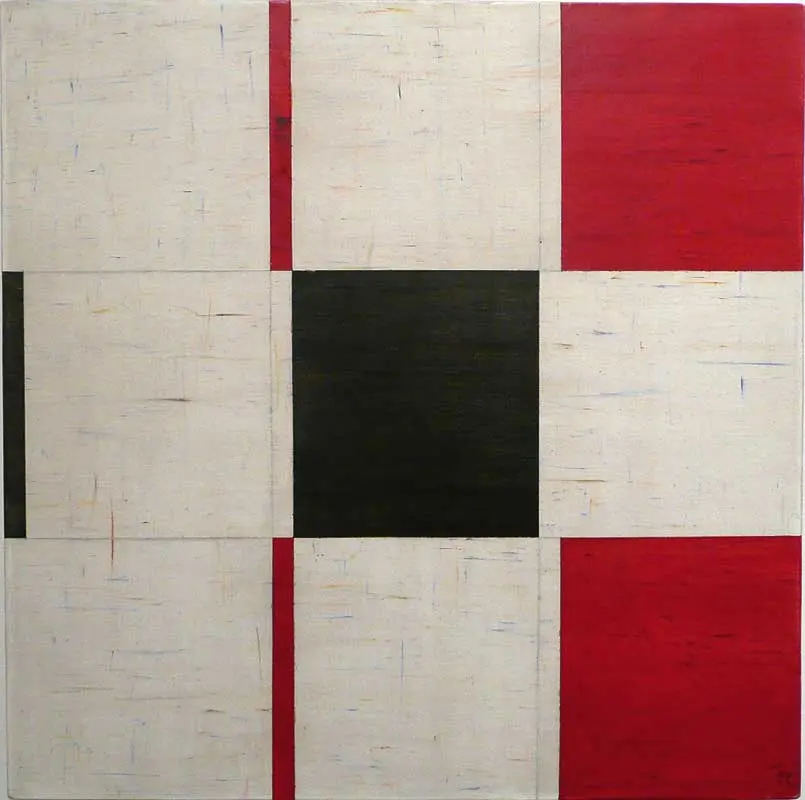
A third element in the work of Castro-Leñero is alteration, intentional modification of the apparently foreseeable that is the key to the unity of his work. The created and thoroughly worked up accident originates in the author’s ludic restraint. It is not all rigor, nor it is all expressionism. The acrylic germinates on the canvas. There is a defined field – each work, the measurement of the paper or the stretches that tighten the canvas. A line, then another, and yet another fall on the abysmal surface. Organizing the territory is calming; it curbs reflection and nourishes the gaze. The stretchers are thick and well-constructed; the artworks are not framed – because this would interfere with this particular type of aesthetic. A gaze from afar would suggest a geometrical painting – flat and energize by the contrasts in color. A closer look reveals a richer reading. There is no denying that drawing plays an evident role in Castro-Leñero’s paintings and engravings and that the colors are very elaborate. A range of ochre, yellow, mustard, blue, and brick, among other tones, interacts in works that from a distance appeared to be created only with white, red, and black. This is Castro-Leñero's fourth exhibition at New York’s Howard Scott Gallery. Here, in 2006 the renowned painter presented the exhibition Suite Rembrandt, an exploration of the tonalities used by the Dutch master. Castro-Leñero has been enthusiastically immersed in this study and, as a result, has developed a type of abstraction that is different from that being created in Mexico and one that has stood out on the many occasions he has represented his country internationally.
With his work Blanco sobre Rojo y Negro (2009), Francisco Castro-Leñero alludes to the profile of painting in the traced incisions that act as containers of erudite wealth. If instead of being only one canvas, this (80 × 80 cm) or the remaining works (smaller and larger), this consisted of several blocks of canvas or wood – a polyptych, modules, or secret doors – and would show the front and the profile of objects. In this and other exhibitions, this artist toys with the serious implications of the adult ludic world. He involves the spectator in diverse and endless games that promote mental health and antioxidants for the brain. The so-called "book covers" also insert the dichotomy of the game and reality: they are sectors that are too thin to pass for profiles of the blocks; they are much thinner than the profile of the works and lead to other options… Are they, or could they perhaps be, works with profiles that are much thinner, that is, books with thinner book covers? We come out of the painting, emerge from the magnet it generates, we are back contemplating the entire image, and here is the total and there are the factors.
A theoretical dismantling would lead us to associate Francisco Castro-Leñero’s work with Richard Rorty, the philosopher who as a young man was surprised when he learned that philosophical problems are transformed, created, or eliminated when new terms or resources are introduced. The artistry of this painter is at the service of the senses, of something primitive and certain that lives in his work. Painting is concerned with a gesture, but this can only be revealed once the intimacy of the experience is achieved. These are not explicit works; they grow in-depth as one spends time observing them. This is how Castro-Leñero conveys his not so obvious membership in the creative well of his ancestral Mexico.
GRACIELA KARTOFEL