For his first solo show in Paris, Gerardo Suter (Buenos Aires 1957 and Mexico) decided to present a selection of sixty works, videos, and photographs dated between 1983 and 2009, with the city as their main theme. We imagine that for this artist, focused for a long time on the human body, the city with its scars, wounds, and sores resembles, metaphorically, a living body in which the passage of time is superimposed and confronted. Between an end and a new beginning, the city doesn’t die but is transformed. It gets rid of its ruins and is reborn. In its history, the past evolves day after day and changes its meaning.
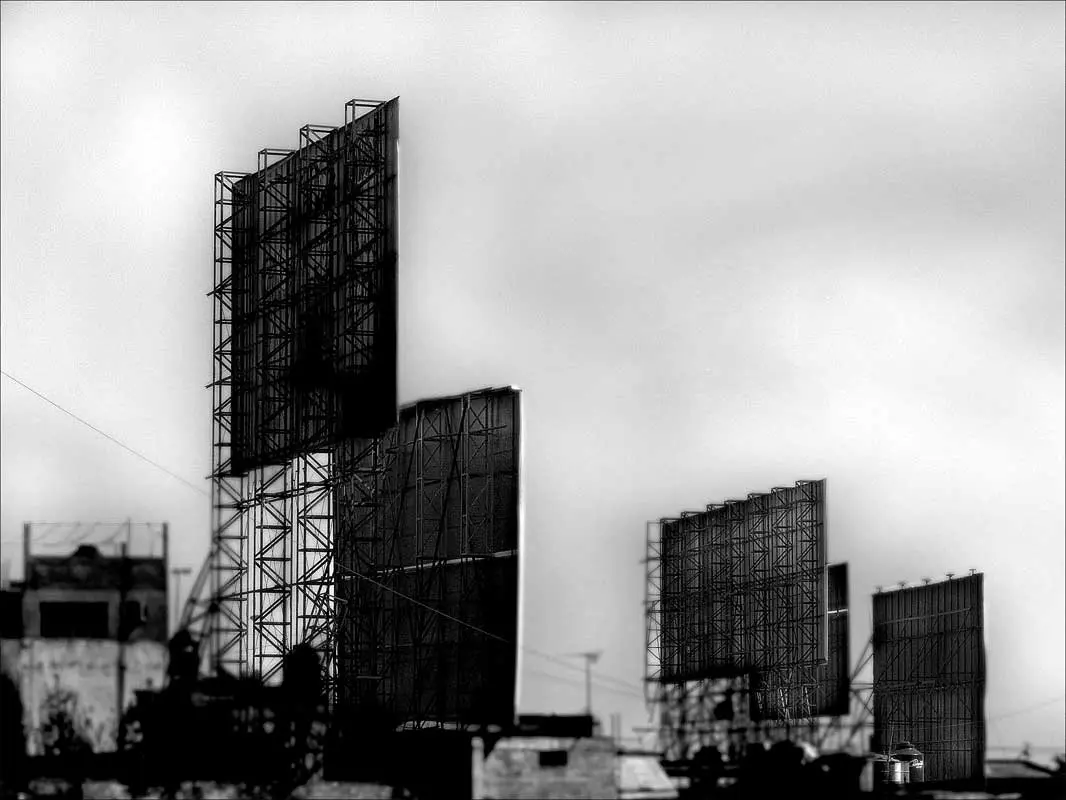
Suter’s goal is not to make radiography of the city in order to catalog its cultural strata. He is interested, rather, in the permanent sway of construction-deconstruction. He apprehends transitions and displays atmospheres more than realities—atmospheres where human beings are absent. In a series of photographic documents and videos, mostly in black and white and alternating with texts, the issue for him is to emphasize the different points of view of the city, but always from the angle of the transitory, the ephemeral, the undefined.
In the first gallery, the photographs (Penúltima región, 2009, inkjet on paper and acrylic protection, 100 x 200 cm and 50 x 100 cm) show the city in construction, finished or unfinished, and present its real shadows (through the subtle superposition of images and overprints), its phantasmagoric shadows, its strata, a kind of irregular and dense quilt. For Gerardo Suter, the city is a place of transit and has no permanence. His aesthetic sensibility is marked by a rather somber vision; his photographs are not intended to seduce but submerge the viewer in uniform, almost extemporal urban landscapes where points of reference are scarce. One photograph, however, stands out from the previous group. It depicts a heavily scaffolded cathedral’s belfry (Catedral, 2008, inkjet on cotton paper, 240 x 80 cm) on which different times are read and deciphered on the interweaving of one upon the other, where superposition induces disappearance but also re-creation. The video Primer cuadro (3’30, Mexico, 2009) shows the Mexican capital from its historic heart, the Zocalo square. In a kind of parade on air and ground, the images allow us to see a naked Zocalo, a city of tightly wound chain mail, with breaks and lightning and shadows, all accompanied by metallic noises. A city that is fast and slow at the same time, a city whose life is transitory.
In the second gallery, two videos display two visions of Mexico that confront and complement each other: the 2004 construction of the Second floor of the periférico boulevard and the destruction during the 1985 earthquake. The first video, titled Horizonte DF (7’10, 2008, black and white video) is a series of vistas of the city that parade from the periférico. Suter designed two spaces for the projection of the same image: large, on two walls, forming an angle; and small, on a flat wall, both images deformed in a triangular projection. These two visions of the same image in succession increase the vertigo of our gaze upon the chaos of the city and bring forth speed as an element of destruction. The video Réplica (black and white video, 5’40, 2005) is comprised of archival images of the September 1985 earthquake, still or animated images, according to negatives, superimposed as the crumbling down shows. Carlos Monsivais’ text plays here a key role (“collage of voices, impressions, sensations of a long day”) and creates a climate of panic reinforced by a high-pitched, rather monochord sound that is heard through the entire video. Across from these two videos, several black and white photographs on the topic of anonymous buildings in a variety of perspectives, like immobile guardians between construction and destruction.
The necessary transition is not that difficult when, on the second floor, we find another set of issues: archeological sites. Indeed, in the series New Mayas (black and white videos, 2006), comprised of a collage of images that juxtapose and confront the old (Frederick Catherwood’s engravings and photographs by Alfred Percival Maudslay from 1890) and the modern (vistas and colors from today’s Maya country), Suter remains faithful to the same spirit of oscillation between two dialectic and indivisible times, as he is in his simultaneous use of document and reality. In several photographs, the vacuum appears to be Suter’s true topic, since the architectural or sculptural element is now secondary and used only to emphasize that space in its majesty, making however its final reading possible (Enfoques arqueológicos, 2008, inkjet on paper and acrylic protection, 120 x 120 cm and 100 x 100 cm). Suter’s last appropriation of an archeological icon, the Aztec calendar, (Anónimo, 2006, inkjet on transparent acrylic, 220 x 300 cm, in three panels) closes the show, emphasizing the image’s mirror effect, which is the fundamental spring of the artist’s conceptual and aesthetic discourse.
CHRISTINE FRÉROT