
The show Gordon Matta-Clark: deshacer el espacio opened on December 9, 2009, at the Museo Nacional de Bellas Artes in Santiago de Chile. Curators Tatiana Cuevas (Museo de Arte de Lima) and Gabriela Rangel (Americas Society, New York) did an outstanding job in enabling with great efficacy two systems of articulation for the exhibition scheme, horizontal and vertical.
A transcendent circumstance lies behind the presentation of this show in this particular place, the Museo Nacional de Bellas Artes. Deshacer el espacio takes place at the museum’s Matta Gallery, whose construction began in 1971. Roberto Matta visited Chile to attend Salvador Allende’s presidential inauguration. The museum was being renovated at the time and Matta took advantage of the opportunity to have the plaster workers build arpillera canvases to be covered with clay, plaster, and straw, on which he would paint. Which he did in the museum’s main hall. Months later, Matta-Clark did a paradigmatic intervention in the same hall’s underground area. Father and son worked in the same space but didn’t meet. Where pére father illustrates the discourse of socialism, Matta-Clark critiques the notion of pictorial representation, intervening on the foundations of the very building his father’s social class had erected to celebrate one hundred years of its ascent to the helm of the Republic.
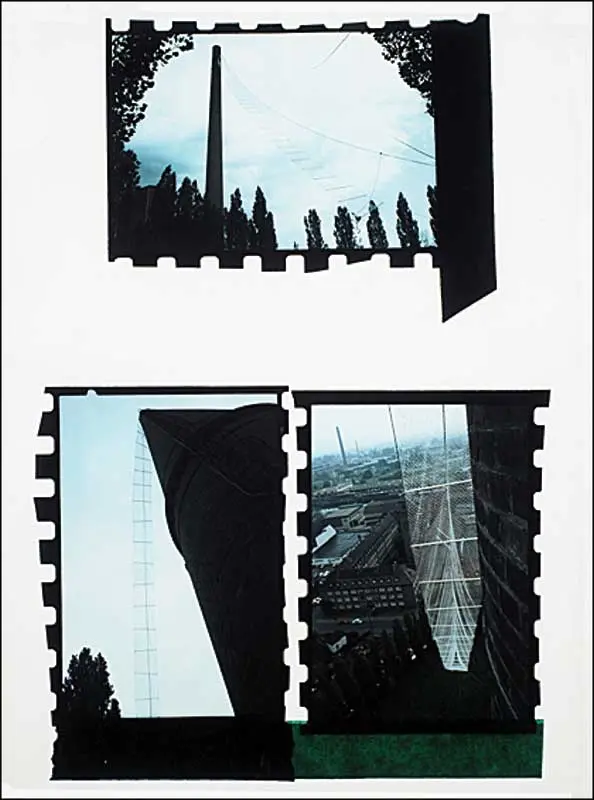
Tatiana Cuevas and Gabriela Rangel worked with this debate as to the basis of their project, cognizant of the fact that Matta-Clark’s growing prominence in the North American scene implies the de-activation of his most basic political postulates. In that sense, they recognize the referential importance of his intervention in the Museo Nacional de Bellas Artes, the first large-scale work where Matta-Clark’s attack on the Beaux-Arts architectural canon foreshadows his radical critique of the role of real state speculation in urban development, in a city—Santiago—currently subject to the determinant commemoration of that very same real state in the perspective of the Two Hundredth anniversary of that very same Republic. In this way, Matta-Clark’s show is an act whose political relevance is amplified by Chile’s own art scene, corroded by endogamy.
The first thing viewers are confronted with is a panel holding two works that connect the universality and the singularity of Matta-Clark's work. To the panel’s left, there unfolds the photographic record of the conditions of execution of Splitting (1974), which introduces us to a viewing of the large-format film—originally produced in Super-8 and later transferred to a 54-minute video—finalized in 1976. This is the starting point of our course through that universality, whereas the singularity referred to the MNBA intervention (1971) is arranged to the right of the initial panel, gathering six silver-gelatin prints of the process. The notes indicate also that these prints are a gift from Jane Crawford and Matta-Clark’s endowment to the museum. In that sense, the body of Matta-Clark’s work has been repatriated and is held in the same place that hosted it in 1971.
In the remaining sections of the show, there are two works that also focus our attention on their temporal and conceptual closeness to the 1971 intervention. These are Food (1972) and Underground Paris (1977). Two works that signal Matta-Clark’s interest in what today is called the production of citizenship, reinforced by a methodological gesture that brings him close to the excavation arts. This denomination was forged in 1971, during the Unidad Popular, and points toward revealing Matta-Clark’s Situationist position, a critique of the representativity of Oligarchic constructions. Later, this interest in the underground will point towards a reproduction of the infrastructural elements of the image of the body.
The initial panel and these two works link our horizontal course through the exhibit while organizing the strata of works that made Gordon Matta-Clark a central artist in at least three domains: structuralist filmmaking, body actions, and analytical cutting; this is to say, in the domain of the repositioning of the body through everyday un/narrative choreographies where the diagrammatic dismantling of living space, through the suspension of the home signifier, question contemporary art’s own habitability.
Thus, the initial panel reveals itself as an entryway distributing access to two nuclei of the work, located in the reverse, bringing to the fore two cubicles at the center of the gallery where the exhibition’s motor resides. At that point, the curators are proposing new approaches to Matta-Clark’s work, reshaping our understanding of its nature: first, works on paper; second, records of significant actions between 1971 and 1973. I will argue that they have privileged groupings of works close to the MNBA intervention, where happenings, performances, social-intervention initiatives on endangered communities are already present in parallel to the ink and marker drawings (Energy Forms) of 1972 and 1973, but which Tatiana Cuevas and Gabriela Rangel present emphasizing the autonomous dynamics of the flow charts as counterparts to graphic thinking programmed for the dismantling of those work habits and processes that legitimize borderline artistic practices—between art and non-art—where we can find, today, a certain minority platform for new productions of citizen subjectivities.
**MALI organized the show in collaboration with the Museo Nacional de Bellas Artes and Barros & Errázuriz was the co-organizer in Chile.
JUSTO PASTOR MELLADO