
Ritual of Passage is Jose Bedia’s first solo exhibition in Miami in the last two years. Made up of various series from 2009, he is showing the different concerns that occupied his mind during this period. The origins of some of these series can be traced to several years back, depending on how deep he has explored the subject. Among the latest is the one inspired by tribal textiles. It is no secret that Bedia approaches life as an anthropologist and as such he has amassed an important collection of ethnic objects. This series is a direct result of Bedia’s interest in these objects which, putting aside the purpose of study, are an integral part of his daily life. The main characteristic of the pieces in this series, and what distinguishes them from the rest of his oeuvre, is the colorful linear work in the backgrounds, mimicking motifs of tribal textiles. The vibrant and almost pure colors bring up the contrast with the protagonists: his usual black and defined figures placed in the first plane, almost like silhouettes.
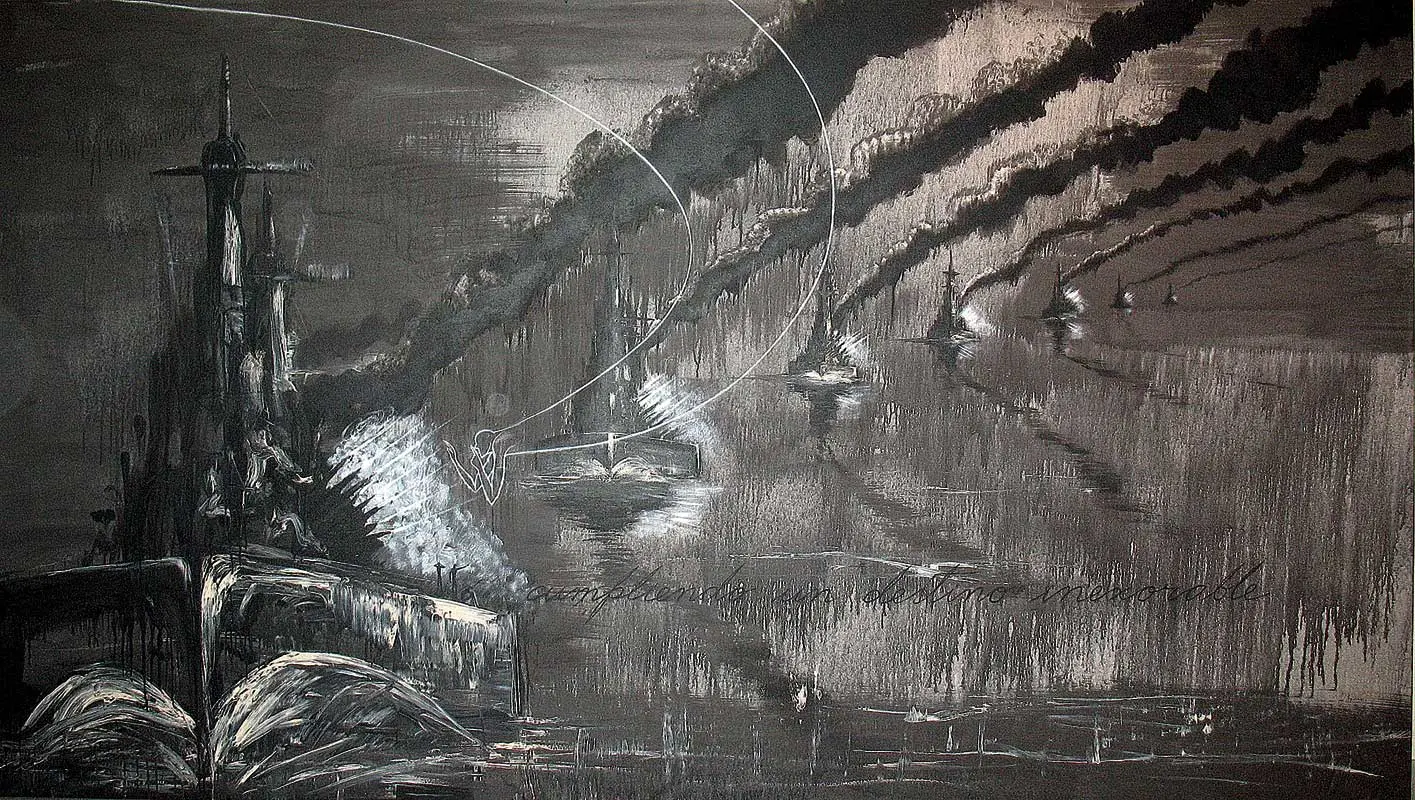
The more daunting pieces in the show are the group of “grey” paintings situated in a separate room. The dominant grey color sets a dark tone like a warning to what is about to be seen. The gloomy sensation is reinforced once we realize that the subject of death is present in an implicit or explicit manner in nearly all these pieces. He has been working for a couple of years in this “grey” series and it is perhaps the one that openly shows his deepest and more personal thoughts. There is an inherent fable quality in these works by using animals to represent humans. This is something that Bedia has been doing for many years since he began to represent in his paintings myths from different cultures.
The idea of sacrifice is embedded in these paintings through the killing of animals in a ritual way, like in Cuando no queda más lugar (When there is no other choice), one of the most painful images in this exhibition. Two animals of the same breed are side by side and the smaller is being sacrificed by the bigger one. Although only one is getting killed both are in agony. It is the killing of its own kind, a desperate act, a point of no return. In keeping with the fable attribute he is representing himself as a lion, sometimes wounded but strong and ready to attack. In Mano de Cobre and Dueño de los vastos espacios, the beast is sitting in a majestic way with a weapon by its side in the first one, while in the second is defending his space by challenging warplanes. The lion is usually seen as the symbol of strength and power but also carries within the duality of being both savior and destroyer. So we see the two sides of the coin: despite his strength, he is wounded literally and emotionally. The tormenting feeling of the scenes is clearly represented by the inner pain that makes him scream in agony.
There is another theme that we have seen emerging more than once in Bedia’s work, from his early installations in the eighties to the more recent warship series and that is war. He chooses massive pieces for it, creating an ominous atmosphere that can be intimidating, emphasized by the dark dominant grey color. There is an obvious sense of violence in these paintings besides the obvious representation of war as such. The sole inclusion of these warships is posting a belligerent attitude towards the world, conveying a defensive mode. The war theme is not only present in the grey pieces; it is also represented in the textile-inspired series. There is a forthcoming hostility in these paintings by representing warfare and warriors in several stages, always alert.
Although the pieces in this exhibition are somewhat different one from another, there is a common thread that unifies them, which is the sorrow represented in each one regardless of the subject matter. This is not a pessimistic view of the world but a soul-searching process. The title of the exhibition, Ritual of Passage, is a reflection of this state: an unavoidable ritual that one must go through to get to the next phase in life. In a sense it is like dying and being born again; it can be a religious act but it also can be just the need of finding a new path in life. Perhaps this is Bedia’s way of letting us know that he is moving in a new direction, that he has completed a cycle and is ready to jump into another stage. This is his rite of passage, through his art.
IRINA LEYVA