It is very clear that the most promising young artists in Argentina have been influenced by modernity in one way or another. This is demonstrated in the most recent works of Juan Iribarren, exhibited at the Faría Fábregas Gallery in Caracas. According to what Luis Enrique Pérez-Oramas once said, “it can be associated with one of the general tendencies in contemporary art, particularly in Latin America, and specifically in Venezuela: that which revisits, reconsiders, deforms, transforms, questions, or makes fun of the fundamentals and symbolic remnants of modernity.” We cannot delve into high culture themes such as, for instance, the relationships established by Mannerism between liquid and solid (Mannerists called it conglutinatio) excrescences. However, we may consider that the first tendencies toward modernity were, indeed, generated during that period and have continued to place their mark on art to this day to a greater or lesser extent.
It is quite meaningful that when first confronting the artist's current work, the influence that the works of Piet Mondrian have on Iribarren's taste and images is immediately evident. It is, nevertheless, a Piet Mondrian very much in the manner of Juan Iribarren, and very different from the Mondrian we all know: The difference is immediately clear in the palette and in the way Iribarren conveys the orthogonality that characterizes the work of the Dutch painter.
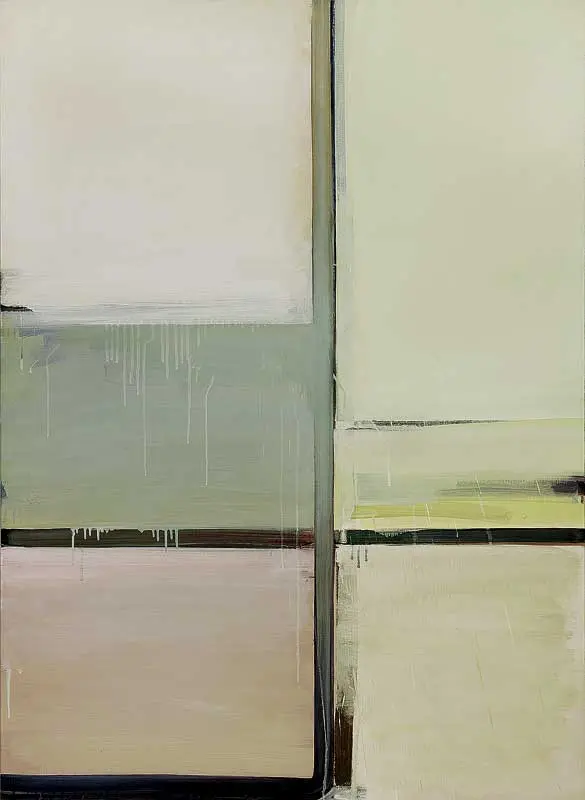
It appears that the artist does not only refuse to continue to use the canonic colors: red; yellow; blue, and white (or grey) painted behind the orthogonal grille of his better-known works (see Juan Iribarren, Editorial Goliardos, p. 12), but he has also turned his back on his abstract rationalism. He creates a deeply personal, coloristic version that is connected with his own experiences. Thus, the color appearing in his works supposedly derives from the reflection of the color emanating from one of his New York studio walls as it is reflected through a large window and changes according to the conditions of light in the city – not only during summer and winter but also depending on the hours of the day. It is a very warm palette that employs yellows, reddish-oranges, lemon-greens, or violets during autumn evenings, and cold pinkish grays, grayish whites, and blues at other periods during which the light – and therefore color – is colder. Fortunately, to clarify further the presence of that revealing window, Iribarren also has decided to show drawings in which the window is depicted without color, but in which it is clearly outlined.
His famous orthogonal composition with rectangular fields of color is the one element that initially and clearly reminds us of Mondrian’s work. But once we observe Iribarren's works more carefully and are able to attempt comparing the two artists, such connection becomes questionable. Iribarren’s fields of color do not only fill the confines of a cell (a consistent, clearly traced grille); they are rather sensitive lines, thick color brushstrokes more or less, that in some works are explicitly traced, while in others are washed to blend with the work’s overall texture and color, as the rendering in general works toward creating an active texture: evident and expressive brushstrokes that underscore their subjective origins.
It is noteworthy that although these fields of color derive from factual reality, they cannot but be the artist’s inventions – recreations, we might say – of something observed or imagined that are successful responses either of the artist’s state of mind at the moment of creating them or the chromatic requirements of the work itself. Some works exhibit an inclination toward expressive brushstrokes, while others are more impersonal. They change the light, they are elusive and represent a wonderful resource for invention.
This is the spirit of Mondrian, without a doubt, but transfigured in its essence. That is why work is innovative. All of Mondrian’s rationality is now transformed into an expressive gesture that is, nonetheless, restrained. The gesture expands without ever being out of control; it is sufficiently constrained to continue reminding us of Mondrian, but only reminding us. Working alongside the artist's personal impulses and the modernist logic is the mood that the different warm or cold lights penetrating through the window at any given time may confer upon each painting. The light must be captured instantaneously before it completely disappears until the next day, when everything would, once again, be different.
IRIS PERUGA