
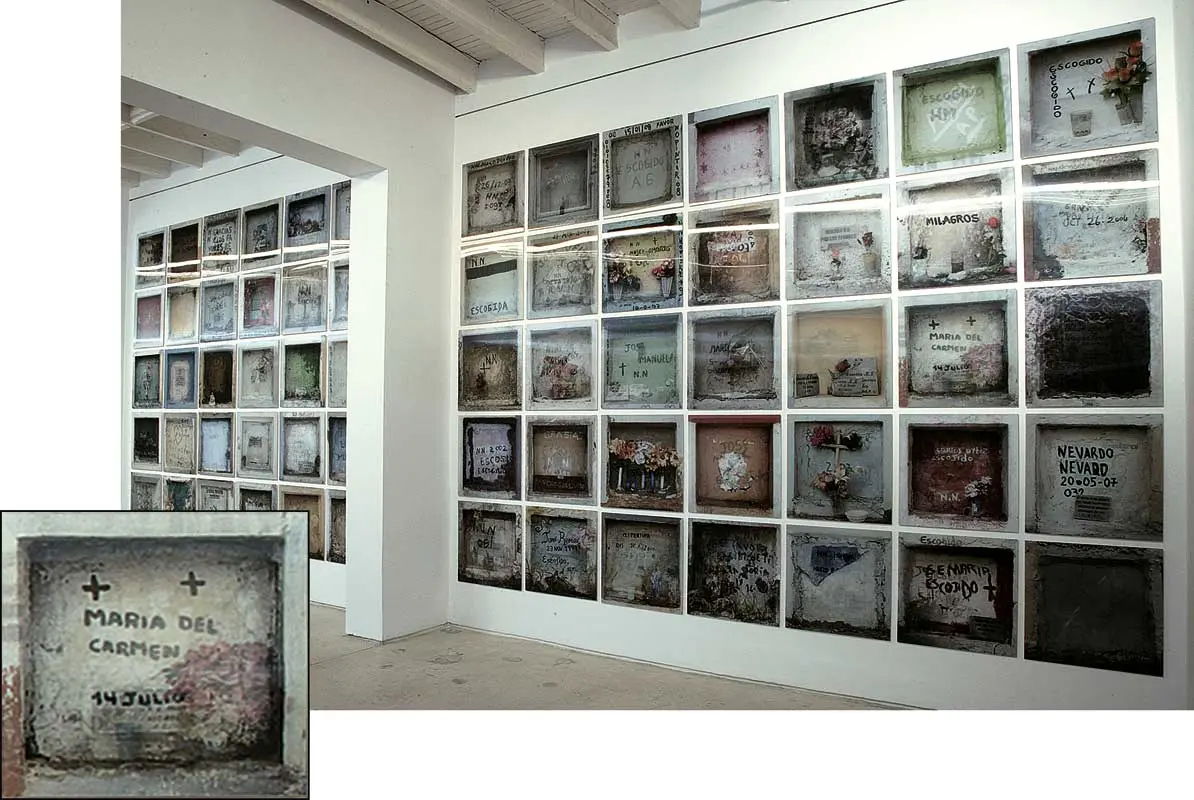
Réquiem NN, at Sextante Gallery in Bogotá, presented in 85 photographs that descent to Hades that Juan Manuel Echavarría began in November 2006, when he arrived at the Puerto Berrío cemetery. A phenomenon that is unique in the Middle Magdalena region takes place there: the graves of unidentified citizens (“NN” in Spanish), almost always taken from the river into which they are thrown to be eaten by fish and birds and interred by the authorities in a charity mausoleum, are adopted by someone from among the townsfolk. This ritual is connected to the midnight ceremony performed by the animero in the “Month of Souls.” The animero, dressed in black, opens the doors to the cemetery so that people can enter and accompany him in his prayers as he touches each tomb and calls upon the soul to come back among the living and help them.
Echavarría arrived in Puerto Berrío as another point in the path of the artist-witness who chose as his fate to follow the route of violence that remains invisible to the elites confined to the safe bubble of Colombia’s cities. In 1995, at the age of 50, when the literary fiction to which he had devoted his life appeared exhausted and all that remained was the forcefulness of his images, he found photography. From it emerged a perspective and a gaze on the indescribable story of violence in Colombia. But also an art that records—with a poetic sense that flows from life’s darkest corners—the many ways in which anonymous, marginal individuals confront death and engage in inadvertent forms of collective resistance.
Echavarría embodies a contemporary political art, devoid of discourse and ideology but filled with the incontestable register of everyday life, where, as Agnes Heller noted, there is another “mirror of history.” His penetrating gaze is transparent: he allows men and women to look at us through his works, and even animals (suffice it to mention the “almost human” eyes of the skeletal white horse in his photograph El testigo) and things (mannequins or bones) can contain the horror experienced, as well as reserves of a poignant affirmation of life.
We think of the collection of insects made by a group of kidnapped women, or of the faces and voices in the video Bocas de ceniza, gestated when Echavarría heard on TV the song of an Atlantic-coast man thanking God for saving him from a massacre; not only didn’t Echavarría rest until he found the singer but he was driven by his voice to seek out similar songs until he reached the Pacific, where he recorded another oral register of his country’s history. In those graves transformed into popular altarpieces with paintings, flowers, and sacred symbols and used to close the ritual of selecting one of the war’s unnamed victims to mark them as a chosen one, there is also—as the artist points out—“coral exultation, a requiem that rises collectively, a way to negate oblivion.”
Echavarría’s photographs document over time the way in which “the people select those ‘John Does’ and give them a name in order to present them with petitions, to symbolically exhume them and give them some form of life back.” This is to say, a form of religiosity in the midst of horror: while on the one hand miracles appear as the last refuge of hope, hope itself springs from a connection of solidarity with the dead. From compassion.
In Réquiem NN, Echavarría guides us towards an encounter with a naïve, primitivist aesthetic that, through floral offerings, the invention of names (such as “Jorge Luis,” “Carlos Mauricio,” or simply, “Mujer”), the adoption of affections (expressed by way of drawings of hearts and little flowers), and the confidence of requested and granted favors, transforms tragedy into a form of popular creativity. His role as a contemporary artist is not to generate but to note and highlight the immense visual poetry—and its life-restoring power—that for decades has grown on those graves, where we also find texts that play visually with space like constructivist poems: for example, by repeating the incantation: chosen one arranged horizontally and vertically. On the scratched-out NN acronym the name "archangel" is superimposed; and, by chance, the black text "do not erase" is reinforced with drippings.
The use of the lenticular technique through which Echavarría condenses two or three separate images in a single photograph of a tombstone enlarged to a life-size scale contains not only the symbolic allusion to each grave being all graves, and one John Doe every John Doe in the cemetery and the country, but also the possibility of recording temporal variations. In the seven journeys he has undertaken over the course of three years, Echavarría has been able to photograph what happens at several gravesites. Gratitude for favors granted after an “adoption,” changes in ornamentation, and even abandonment and new appropriations, christenings, or the inclusion of family members, reflect not only visual events regarding the adopted dead but the life of the townsfolk. “When I go to Puerto Berrío,” Echavarría says, “I stay there for hours, days, and I meet the owners and listen to the favors they have received from the dead. I listen to their stories.” He writes those stories in a diary, much of which we still don’t know. Réquiem NN is an open project with a visual aesthetics that emerged from the vast expanses of death, and he will continue to tell it “while the war continues to rage in Colombia.” Echavarría’s lenticular photographs capable of recording the story of these gravesites argue once again for art that achieves the meeting of the most terrible legacies of violence and the beauty of those collective gestures developed to confront and resist it. An antidote against the rivers of oblivion. A song to memory.
ADRIANA HERRERA