
Most of the time today, achieving an aesthetically sustainable projection in abstract art is a different challenge than that posed by figuration, since the latter offers an unlimited field of references that is difficult to capture when formal elements are intensified and concentrated into a visual language with autonomous values. A rather trite truth that also highlights the fact that figurative representation demands a more rigorous techné if it wants to find respectable compositional solutions, because abstraction implies a greater degree of intellectualization of the pictorial act, a more highly subjective articulation of the elements of the picture, which in turn perhaps requires, paradoxically or not, a deeper awareness of the technical toolbox. Because of this, every abstract art show that is announced makes me concerned about the efficacy of its author’s possible proposal, suspicion about the place it will occupy in the context of today’s artistic corpus, and other problems of reception, beyond the relative celebrity of the painter in question.
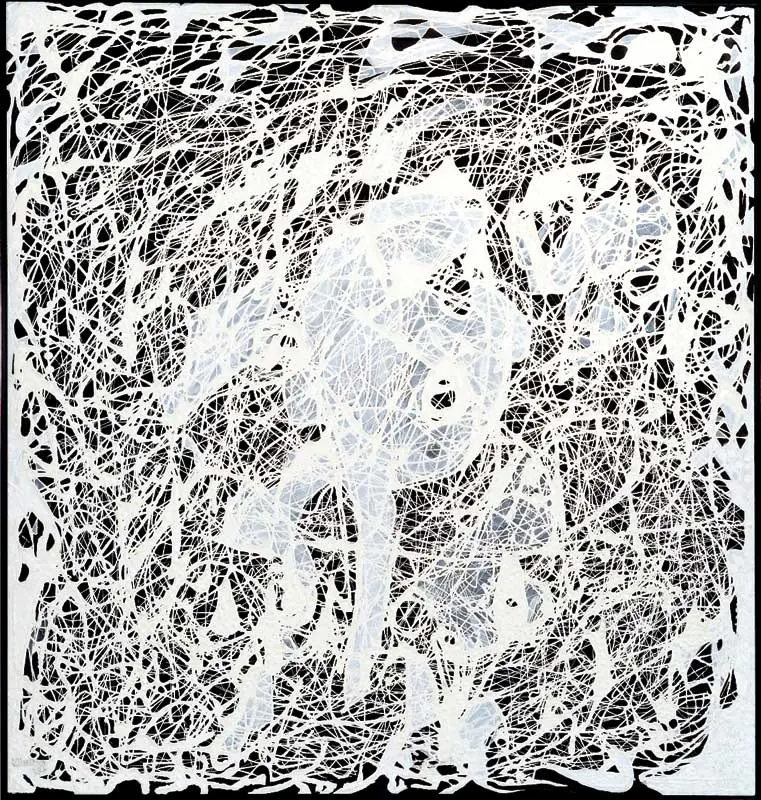
It was under such a haze of uncertainty that I attended the opening of Minerva abstracta at the Museo Nacional de Bellas Artes, specifically in the Cuban art building, on October 9th, 2009. I must confess that I always attempt a certain de-automatization, more or less in the Surrealist way, when it comes to face this kind of works of art because it would be unfair to fall back on prejudiced criteria or a priori extrapolations. Minerva López presents a series of paintings of solid stylistic coherence, tending towards a pointillist organization of the representational space—be it with homogeneous backgrounds or backgrounds in varying hues— that push towards horror vacui, but with the sensation of it having been reached through an economy of resources Indeed, while on the one hand López’s brushstrokes generate a network of structural relationships that cover almost every area, on the other her use of small circles as a basic figure, devoid of chromatic pretensions, reveals an astute and very personal deployment of abstract strategies.
The titles of her works are very eloquent and play a key role in their visual decodification, establishing suggestive bridges with the object of representation while restricting and specifying the show’s ideothematic universe. What Bakhtin, in his analysis of Rabelais’ work, termed “unexpected vicinities.” Indeed, Minerva López sets out a dialog between topics of Cuban syncretic religions and the discourse of abstraction, two realities organically connected in the text/paratext in order to generate a sui generis dimension of outstanding aesthetic accomplishment.
Perhaps most illustrative in this sense is the series devoted to Obbatalá. The predominant color (white) acquires the corresponding symbolism: thanks to the reiterative allusion to the orishá in several titles (Obbatalá; Obbatalá y nubes; Ofrenda a Obbatalá; Merengue para Obbatalá), these paintings acquire a less decentered semantic density, which becomes the starting point for viewers to enter and appropriate that mythical microcosm. The color white goes beyond connoting traditional semes of purity, light, etc.: as the mixture/summary of other colors and, in this case, the typification of Obbatalá, it manifests itself as an all-encompassing apprehension of existence, with its own cosmological laws. It is not by chance that this Afro-Caribbean deity is associated with creativity and intellect; it is an instigation for the receiver to actively participate in the resonance of that dialog between formal macrostructure and verbal referent.
Other works confirm this procedure with titles referred to Afro Cuban spirituality: Camino enredao; Su manto estropeao; Collar preparao; etc. Yet others move away from that field of associations and widen the repertoire. In Nubes de cristal, for instance, López uses a variety of chromatic options on backgrounds that attempt to sketch certain figures, something that becomes even more noticeable in Cristal de nubes, where we seemingly mutilated, insinuatingly grotesque find humanoid shapes. Note how the chasm between both titles gives the show a playful tone. The painter knows that the terms nubes and cristal evoke all kinds of imaginations, refractions, errors, and in that way, she plays a game of interpretative possibilities with her viewers.
We note an intertextual connection with Dante’s Inferno in Selva umbría, where López focalizes two dark areas at the center of the painting, on which the rest of the previously explained compositional presuppositions turn. The dialectical relationship between sin and virtue is given by the black/white contrast and reveals itself as a problematic human phenomenon, especially in the thickly textures brushstrokes that render the pictorial semiosis of lines, dots, and blotches more complex. This resource is also seen in Piedras de nieve, where the color white is once again invested with sense and brings peacefulness, stability, and introspection to the category of the sublime.
Perhaps one complaint regarding the show is its marked intertextual reference to Jackson Pollock in certain works, such as Movimiento al café and Rehilete espacial—although with their own peculiarities, of course, which differentiate their global design. Those paintings hark back to the American artist’s Black and White through the inversion of these colors (by the way, a chromatic chiasm?): black background and dripping in white, a technique that, since its inception, seems inescapable for abstract art. But without a doubt Minerva López has presented a series of works that dignifies the abstract veneer in the country’s art scene, refusing to limit itself to a simple recreation of shaped but rather reelaborating with great ingenuity its expressive resources in order to communicate ideas and sensations and to conceive imaginary, polyphonic universes and reflections focused on our less immediate, more essential realm of action. In an encompassing vision, our sensorial experience is ebullient with aesthetic pleasure and with a sensibility that fills the individual’s inner world. The creative vitality of a painter who continues to wager in favor of art in continuous experimentation is to be admired. Let’s salute her, then.
ANTONIO CARDENTEY