
A bird must have made a nest somewhere on the ceiling of the Thomas Cohn Gallery, and anyone visiting the exhibition of the recent works by Brazilian artist Oscar Oiwa, could hear the birdsong resonating throughout the exhibition rooms and creating an unexpected and fascinating soundtrack, particularly effective with the series Nest (2009). Very representative of Oiwa’s production for the playful freedoms used in the scale of the objects represented, the series Nest nevertheless stays away from the apocalyptic visions that characterize the artist's most famous works. The red, fleshy, and sensual hibiscus springing from the exuberant vegetation indicate tranquility that seemingly nothing can disrupt. Formerly when Oiwa painted nature, he would generally include some disquieting and disturbing element, something such as the seed of a deterioration that would be announced as inevitable. While this catastrophic germen referred back to the traditional motive of the memento mori, it was also a symptom of an obvious ecological concern: that which constitutes another of the great themes permeating the entire work by Oiwa. In this new series, nonetheless, something appears to have changed: the vision of nature does not lead to a disastrous omen. Even the recurrent theme of the broken down or destroyed house with its diminutive and dispersed rooms does not convey the same failed and forsaken sensation that emerged from previous works; the house, instead, invites one to complete surrender, osmosis of the construction with nature, whose superiority now appears indubitable and indestructible.
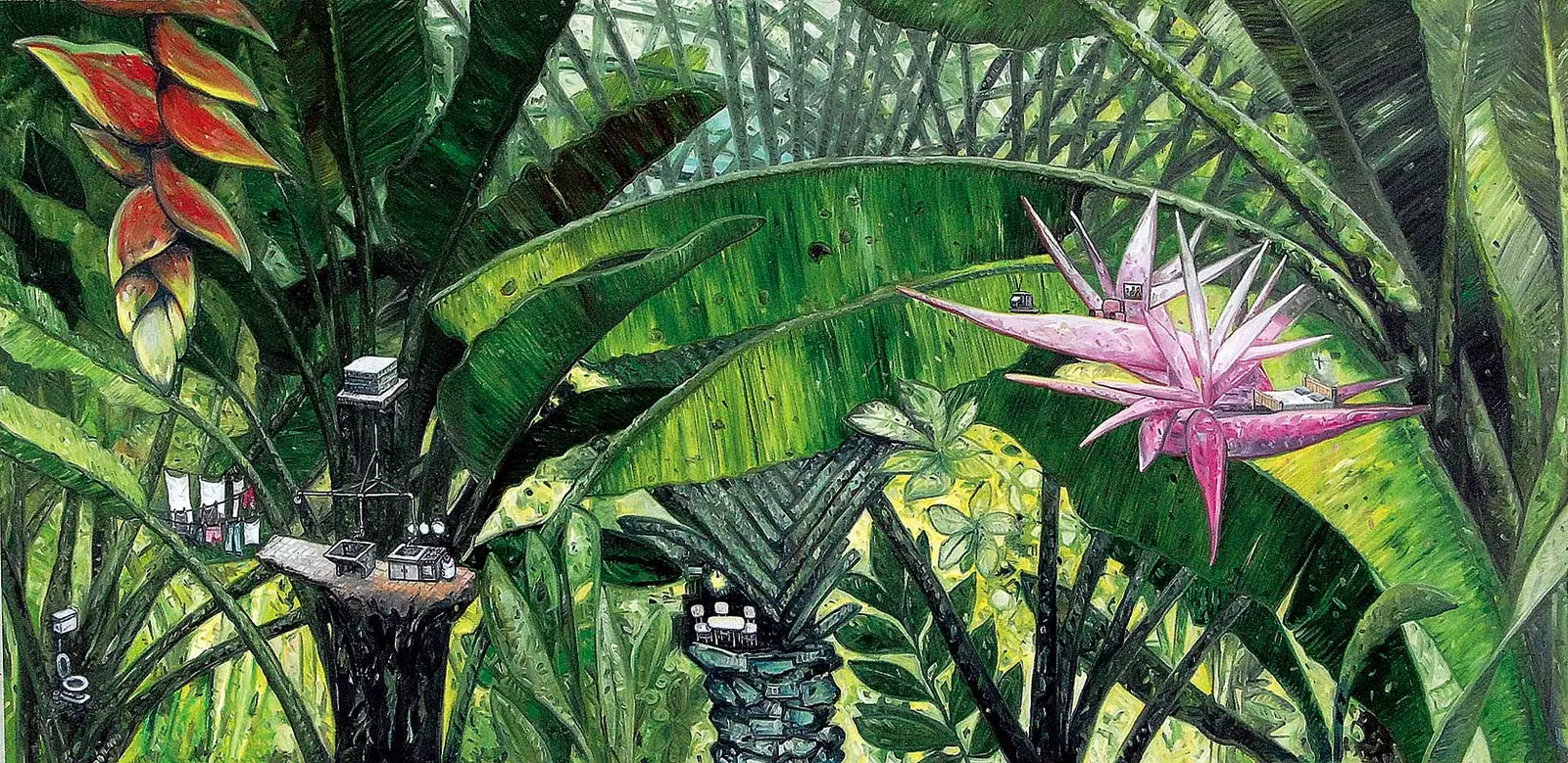
The arrangement of the painting in the space simultaneously reinforced and subverted any comforting reading. In fact, upon entering the gallery, visitors could only see the Nests with visions of a luxuriant nature, and it appeared as if one had wandered into a marvelous garden. But hidden from the initial gaze, on the walls, other, denser works by Oiwa would gradually reveal themselves throughout the exhibit. In works such as Oil Ghosts (2007), in which several black oil stains float near the ocean's surface, in which more than the contours, this oil forms—very similar to the silhouette of the U.S. map and other nations in competition for oil dominance—the depictions of eyes that make them unsettling, as they acquire a biomorphic appearance, in what is nearly the abstract and intangible personification of power that rules contemporary society. In the interviews and texts that describe his work, Oiwa insists in the metaphoric, almost literal, reading of the endless characters, objects, and landscapes included in his paintings, such as the oil stains, or the furniture, which confers a domestic tone to the idyllic landscapes in Nests. Notwithstanding this, what the artist actually achieves is an ontological transformation. All the elements that he extracts from reality function in another registry, namely, in that of the world of fables. In addition to continually remitting us to the reality from which they were extracted—and they are a clear allegory of such reality—things become part of a very peculiar reality in Oiwa's works. It is from this apparently conflictive relationship from which perhaps the great fascination for his paintings emanates.
Giant skids floating amid the rubble of the buildings; tunnels that begin in Río de Janeiro and end up in Tokyo: flying flowers that transform Manhattan into an enormous garden; stores that sell llamas of all sizes…Oiwa’s universe has always been inhabited by surreal and fantastic creatures that, we must note, are quite familiar to us. As if in spite of this fantastic nature, the canvases could create a plausible narrative, that is, build a universe governed by rules that are undoubtedly different to those regulating our world, but that we regard as coherent. The connivance between naturalistic representation and the fabulous-fantastic registry is one if the more meaningful and characteristic aspects of Oiwa’s work; it enables us to approximate its production to the Brazilian Latin-America literary tradition of so-called magic realism. The universe of authors such as Jorge Amado, Alejo Carpentier, Isabel Allende, and Gabriel García-Márquez, to mention some of the better-known writers, is characterized by an analogous oscillation, in other words, by the interaction of meticulously naturalist descriptions, often deeply committed to a sociopolitical point of view, and fantastic literary pages full of phantoms, miracles, and metamorphoses. The possible and the impossible appear to interact, the absurd and the unexplainable become more plausible, the fabulous turns into the natural and even the expected. Insomnia, the rain, and the amnesia afflicting the inhabitants of Macondo in One Hundred Years of Solitude, for instance, represent mystical, nearly biblical, events that are comparable to the black snow falling on São Paulo in the magnificent work Black Snow (1997, not included in the exhibition), or to the immense hurricane that is configured in the monumental canvas titled Hurricane Valley 2009, which threatens to destroy everything that it finds in its path.
JACOPO CRIVELLI-VISCONTI