The young multidisciplinary artist Rudolph Castro (1982) presents his first personal exhibition with 13 acrylics and mixed media, 13 drawings, one installation, and three videos. The exhibition is titled Mi (I) Novecientos Noventa (Nine Hundred Ninety), because when Castro was eight years old he lived through the most difficult violent period in Peru when terrorism took the lives of 69,000 people. As a boy, he was exposed to daily dosages of news on explosions, deaths, and destruction. This experience left him deeply anxious, and his way of expressing this is through his art.
A first glance at Castro’s work reminds us of Pop Art, as he paints Laurel and Hardy, Legos, Playmobiles, dolls, and other children's toys. He is in reality a conceptual artist, because his ideas concerning the death, explosions, and massacres that occurred in his country are present. In this respect, the artist says "I like playing with visual ambiguities. A first look at my work simply shows toys, but once the titles of the works are read, the viewer realizes that there is another story behind them, things that the spectator does not know or situations that we have lived. And the conclusion of someone who sees it like me is that it does not take place again."1
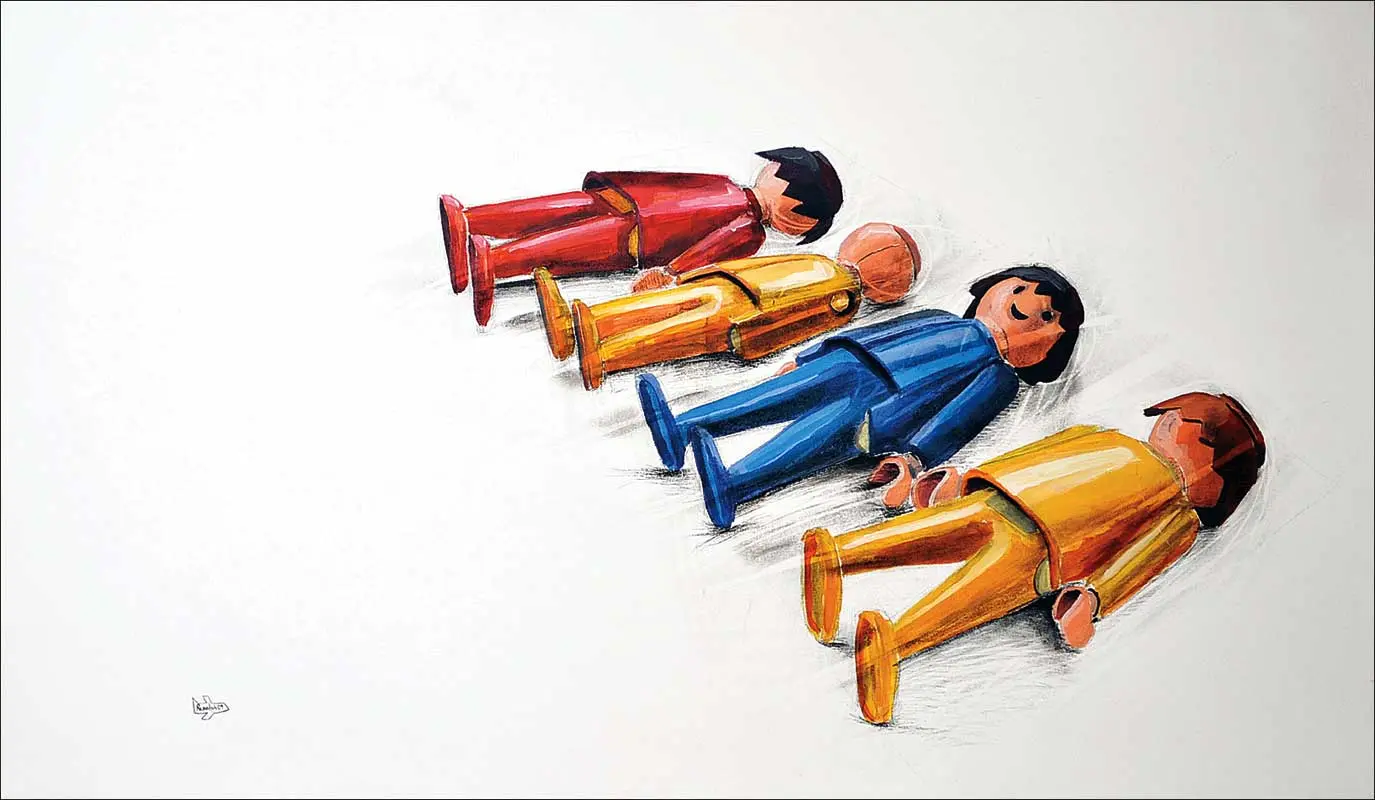
The work titled 4644 - 4643 = Putis depicts four playmobiles against a completely white background. Three of these are upside-down, and the one standing up straight gazes at the viewer with its smiling face. Upon careful observation, the viewer realizes that one of the figures is missing an arm and has no hair. Thus, the inference is that it was mutilated. Castro notes that "the title of the piece is based on that there are remain 4,644 clandestine mass graves still unearthed, and in Huanta province, there is a mass grave that has just been exhumed, where 92 human remains have been accounted for, the result of a massacre by the armed forces in December 1984. DNA tests were able to identify 28 bodies. Later, it was possible to determine that 45 of the bodies belonged to children between the ages of 0 and 17 years of age and that not only firearms were used, but also sharp instruments, to end the victims' lives."2 After knowing this, the viewer realizes that the story behind the beauty of these toys is actually very dramatic. This work represents the unearthed mass grave of a massacre in the town of Putis, but Castro subtly presents it in such a curious and decorative way that the tragic element is nearly absent in his work.
All of these works show only toys in front of large empty backgrounds. This serves two functions: the first is to ensure that toys are the central element of the work, thus being effective for projecting all of their meaning and symbolism. The second function is to create a visual imbalance of the space that represents the story and the tragedy. In any work in which there are balance and symmetry, there is harmony, and where this cannot occur.
There are two other works with the same story: Comisaría de Palca (Palca Police Station) and Comisaría de Palca AM (Palca Police Station AM). As its name indicates, the story occurs at the police station in Palca, a town in Peru's Junín province. Here Castro creates a police station with two walls and a door made of Legos. But in Comisaría de Palca AM, the Legos are on the floor. This work is based on reality because the actual police station in Palca was destroyed by terrorists. Here, the background and floor are painted a light gray, but as in any of Castro's pieces, there is a void because it does not have a floor, or a table, on which a child could play. It is an image in which space has no form, nor purpose, like the pain of the victim's relatives. What appears to be the image of a child's game played with Legos becomes a dramatic representation of the history of Peru.
In 12 Litros de Agua (12 Liters of Water), Castro depicts a doll seated with its back to the spectator before a grayish-blue background. It is possible to see the shadows of both the doll and the bucket of water. At first glance, the doll’s shadow appears to be spilled blood, due to its dark-red cast. A second reading allows one to realize that it was the shadow. But because it addressed themes of death, victims, and terrorism, blood is in the artist’s subconscious as he works with this in mind. This way, Castro imprints the mark of terrorism in this work unconsciously. He plays with space because the bucket is outside of the frame and only its shadow can be guessed at, as the doll's own shadow ends up in our space. Castro wants viewers to become involved in each work by having to think about it. The observer would have to ask: What is this work doing here? Did Castro used to play with dolls? This particular work tells the story of his girlfriend, who mentioned to him that when there was no water during that era of terrorism, her mother would wait in long lines for extended time periods to get the precious liquid as Castro’s girlfriend, a little girl then, would bring a doll along to play with.
The installation titled Toque De Queda (Curfew) consists of six children’s lunchboxes in orange and yellow tones and each placed on a white column. Each lunchbox has color photographs accompanied by text on the front of the lunchbox and a headphone set. The visitor would listen through the headphone to stories by relatives of the terrorist victims. Three of the audios are in Quechua (the official language of Peru), and the other three are in Spanish. One of the lunchboxes, which has the image of a grieving mother on it, has the following phrases written on it: "Where is my son? What have they done to them? I found many corpses tied by the waist... I screamed... Arquímides, where are you?" On another lunchbox, there is the picture of a man speaking at the Truth and Reconciliation Commission. This photograph includes the text: "They killed my father with silencers, but I will not remain silenced." This installation is visually soothing because of the attractive colors and the way it affects the persons listening to the audio. Individuals are known to have left the area in tears after having listened to the audios.
The exhibition also includes three videos filmed and edited (two of these) by Castro. He is a multidisciplinary artist who is now working with photography in another of his projects. One video is about his trip to Tarma, the city in which he was raised. There, he thanked the persons who contributed to his upbringing. Another video deals with his favorite game when he was a child: cops and robbers, "where my murderous weapons are my hands and the bullets are the sounds coming from my lips".3
Castro's work is visually pleasing and appears to be a children's game, as one looks at the toys and immediately remembers having played with them. But his work contains dramatic stories, and this ambiguity is what makes his work more interesting and impressive. His work reminds us that terrorism has not disappeared in Peru. This exhibition will also be presented in the cities of Ayacucho, Cuzco, and Arequipa.
NOTES
1. Interview with the artist, December 2009.
2. Interview with the artist, December 2009.
3. Interview with the artist, December 2009.
AUGUSTO CHIMPEN