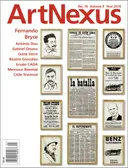
The Museum of Latin American Art in Buenos Aires (MALBA) recently presented an exhibition dedicated to two female artists who actively participated in the vanguards associated with abstraction in Argentina during the 1930s and 1940s. The exhibition and the accompanying catalog allow us to take a new look – and a new appreciation, no doubt – at the controversial atmosphere filled with innovative and transformational energy experienced at that time.
The selection of these two artists, Yente (1905‒1990) and Lidy Prati (1921-2008) reflects the wish that they, "in Eduardo Costantini's words at the presentation, could be appreciated in their true dimension and originality, and that the works that turned them into true referents of the development of abstraction during the middle of the Twentieth Century in Argentina could be properly evaluated."
It is precise with the idea of understanding the bellicosity of the artistic environment of the time that the exhibition begins with works by Pettoruti, Xul Solar, and Juan del Prete, these first manifestations of this artistic current in Argentina.
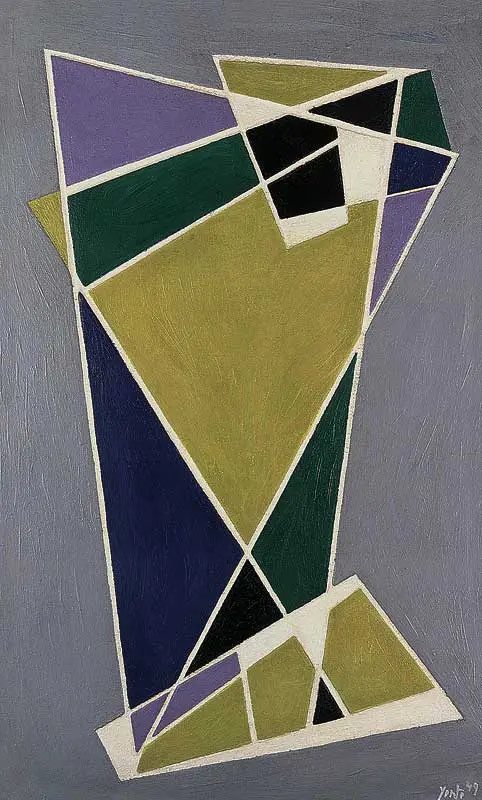
Yente, born Eugenia Crenovich, was raised in a Jewish family where she received a good cultural education that led her to attend the Faculty of Philosophy and Letters, then the workshop of legendary teacher Vicente Puig, and to become involved in the art world from an early age. From 1937‒1938, she exhibited works that were already decisively abstract. These pieces were the predecessors of the reliefs and extant works made with celotex that represented a great part of her work during the 1940s.
The definitive step that the production of these years would represent to her had already been recognized by the artist's own evaluation of the work, which took into account an encounter she had with Juan del Prete in 1935. Such a step represented a door that would open to usher her into the way ahead. It was this transformative factor and the presence of del Prete in her life that conferred upon her a singular kind of support, that is, del Prete was a valid interlocutor for the exhibits that went on to mark the path of constructivism in Argentina: Arte Nuevo (New Art, 1947); Nuevas Realidades (New Realities, 1948) and 2º Salón de Arte No Figurativo (Second Salon of Non-Figurative Art, 1949).
Yente was an extraordinarily versatile artist. She created paintings, reliefs, objects, drawings, and book illustrations and books―some of which she even wrote―and collages and tapestries.
During the 1950s, her brushstroke became increasingly freer; matter began to play a central role that led the artist, during the following decade, to come closer to the informalism that facilitated her use of patches, splatters, and highly impacting textures.
Adriana Lauría, an expert on Yente’s work and curator of her exhibition, chose to show a large part of Yente's vast production, including works from every period and technique. Lauría writes that Yente "deliberately chose a secondary role with respect to Del Prete's career, as she thought that the visibility and repercussion of her own work were less important."
It was precisely this decision to remain in the shadows of her husband's strong persona that prompted Marcelo Pacheco, chief curator at the MALBA, to add Lidy Prati to the exhibition, because despite her being an important representative of the vanguards from the 1940s and early 1950s in her own right, Prati is much less known by the general public than her husband Tomás Maldonado, another imposing personality in the Argentine art world.
Lidy Prati came from a well-to-do Italian and Swiss-German immigrant family that settled in Chaco province. She attended parochial schools and was introduced to literature, visual art, and music at her uncle's home in Buenos Aires.
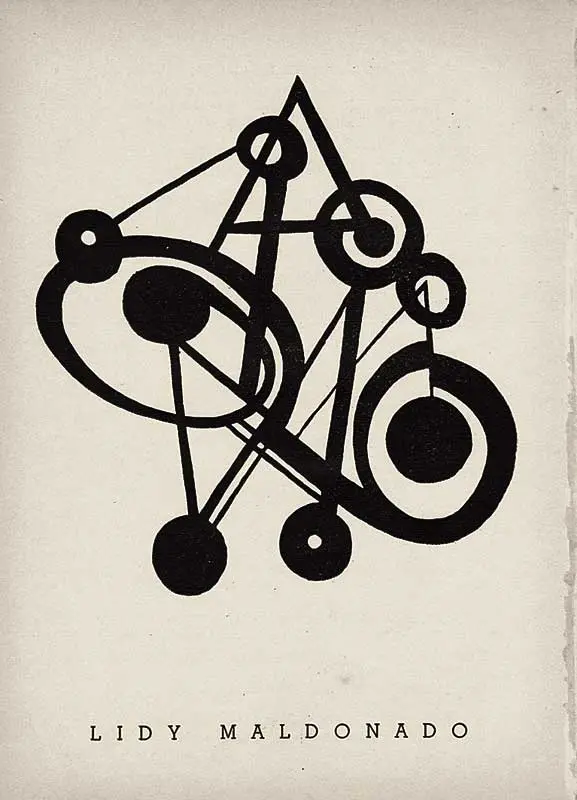
From an early age, Prati became part of the group of artists and writers that would eventually publish the revolutionary Arturo magazine (only one issue was ever published). Her family partially backed this project financially, as Prati created the vignettes under her married name, Lidy Maldonado. This took place in 1944, the same year that Tomás Maldonado and Lidy Prati got married.
From that moment on, and until their divorce ten years later, Lidy participated brilliantly in all the activities of the concretist group. She shared the same artistic expectations and was one of the signers in November 1946 during the creation of the Asociación Arte Concreto Invención, as well as of the manifesto that accompanied their first exhibition in March 1946 at the Salón Peuser. She was also present in other exhibitions by the group in 1945 and in 1947 at the Salón Arte Nuevo (in which Yente also participated), as well as at the Salón Nuevas Realidades in 1948.
A highly original work done by the artist became the cover of the Invención 2 magazine; another of her images was reproduced for the first issue of the Arte Concreto Invención periodical, and her painting Concret A4 was included in the first issue of the Ciclo magazine.
From 1949 to1954, she assisted Maldonado with his classes on Concrete Art and Industrial Design in Teresópolis, Brazil (1951); she traveled through Europe, where she visited Georges Vantongerloo, with whom she maintained an epistolary connection for many years. She participated in several exhibitions in Argentina, Milan, New Delhi, Río de Janeiro, and Amsterdam, and was also one of the artists representing Argentina at the Second São Paulo Biennial in 1953.
The exhibition at MALBA includes works from that period. Some works belong to her family, others are from the collection of the Ministry of Foreign Affairs and Culture, as well as from other private collections. Among the works, there is a trimmed frame that has gathered much interest. The documentation accompanying her work is also very illustrative as well.
The fact that Lidy Prati stopped painting in 1956 has left a great void in an exhibition that has covered this gap with several of her numerous works on paper. Several series in ink and/or tempera were exhibited – the majority of these for the first time – that utilized oiled paper, color pencils, and a series rendered with a blue ballpoint pen – all on paper – and created in 1982 and gathered together for this exhibition under the title Cuadernos de Viaje. This title is explained by the fact that, between 1971 and 2001, the artist worked as an official at the Ministry of Foreign Affairs and Culture.
While Prati was active in the art world and later in her life in layout and design, there is no doubt – as this exhibition clearly shows – that a break occurred in her artistic process, and while she continued to be creative, she also walked away and renounced the brilliant place that she had rightfully occupied. After she and Maldonado separated, her artistic endeavor became solitary and intermittent.
There is no doubt that the cultural conditioning of Argentine society during the 1950s was not an ideal situation for a female artist who went on to experience such an emotional breakdown. But it is actually very difficult to determine to what degree her decision to leave an artistic career had to do with her condition as a woman within this context, and to what extent it had to do with her own sensitivity and emotional frailty.
In this respect, María Amalia García, author of the text dedicated to Lidy Prati in the exhibition's catalog, delves into the gender issue during this historical period and points out that it would be a "fruitful line of research to conduct a sexualized reconstruction of the concretist discourse and of Prati’s participation in the actions of that vanguard."
Moving beyond this issue, what MALBA has achieved with this exhibition is to convey the individual qualities of both Yente and Prati, within the context of MALBA's support of Argentine artists who, for whatever reason, do not have the visibility they deserve.
NELLY PERAZZO