Curated by Ernesto Pujol, Ideational Architectures proposes the pairing of two artists that work in similar conceptual arenas and communicate their ideas through the use of architectural structures in mediums like drawing, sculpture, and photography, questioning our relationships with everyday objects and their connotations. At first sight, it would seem as Alejandro Almanza Pereda (Mexico, b. 1977) and Alexandre Arrechea (Cuba, 1970) share the same aesthetic—Almanza’s serigraph All mod cons and living in the same block, 2010, where a display of 79 different views and versions of cement blocks (arranged in 9 rows by 9 columns; the last row short by two), struck me as a characteristic “Arrechea drawing” at first, but upon closer inspection, the message was obviously different, as the different patterns and unsuspected gaps of the blocks made them non-functional, “cons” that obviously could not be used in construction. The same sort of composition appears in his other drawings, where a section view of a well is reflecting a bucket that is not really there and another serigraph where a scale is placed on top of a case of eggs. Almanza’s work is characterized by this idea—it deceives your eye and your mind with the unusual combinations of elements that seem to put the viewer and the objects themselves in safety hazards, such as in the object-sculpture Home is where you lay your hat, 2010, which is a glass door with a metal door knocker. The consequences of knocking on that door seem obvious due to the nature of the materials it is made out of.
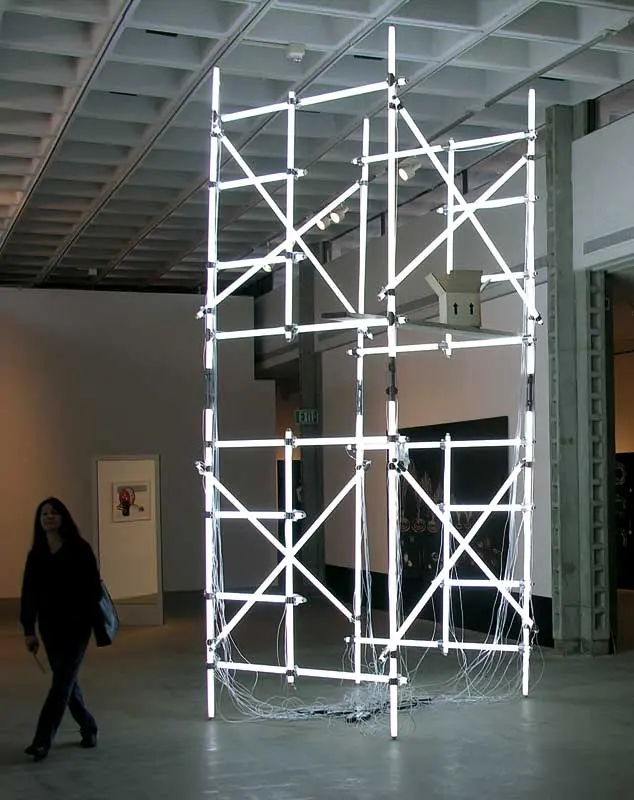
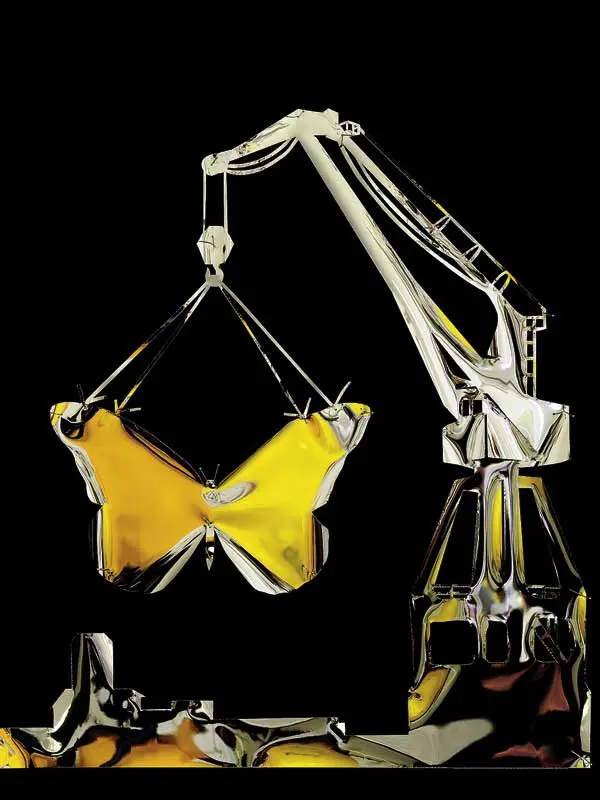
Arrechea’s combination of materials is more symbolic and not as “dangerous.” His hybridization of objects and scenes, such as Masculinity 2, 2010, a photograph of a construction crane holding a butterfly, which does not only represent a different approach to photography—Arrechea photographs the light and colors reflected on metallic surfaces (the shapes of the objects in the image)—but also continues on his exploration of improbable amalgams like a building on a spinning top, or a running man with helicopters replacing his head and feet. Both Almanza and Arrechea work on the limits of the possible and the impossible, constantly challenging the viewer to question the codes associated with the nature and function of everyday objects and how we recognize their “correct” purpose in the contradictions of their compositions. Almanza’s main piece in the exhibition is Change the world or go home, 2009, a scaffolding structure created with fluorescent light bulbs in place of metal pipes, a development on his Andamio from 2007, which explores a twist on the fragility—a test on fate—of a structure made to support materials and people during construction. This impossible construction in which Almanza gives protagonism to trivial materials such as light bulbs by providing them with a silent “power” or control over the viewer’s safety and the safety of the materials themselves, creates a nice dialogue with Arrechea’s works about rolled buildings, such as in his watercolors titled After the Monument Series, 2009, and the sculpture Elastic Time, 2009. Buildings encounter themselves in the impossible situation of being rolled in a reel as a cord or a film, acquiring a vulnerable quality that could not be real according to the laws of physics. A work originally produced for the Havana Biennial of 2009, The Room of All, works as a physical representation of the processes of the stock market index, as well as an ironic comment since the sculpture is made with steel panels, playing again with our notions about the connotations of certain materials, in this case, steel, and how we associate it with qualities such as durability and indestructibility.
The common language that these artists share, their “ideational” architecture, as Pujol appropriately describes it, should not be mistaken as an idealization or utopia of architecture in their works, but instead of the use of the language of architecture as a suitable system to convey their ideas. The sensible curatorial choice of presenting these two artists together at the Los Angeles Municipal Art Gallery was a perfect opportunity to experience two different formal approaches from Latin American artists that do not ascribe to the conventional resort of narrative. Almanza’s impossible pairing of objects and Arrechea’s compositions made with improbable materials challenge individual and social “balancing acts” in trying to understand our contradictory relationships with everyday objects, private and public spaces.
SELENE PRECIADO