
With his exhibition Volcánes, Cables, Ahuehuetes, Lonas. Vistas Desde el Romanticismo (Volcanoes, Cables, Trees, Canvases. Views from Romanticism), Alejandro Pintado reaffirms his condition as an artist working from a multiplicity of disciplines and tendencies, also known as postmodernity, altermodernity, or transmodernity. At the beginning of the 1990s when the author began his artistic career, he created non-aggressive urban landscapes that were also analytical, the majority of which were painted white or white-greyish. Today, his landscapes do not only focus on urban scenes, but also depict countryside settings, volcanoes, and ahuehuete (Montezuma cypress) trees. They maintain a romantic touch, convey our dependence on energy resources, reveal conceptual coordinates, offer dynamic works, and establish various visual surveys in each piece.
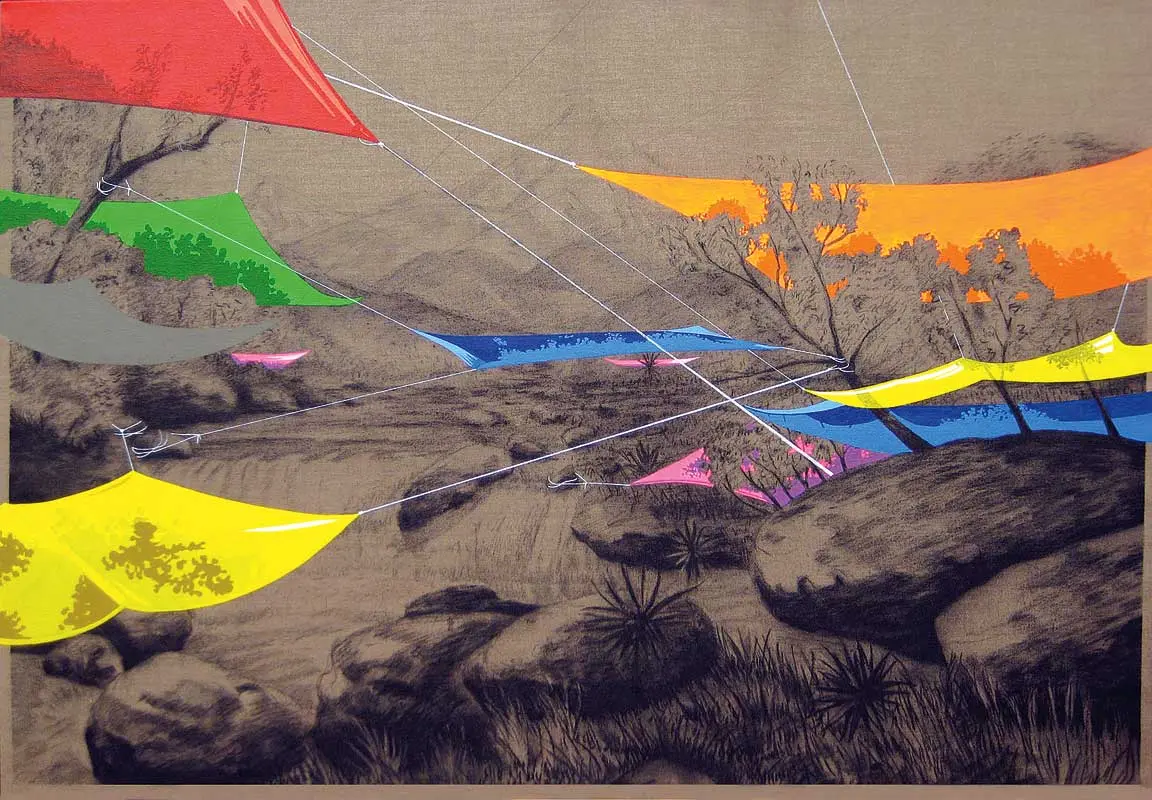
The exhibition was ethereal and engrossing. Scientific and ludic elements unfolded as the walk through the exhibit progressed. The canvas became landscapes in Patrones de Interacción (Interaction Patterns) and Vista Momentánea del Valle (A Glimpse at the Valley). The cords that maintain the composition tense appears to move from one side to the other across the canvas or paper, as they superimpose themselves on the rest of the scene in a spatial interaction: the grey and beige landscape appear distant, the acrylic canvases painted in yellow, red, blue, and green emerge into the foreground. Likewise, the aforementioned interaction could be read as comprising elements from several time periods. These landscapes, drawn with charcoal on raw linen, evoke the romantic Mexican masters – in the manner in which the volcanoes and the vegetation are rendered – and have a connection with works by international artists due to a shared interest in nature. But the weft constructed of linear and color tensions – to mention two aspects – reveals the contemporaneousness of his work. Pintado’s paintings are post-conceptual and definitely post-Christo.
La Incertidumbre del Telón (The Uncertainty of the Curtain) is the title of a charcoal and photoluminescent acrylic on unprimed linen. Interacción Temporal is an engraving superimposed on paper and photoluminescent paper. In both works, the engineered structures block, frame, and section the landscape, in one of the many ways that humans interfere with nature. Pintado has been using techniques and materials that point to a variety of historically relevant “drawings” and “engravings,” while he also introduces contemporary synthetic materials that he successfully combines these with drawings and engraving techniques. An antithesis of classicism, linen becomes the raw support in plain view, uncovered, which evokes the little-known paintings of the 1970s – also drawings on raw linen – by Antonio Seguí.
In his 2009 and 2010 works, Pintado reaffirms that his reflection derives from the use of spaces. During these last two years, he has created some installations and photographs that contain urban signage elements, which subsequently led to other signs that retrieve the two-dimensionality of his pristine focus. He has always shown an interest in finding different ways of seeing. Today, he expands his approach to paint his images in an ecological light. In the real world, vectors, spears, cords, and pipes cohabit with the land, although not always in a respectful manner, as is the case of his work Contemplación de la Mente (Contemplation of the Mind). Another work, Retícula Orgánica (Organic Reticulum), reveals the beautiful, lush image of a tree in which the spatial relationship is rendered in photoluminescent acrylic. It is a drawing-painting that showcases the structures in nature that protect and support the life of certain species. Can an isolated tree such as this one subsist? Do we have to arrive at that point?
Incisión Paisajista (Landscapistic Incision) depicts a lattice of possible shadows, illusory vegetation, canvases dissected by the profile of the “green floor,” and even patterns that evoke such situations. This prompts some questions: Is the purpose of the constructions and the canopies to protect the landscapes? Are these landscapes a reservoir of the images that no longer exist in reality? Alejandro Pintado depicts spaces that seek refuge, care, and that are rendered by a young artist who is able to express himself with maturity.
Like a composer who writes music for two voices, Alejandro Pintado compares similar actions in drawings on canvas and in engravings on paper. By doing so, he offers options to keep the works commercial and to expand his creative versatility. And the results are immensely satisfying. The materials enable several visual experiences. The exhibition consists of a group of sixteen paintings and one sculpture, titled Volcán Fluorescente, done on fiberglass with fluorescent paint. Playing with different periods, Pintado affirms his inclination for the romantic in the title of the exhibition, all the while additionally revealing himself as a modernist in the title of his diptych Vista Del Valle desde una Regresión Modernista (View of the Valley from a Modernist Regression). Within the malleable limits of what is called “modern art” – a rejection of renaissance tradition prompted by an interest in experimenting with novel artistic forms that took place between 1870 and 1960 – Pintado relies on mixed media in the foreground is what is the modernist, gesticulating, colorful, and non-figurative outward push toward the surface of the canvas. Nature is treated as a distant, evocative, and historical element. Pintado offers the spectator a chance to intervene and become part of the transmodernism of the work.
GRACIELA KARTOFEL