
“It could be said that photography always carries its referent with itself, both marked by the same loving and funereal immobility: they are glued to one another, member to member (…) Photography belongs to that kind of laminated objects that cannot be separated without getting destroyed (…)” Digital media have radically altered the condition pointed noted by Barthes in Camera Lucida. Digital manipulation no longer provides the certitude that the object we see in a photograph “was there in that place and time.” Yet, it is possible to perceive in the images captured by Ana Isabel Adarve and Marcelo Mejía an impressive realism; there is in them clarity that gives objects and spaces a kind of super-reality that in turn seduces and confounds us, and in their processes, surprisingly, we discern an approach to painting.
Ricardo Arcos, director of the museum and curator of this show, says about the title: Fototopías, the concept that focuses this curatorship, is a neologism I use to configure a site on the basis of photography, or where photography in itself can be conceived of as a site due to the referent it reveals. At the same time, that site is framed within urbanistic conceptions supported by contemporary utopias. Current constructions are erected under the principle of fear and terror; our habitable spaces are built as paradisiacal fortresses that separate us from the real world, true ghettos that create impassable borderlines between their inhabitants and reality.” This show reveals the ways of seeing urban spaces exercised by a visual artist and a photographer/architect.
Time, that quality that David Hockney misses in analog photography and which is present in the painting, appears in the process of construction of these images. The temporality of painting, according to Hockney, is built in the artist’s prolonged and reiterated perception of his or her model, in the long duration of the act of painting, in the superposition of pigments; thus the density of the pictorial image and its supremacy over photography, a matter that goes beyond the construction of his joiner. In the case of these two artists, there are many shots after one image, and then long labor in the process of edition and construction, where each uses his and her own strategies.
Adarve’s images, titled Fototopías, showed her process between 2004 and 2009. Her interest in urban spaces as containers of social tensions connects her series En remojo the last one she did before traveling to further her studies in San Francisco, where the body is present in the streets of Bogotá. This disappears when she starts to capture her experiences in the US.
As in cubism, at the moment of shooting a photograph, there is a displacement of the seer over the object seen and the space that surrounds it. Later these images are carefully assembled and retouched; every last detail is profusely amplified and controlled. From this long instant of perception and construction, a single image emerges. This explains why only around twenty images are gathered from her entire eleven-year career.
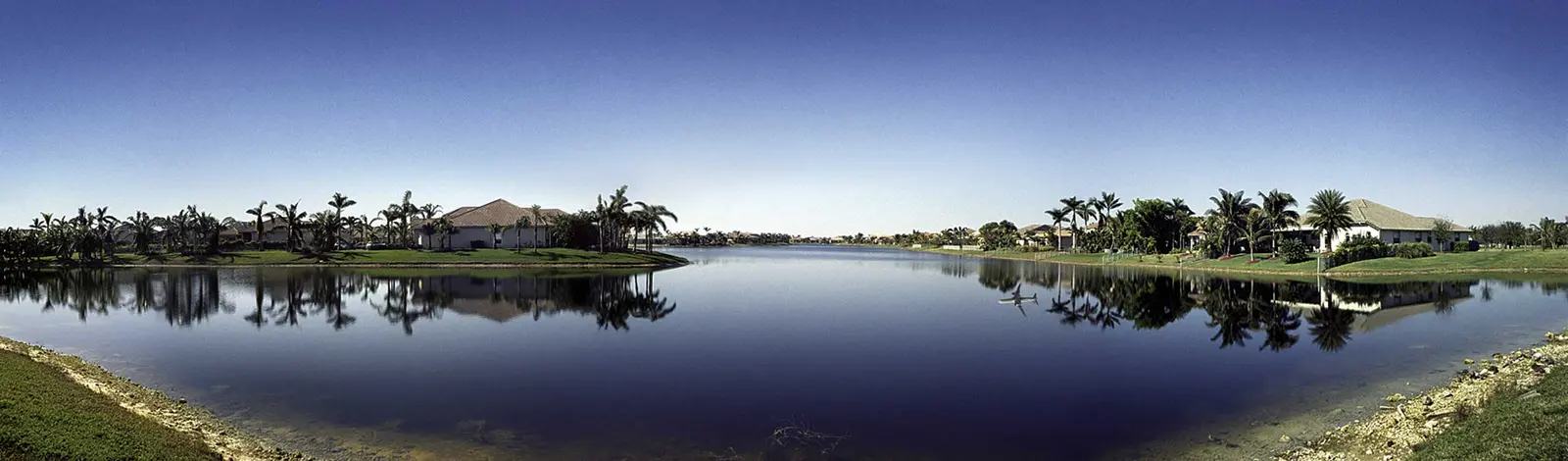
It was only after learning about this process that I was able to understand the astonishment produced by Adarve’s photographs, especially those in the Disrupciones series, where she explores the topic of American suburbia. Her photographs capture the perfect alignment of houses in the midst of the controlled, aestheticized nature that always disconcerts foreign travelers. In one of them, we see, the calm waters of a lake that reflects the warmth of the lights illuminating those homes whose aspiration is beauty and peacefulness, the reflection of an airplane that is not in the sky. A presence that, after 9-11, can be rather frightening; this reflection functions as a ghostly appearance of fear. The image captures the “white man’s” phobia of all that is strange and threatening, and that of foreigners of a way of life that is devoid of naturalness and humanity. While the plane was not there in that time and place, we can indeed say that it is there, present, with “its funereal immobility,” no longer a loving one, in the imagination of Western man.
Marcelo Mejía studied architecture and then art. He never practiced his first profession, but the experience of urban spaces and of modern, rationalist architecture and the topics that traverse his series Heterotopías a term used by Foucault to define the condition of the contemporary city spaces, sites where acts of “vigilance and social control” are performed.
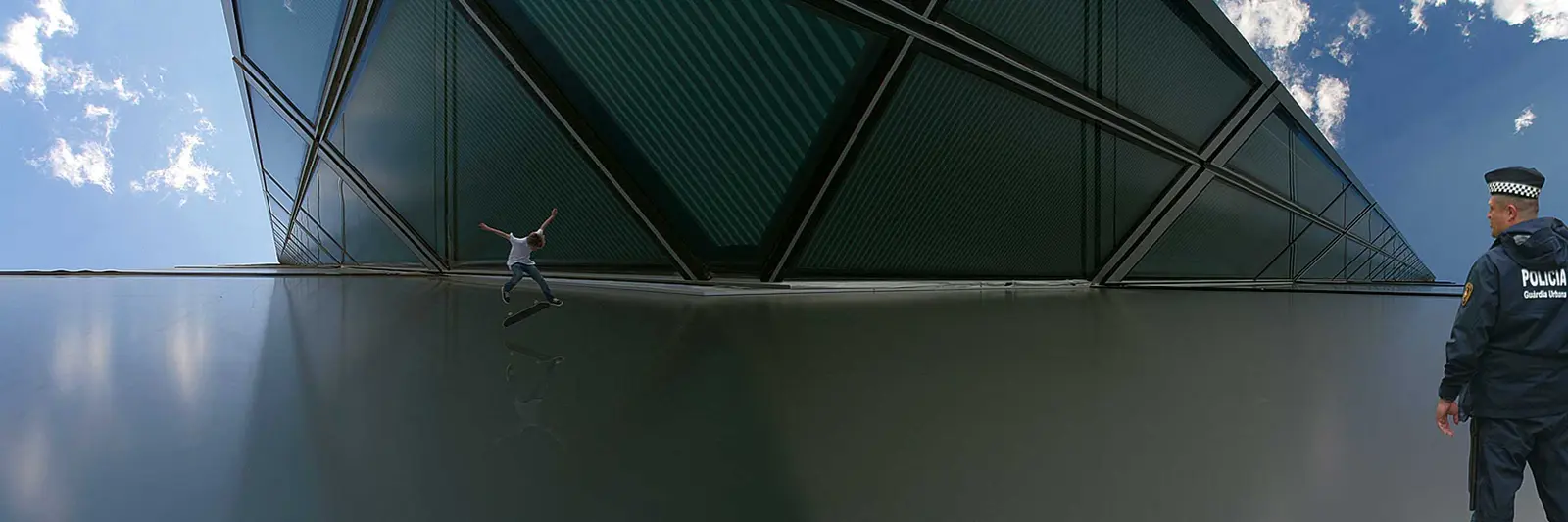
For the production of his images, Mejía also makes several shoots, in his case of institutional buildings erected using the highest technology, highlighting polished and reflecting surfaces in glass and steel. Materials that generate aseptic spaces, perfect in their geometry: symbols of power where access is strictly regulated; constructions that, in his words, “are configured as paradigms of non-places and heterotopias.”
His point of view seeks out extreme angles. He brings the camera very close to the façade so as to capture a kind of forced foreshortening. In the final image, this vertical shot is used as a horizontal element that structures a strange, open and majestic urban landscape. The real and the unreal live together in these images. What we perceive as real are the reflecting surfaces, fragments of architectural works that place us in impossible locales possessing something of the unreal and the absurd, but seem oddly recognizable, like places we once visited. The human figures inhabiting their monumental, cold architecture are always diminished, and some appear in an alert attitude.
In the construction of his images, Mejía acts as an architect who creates habitable spaces. Heterogeneous elements converge upon these spaces, fragments of one city join fragments of another, they are doubled and unpacked to create impossible architectures inhabited by silence and asepsis, the “non-places.”
Their gazes alert to strangeness, both Mejía and Adarve use digital technology to reveal the de-humanization of certain places built by Man, where some Western utopias come to be crystallized.
MARTA RODRÍGUEZ