
An ethno-artistic expedition moves forward collecting evidence of other ways of life in the city’s most sordid interstices, rather than along the Camino Real; it sneaks through ravines and gorges and not the most multitudinous avenues, jumping around in garbage and bad smells, just like street people do as they seek the precarious hospitality of clandestine roads for protection against the elements and against people’s mockery and disdain.
It is there, outside the trodden path, that Arte social por las trochas. Hecho a patá, palo y kunfú situates itself. This show of works by Argelia Bravo (Caracas, 1962), presented by Sala RG between December 2009 and February 2010, encompassed several installations, videos, objects, photographs and dermo-copies created between 2004 and 2009. The majority of these works revolve around the figure and habitat of Yahaira Bravo Marcano, a transgender individual who has been the victim of discrimination and physical violence due to her sexual orientation. Her body — like that of anyone who deviates from dominant stereotypes — is a site of convergence for desire and guilt.
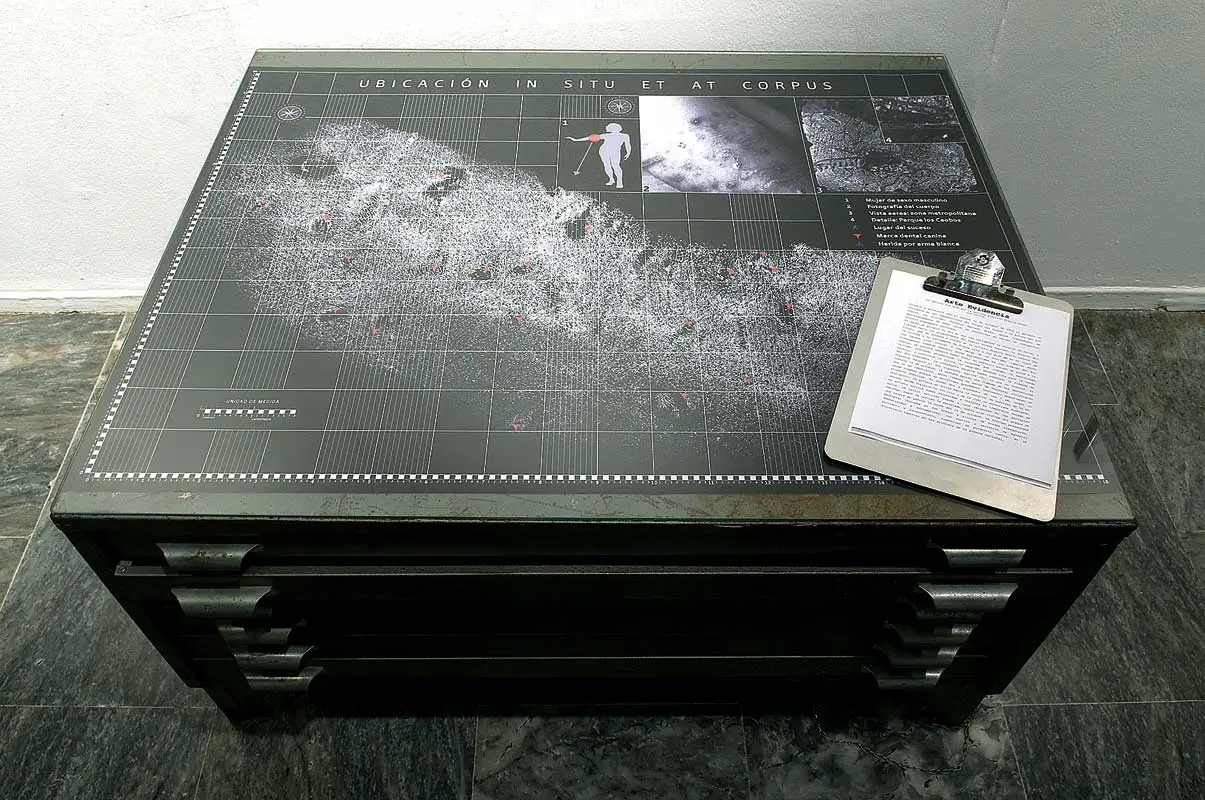
The testimony of intolerance and exclusion is evinced not only in the prints obtained through fingerprinting procedures (Arte evidencia 1. Inventario de un itinerario corporal) and certified by a specialist in the conservation and restoration of art objects (Arte evidencia 2. Humanidad objetivada), but also in that furtive passage through hostile and solitary pathways in order to evade harassment and social rejection. Here the notion of place and the idea of the body are fused as one. The scars caused by kicks, floggings, and burns on display in Yahaira’s body are the symbolic equivalents of the ferocity of the urban territory, and they demarcate a space whose coordinates lie outside official cartography (Arte evidencia 3. Cartografía de una historia interminable).
The proposal gives continuity to an exploration begun by Bravo several years ago of Caracas’ transgender community, from which emerged experiences like Rosado Bravo (MBA, 2004 / 20th Havana Biennial, 2009) and My identity card (o Toronto con chispitas de maní), (El Anexo, Caracas, 2007). On this occasion — as in those instances — the artist takes advantage of various fields (anthropology, activism, forensic medicine, museology, art) to unveil the cracks in the normative apparatus and the damage it causes to the transgender population. In pursuit of this goal, her investigations transcend the becalmed penumbra of an artist’s study and move to apparently unconnected domains, be it offices, laboratories, remote urban locations, or exhibition sites.
As curators Albeley Rodríguez and Carmen Hernández point out, Bravo’s strategy questions binary and exoticizing approaches to the Other, attempting to unmask the circulation of codified flows for the control of identities and behaviors. Yet her work avoids literal solutions, experimenting with dissimilar media such as video, performance, and the graphic arts and using those techniques as documentary vehicles, juxtaposing their aesthetic meaning to their ethical implications.
In Bravo’s case, art is a symbolic device intended to give visibility to this complex problematic. This is the framework in which artifacts of various kinds are presented: a paper bag for the collection of evidence, a worksheet for recording forensic data about the victim, a diploma certifying Yahaira’s condition as a sex worker (even though such respectful recognition is not validated by hypocritical social mores), or a display case for the placement of ominous objects (baseball bats, rocks, cutting instruments, spoons, etc.), as if from a police raid. Together, these elements give shape to a critical gaze, framed by gender studies, that attempt to engage society’s attention. In that sense, Bravo does not judge anyone nor tries to appeal to our emotions with melodramatic artifice. She stays close to the facts, limiting herself to displaying a bodily map of violence that reveals the contradictions in our models of identity representation and leaves its viewers free to reach their own conclusions.
FÉLIX SUAZO