Dois, the most recent individual show of works by Carlos Bevilacqua (Rio de Janeiro, 1965), was presented by Fortes Vilaça Gallery from March 18-April 17. It comprised ten objectual sculptures dated between 2009 and 2010. Here, the ample gallery assigned to this site-specific installation became the substratum for a spatial continuum that expanded and was amplified in every place where these new works were located — ceiling, floor, walls — playing with the twofold relationship between tension and unstable balance. Each work is in itself a meticulously constructed assemblage using unorthodox, rather heterogeneous materials: steel, glass, fishing line, fiberglass thread, felt, non-polychromatic wood, rope in various widths, and rubber.
In this corpus of works, we find a more dynamic and reformulated postulate of the surrounding and the space for each one of them, where Bevilacqua emphasizes a debate and polemic around the discourse of contemporary sculpture tout court and the different modulations of a poetics of the object.
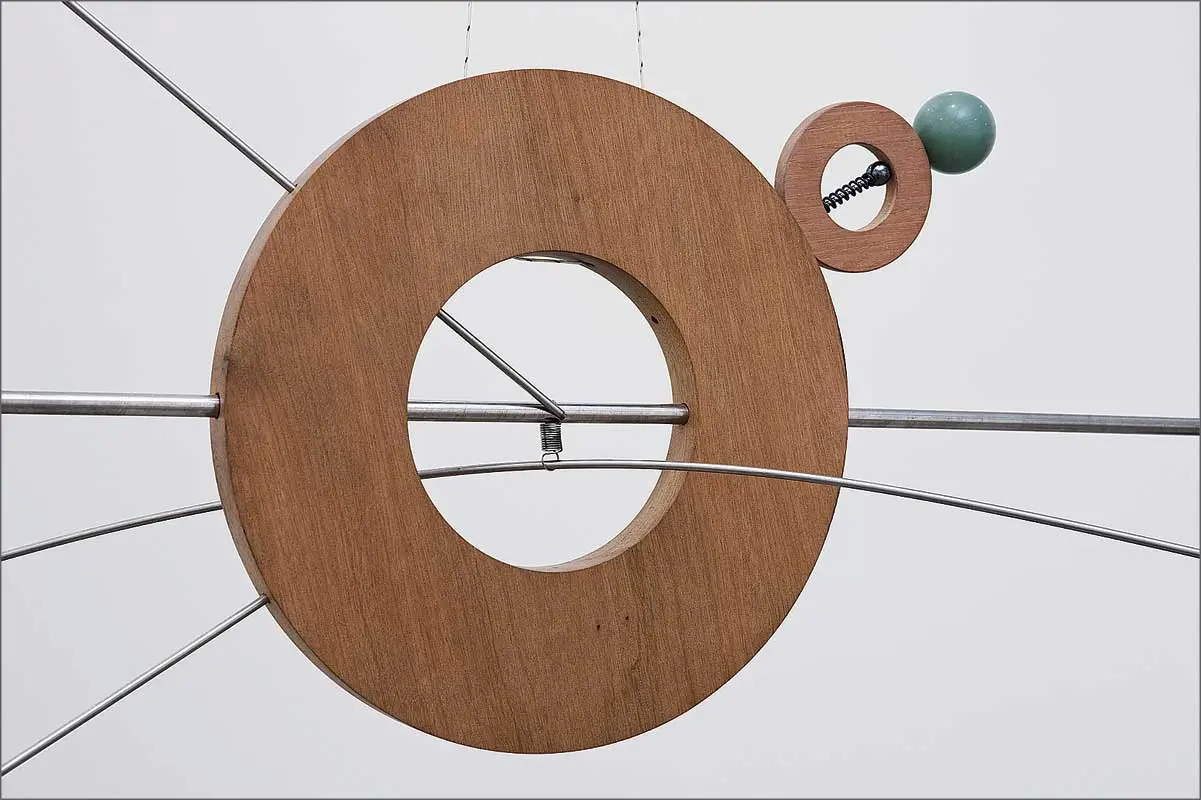
We have advanced an initial indicator in Bevilacqua’s current work: the use of extra-artistic, non-traditional materials, which, in turn, according to their dispositio and ars combinatoria, reveal a desire to explore the physical qualities and the degree-zero of such an exiguous, ethereal, lightweight materiality. For this artist, sculpture, object and installation have to do with an almost de-materialized tracing of the lightness of borders, not of stoutness or weight. Lessening the weight of sculptures was already one of the essential characteristics of the MADI (Movimiento, Abstracción, Dimensión, Invención) art of Carmelo Arden Quin, as well as of Concrete and Neo-Concrete artists, two of Latin America’s great international avant-gardes, emerged in the 1940s and 1950s in Argentina and Brazil. In this sense, Bevilacqua seems to be in a fluid dialog with such referents of modernity, in a key, from a contemporary moment open to all and any crossings and transversalities it can establish from its epochal threshold, which is ours, reformulating critically and for himself paradigms that are in no way monolithic or dogmatic for the Brazilian artist.
One could wonder, then, whether this is another way of “thinking” post-minimalism, this time with clear a-referential notes and without voiding the material analogon since the works “are there” to be touched, not simply attached to the wall or the floor, but appreciated in their entire diffuse sensoriality, loaded with formal contents such as the value of the symmetrical, the significance of the figure of the circle, the spherical quality of the forms, the relationship of rotation, suspension, displacements, gyrating orbits, trajectories, pendular movements, and everything that could serve to bring complex harmony and equilibrium to this set of works that create a space populated by a variety of meanings.
Euclidian and non-Euclidian geometry is also present in Dois the proposal of space as a receptacle and another as vacuum: the two great topics of contemporary sculpture. With this opus subtiliter —where the highlights are works of the stature of Seven Skyes, Distant Ek and Centripetal Droop I— Bevilacqua builds works based on the concepts of repetition, seriality, and fluctuation, as well as the concept of similitude and spatial continuity. Dois, according to the artist’s own statements, “can be a pair of equals, a pair of opposites, being and anti-being at the same time, heaven and earth, wave and particle, static and dynamic form, volume and vacuum.” “The true avocation of a sphere is movement,” the artist says. In this way, we encounter a succession of circular shape, cylindrical and spherical bodies, as well as helicoidal, parabolic trajectories that not always, fortunately, transmit a repetitive value but, at any rate, a common denominator that, like a shifting cipher, modifies the relationships between the works in play. From the circle to the ellipse there is a single step, and Carlos Bevilacqua is already on that path in its entirety, as he moves deeper into the values of both figures, points of reference of Renaissance harmony the former and of Baroque perpetual movement the latter.
CLAUDIA LAUDANNO