
Photography has the captivating power of suspending time, freezing into a fixed image that which belongs to no one but Chronos. This ability to rarify, which implies the conscious alienation of a particular gaze by the trained eye, carries with itself a persistent substantivization that brings forward an entirely different perspective on everyday events, once returned—like a strange offering—to the viewer.
Rooted on that minimal—but visceral—vortex, the everyday fact peers out as a vast terrain for exploration in the work of Eduardo del Valle and Mirta Gómez, whose careers span three decades. The couple, formed since their student days, has developed a highly personal line of work in photography, the first highlight of which is the subject of interest they choose as the point of departure for every one of their series.
The topics at hand can be dissimilar. They might be the formation of salt mines, vernacular constructions, an electoral process, or death. Yet there is always a common element threading through the work of this collective. Del Valle and Gómez always work with the concept of flow, and this continuum becomes their cornerstone. This basic element, articulated to the quality of rarefying quality of the photographic act, propitiates a peculiar effect masterfully handled by the couple, generating a kind of metaphysical state that marks their entire trajectory.
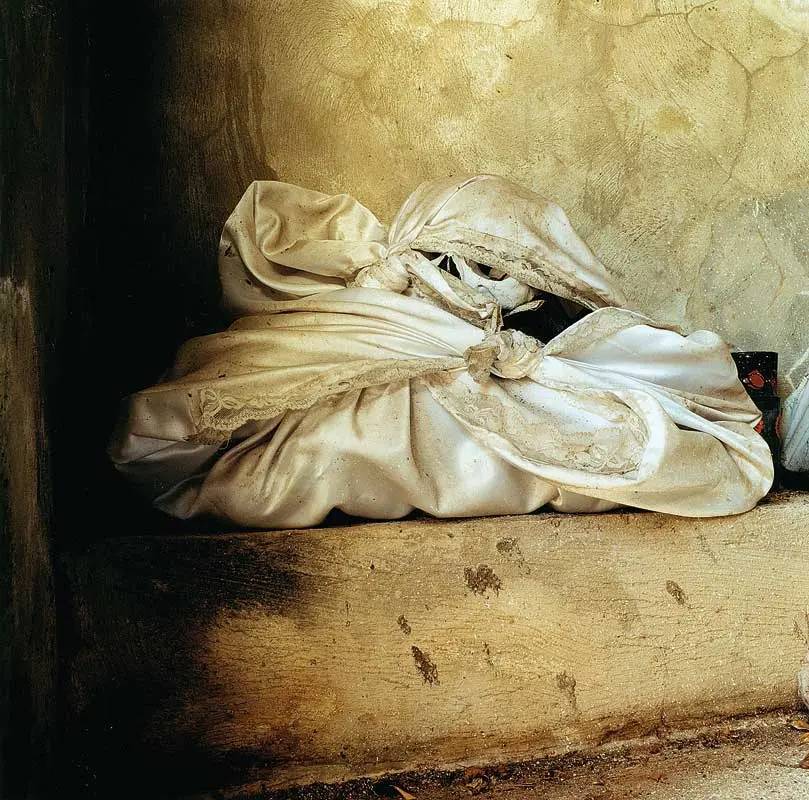
En vista is the title of the poignant exhibition of the couple’s most recent series of works presented by the Frost Art Museum. Encompassing seventeen chromogenic photographs, a video showing the couple’s working process, and a table with book-objects referred to previous series, this is a solid show. The photographic series is accompanied by an extract from Octavio Paz’s The Labyrinth of Solitude. Upon crossing the entrance to the show, the viewer is overcome by a controversial sensation. The formal beauty that dominates the series contrasts pointedly with its subject matter: death.
From a conceptual standpoint, Del Valle and Gómez introduce a point of reflection around the subject, which is somewhat of a taboo in the history of the West. A tradition where human beings resist a dialog with Thanatos, death as a normal result of the life cycle.
The photographs have been taken in the impoverished rural region of Yucatan, where death as an everyday occurrence is connected to nutritional deficiencies, in contrast with the high levels of violent death that characterize other regions of the country. In Yucatan, the act of burial does not involve sophisticated rituals: bodies are simply interred in their natural state, and exhumed three years later. Once out, the remains are cleaned, covered, and placed in an ossuary.
Every year on the Day of the Dead, families come to the cemetery carrying fabrics and cleaning implements to shine the bones and skeletons. This peculiar ritual seems to have developed on the basis of a Maya tradition according to which on that day the soul of the dead return to share with the living and enjoy the things they enjoyed while alive. The body remains the proper receptacle, thus the families’ effort to pay tribute to it as a welcoming ritual. Once the bones are cleaned of dust, they are covered with fabrics printed with motifs that connect to the dead person’s personality. These clothes must be changed every year.
Del Valle’s and Gómez’s photographs in this series introduce a new polarity, based on the genres of art. We encounter here at once portraiture and still life, and our reading of the show will depend on our own positioning regarding the subject. The show also stands out because of its chromatic unity. Three color zones are salient: the sepia of the stone, the white of the canvas, and the unmistakable Maya blue that emphasizes the presence of the ritual of the dead, and which, from a symbolic standpoint, underscores the idea of immortality—this natural pigment is water- and time-resistant, preserving to this day the brightness that characterizes it.
Abstracted from time, the photographs included in En vista constitute a metaphysical treatise on human existence. At times, the empty bowls interpellate us, as if through them the soul of the dead person were talking to us. On other occasions, we seem to discover traces of the subject’s personality, and inevitably we seek to reconstruct the life contained in the bone. Little by little, we are freed from the dark weight that the West has imposed on death, and we look at it softly, without fear, and we are reconciled with it as a natural, final stage of our transit through life.
JANET BATET