Federico Uribe is known for his painstaking installations created with simple everyday materials such as papers, straws, and wood sticks. These are not traditional sculpture materials; nevertheless, Uribe looks at it from a different perspective and uses them to build his pieces.
However, in his last exhibition titled Abstract-O at Praxis, Miami, he went in another direction and instead of the expected figurative installations, presented individual abstract pieces. There is a clear and distinctive evolution from his earlier work to what we see in this exhibition. His previous work had a more realistic tendency; in some instances imitating convoluted and elaborated scenarios populated by many creatures. Now we can see how he is moving away from the explicit narrative towards a more abstract and conceptual approach. He is getting away from the barroquism of his installations to create “cleaner” pieces by focusing on the objects per se and not in ‘telling a story as do his installations.
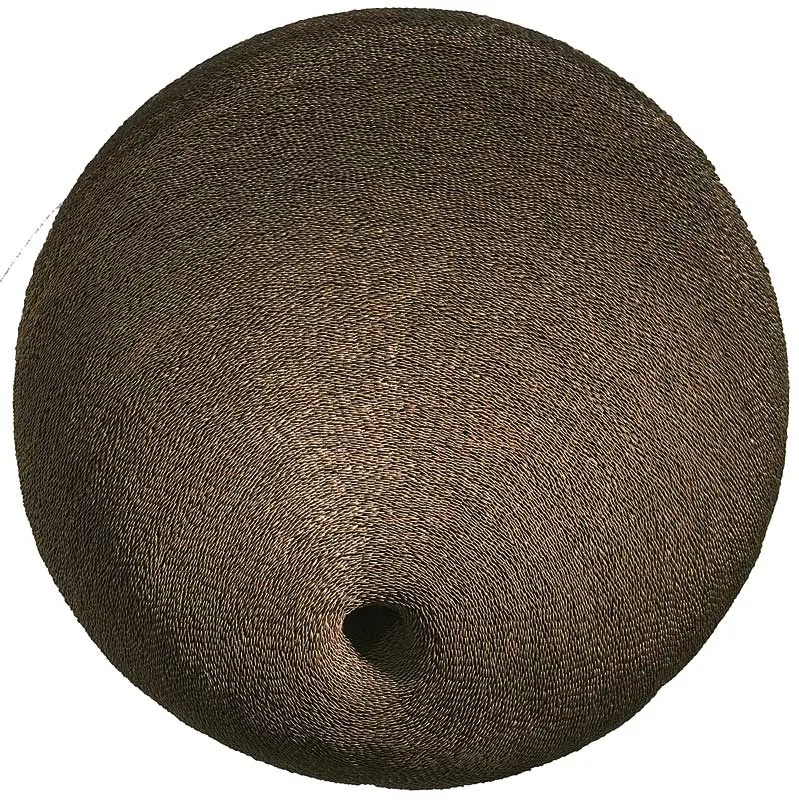
Although following a similar principle of construction, these recent pieces are rather different. Looking at them from far away it seems like an organic and fused unit, but getting closer is a different story. These seemingly abstract pieces upon closer inspection reveal a whole new level of detail and intricacy. Constructed in a weaving pattern each element is tied to the next, in an apparent repetition. This is his trademark: deconstructing objects to make new ones. The intrinsic beauty of these pieces lays in the principle of construction. For Uribe a pencil has a new mission; he is not interested in it as a writing tool, and he looks at it as a working material, as one of the elements that would allow him to create new artwork. These “nest-like” pieces resemble the natural ones made by birds, and in a way, it is following the same principle by interlocking elements until new work is created. But the artist doesn’t limit this system to pencils; he also uses other dissimilar materials such as coins, like in Buddha, using pennies to make an attractive round piece in an ascendant pattern, similar to a hummingbird nest.
Some of the pieces show what can be interpreted as an apparent contradiction. Good examples are Oriente-Occidente (East-West) and Ying-Yang. Conceptually it is representing together two very different units, apparently opposed by principle if we think about the contrasting ways of both sides. This is what he is reflecting formally in Oriente-Occidente, the center of the piece is made out of plastic forks, creating a rough surface, while the outside is made by woven wood sticks. Visually the piece resembles a sun, with a tide nucleus and a surrounding aura. Conceptually he is alluding to the furthest hemispheres and its contrasting life philosophies. Ying-Yang was done with the same principle in mind and the surface dissimilarity comes up again, but this time colors are used to intentionally reinforce the deviation: the inside of the piece is smooth and red while the outside is made of shiny metallic grey spikes. Theoretically, he is alluding to the legendary simultaneous, opposing sides that are part of every being, the two ends of the spectrum touching each other.
Cultural Gap is, by all means, a decisive piece. Books are an excellent metaphor of culture, so by using them as materials for a piece titled Cultural Gap he is referring to the lack of culture and the misunderstandings that come out of it. Corner is another piece made of “woven” books. Literally placed on a corner it seems to defy the laws of gravity.
Entretenedores (Entertainers) is another ironic piece in which Uribe plays with language and its possible interpretations for a bilingual person. Made of forks (tenedores) he uses the title as a clue, which in Spanish could mean literally “between the forks” but also could be an entertainer.
These attractive pieces raise immediate questions: What is it? What is it made of? What is behind each of them? The need to touch them is almost inevitable, and we have to fight to keep up with the well-known and long-established behavior in art galleries and museums. Nevertheless, our surprise only grows by reading the labels and realizing that Uribe is using anything he can lay his hands on, elements that we see in our daily life, and never thought of it as an art material. He is a “maker” on a mission, by deconstructing everyday objects and making art with them he is bringing in front of our eyes a completely new reality. He can see beyond the external appearance of an object, extract the essential qualities, and convert it to new ones.
IRINA LEYVA