
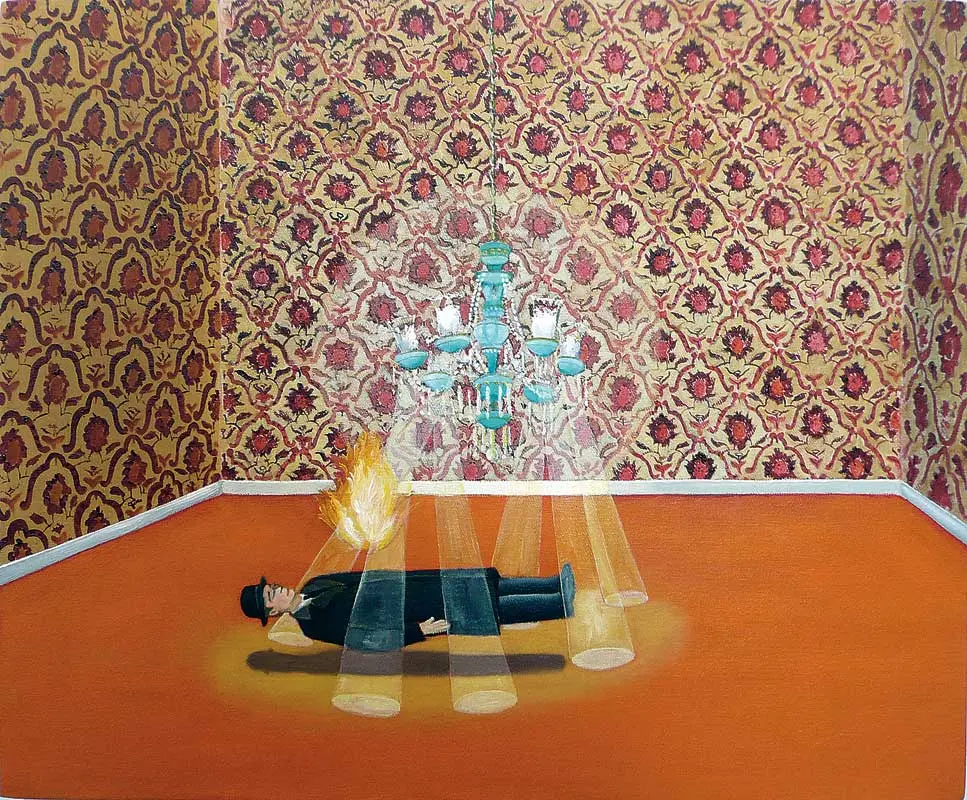
At the foot of a long hovering staircase, a magrittian man in a bowler hat stands holding a shovel, overlooking what seems to be a hole in the icy ground beneath a chandelier that ornaments the otherwise empty, pale blue and white space (O Inevitável (um enigma aflitivo que o vinha torturando havia algum tempo), 2009); he appears again in a different painting, lying outstretched beneath a different chandelier, body outstretched hovering slightly above the orange ground, while a flame burns beside him and rays of light illuminate him theatrically in a space enclosed on three sides by decorative print (Brilhante, 2009). The alluring scenes portrayed in Rio de Janeiro-based Flávia Metzler’s (1974) exhibition Sensação e Crise (Sensation and Crisis) at Galeria Leme’s project room from March 23 to May 8, 2010 in São Paulo are part of a series of nine small-format oil paintings that dot the walls of the gallery’s annexe.
Although the collection of paintings is inherently eerie, none of them is fantastical to the point of being surreal; suspension of disbelief is the order of the day in the realm Metzler creates. In a third painting, a lady dressed in a long black gown glides over what could be water, the red walls that reveal a floral print only where the ray of light coming from the fixture hanging above hits it, seem to indicate she may be indoors. Time, location and situation in all Metzler’s paintings are evasive and escape the viewer’s full grasp. She identifies her previous series as the point of departure for her most recent work, where previously she was concerned with the concept of parody and re-contextualised fragmented references of renowned art historical pieces. Although it is still evident in this series, parody is no longer a central concern; narrative and questions pertaining to the medium of painting take on more important roles. “References to parody are freer in this series; I try to leave them as open as possible. Interpretation, reactions and sensations are in the hands of the beholder” says Metzler, who proceeds to comment that she likes to refer to the environments she creates as “moments of suspension” and that her concern with the décor in each scene comes as a counterpoint to this, “almost as if it were the antagonistic element to mystery and intellect: the mundane,” something she brings from John Singer Sargent, one of her sources of inspiration along with Magritte.
A man sits on a short swing hung on the ceiling far above the ground, book in hand, while another in a straw hat and glasses dangerously hangs from the Deco chandelier in the winding stairwell (Homem dependurado, 2010). Humour is more evident in some pieces than others and Metzler brings it into these unusual scenes, perhaps inspired by Dostoyevsky who she holds as yet another source of inspiration for her recent work. “In Dostoyevsky, I search for profundity and simplicity, which I believe are strong aspects of his work, and the ease with which he creates embarrassing situations - I find it genius; he manages this with a great deal of humor.” In another piece, (Uma reunião inoportuna, 2010) three elegantly dressed men can be seen in yet another strange and amusing situation. One, crouched down like a frog, the next stands erectly looking into an elevator where the third man seems suspended in the air, either caught in mid frog leap or bizarrely hanging there unattached to anything. The un-poised situations constantly clash with the demeanour and elegance of the characters that inhabit them and the surroundings they find themselves in; the small format obliges viewers to get up close, which to Metzler is important in containing the sense of mystery and allure they emanate. Metzler’s painting is like small windows into disconcerting scenes that reveal the antagonism of narrative as construct and rupture with strictly linear notions of reality in painting.
CAMILA BELCHIOR