
Titled Homo Nymus, the new exhibition by Iván Puig (Guadalajara, 1977) at the Kunsthaus Gallery in Miami, reveals the ordinary in us. The allusion to the Latin root hommonymus (meaning to have the same name) refers to the attitude of a work that shares a new approach on the relationship between art and sociopolitical context. The aesthetical appropriation of what occurs to someone else’ body, through murder or being expelled from a territory –or even the emotional experience of boredom– becomes the connecting thread of an artistic practice that also involves working with a collective that searches for social traces
Belonging to a generation marked by disillusionment leads to a form of subtle irony that represents reality through ludic simulation. It is essential to mention the installation titled Hasta las Narices (Up to the Nose, 2004), which was created at the Haus Der Kunst Gallery in Guadalajara, where Puig created a fictional white Volkswagen Beetle almost entirely under a white liquid. It is an allegory of the generalized frustration in Mexico, four years after Vicente Fox had been elected.
There is a continuous line between this work and the later pieces also included in the exhibition Homo Nymus. Puig – who is additionally a homo faber and homo ludens – constructs works that address the common political tensions that include quantitative tools extracted from the social sciences. But these instruments for measurement and/or methodologies are not evoked as if they were infallible. They refer, instead, to an insistence on hard data that is overwhelmed by reality.
A photograph titled Expulsión (Expulsion) documents a project jointly developed in Guanajuato with Gilberto Espaza and Marcela Armas. Puig has been working alongside these two artists for years and has just formed with them the collective Tríodo, the name that appears in the information label for this intervention created during the remodeling of the Museo de Arte Contemporáneo in Oaxaca. The idea of referring to the large numbers of expulsions, in a state in which rampant poverty is only equaled by the presence of many social movements, led to the textual reconstruction of this phenomenon using the old wooden beams of the museum that were being discarded. The world “expulsion” was created on the floor and points toward the north – the cardinal point marking the people’s direction of exit – while the beams were cut to render a statistical chart. Each represents a year between 1950 and 2009, and its proportion correlates to the migratory net balance. With a dimension that permitted for the letters to climb, and the quality associated with the age of its material, the piece is the aesthetic expression of a chapter in Oaxaca’s political history.
In the installation titled Parallantos, the black and homogeneous open umbrellas –like those in panoramic cinematographic views of funerals of great personalities– are perpendicularly attached to the wall. The umbrellas close every 13 seconds –a number associated with the statistical average frequency of a violent death in Mexico and Colombia. A counter records each occurrence.
The statistic serves as a homogenizing medium and, as Puig notes, “it leaves out personal stories and particular elements.” Nevertheless, when the observer is before the piece, the closing of the umbrellas is a reminder that someone is dying at that precise moment. It is not solely about the problem presented by the relationship between the objects, as in the painting Hegel’s Holiday in which Magritte wanted to correlate water with the black umbrella. If Puig is actually invoking the rain-tears metaphor (he invents the neologism that in English translates as “for tears”), he is more importantly transforming statistical hard data into an aesthetical vision that confronts the spectator with the here and now of someone else’s death.
Likewise, resorting to a perspective removed from old ideological tones, in his diptych Jaque-Mate (Checkmate), we are sent back in time to two moments in the Twentieth Century: in Jaque, Puig uses iconography from the U.S. victory over Japan at the Battle of Iwo Jima (the U.S. flag raised on Mount Surabachi), which led to an era when there was, somehow, hope about world peace and progress. In Mate, the game board amid the rubble refers to the military actions that not only ruined Baghdad – the cradle of civilization – but eradicated also any hope for peaceful multicultural coexistence.
Irony is an instrument that can demolish false paradigms. In the installation Patrimonio (Heritage), Puig relocated the iconic typography of the Hollywood sign to the mountains that surround Oaxaca. Here, he purposely builds a scenography as artificial as the title given to Oaxaca – World Heritage Site – a place with enormous social problems, increasing violence, and low access to higher education.
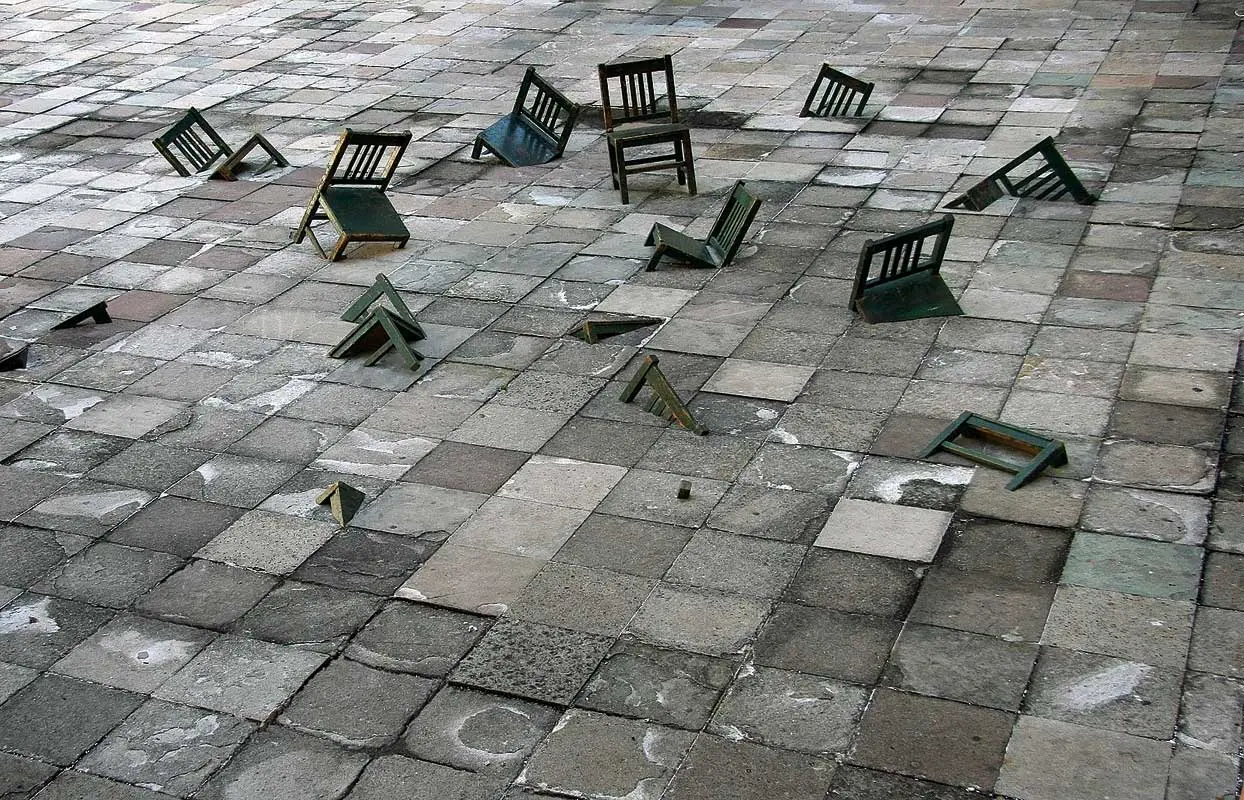
In the photographic diptych titled Crecimientos Artificiales (Artificial Growths), Puig employs once again the connection between a chair and human morphology as he destroys some chairs found at a teacher’s school in Oaxaca in order to create a scenography on the floor with the fragments arranged over traced diagonal lines. The eye cannot tell whether the chairs emerge or sink, but the apocalyptic atmosphere built with school objects leaves little doubt. We are confronted with a political aesthetic that emerges through irony – not ideology – in a world in which devastation is one more sign of uncertainty.
ADRIANA HERRERA