
For Jorge Pantoja’s contemporary, it is impossible not to subconsciously belong to that art zone recreated in Cinematheque the series of drawings on construction paper recently exhibited at Carol Jazzar Contemporary art. Pantoja’s compatriots, indeed, are united in an addictive identification with the movies, which at one point became, more than a pastime, a frequented avenue towards a legitimate space of privacy. Cinephile passion worked for us as a perfect window into an existential escape, thanks to which fact we devoured miles upon miles of celluloid and became veritable walking cinematheques.
As in any orwellian society, Cuba abounds in reasons for asphyxia that push citizens towards finding opportune refuges against angst and ennui. The movies are, undoubtedly, one of these refugees. A dimly lit room, peacefulness, relative isolation, and above all an encounter with foreign references that momentarily rip through the stringent veil of political coercion, turn the act of installing oneself in front of a moving picture a kind of armistice. Any film genre can function as an immediate opiate for the latest upheaval created by the social forge.
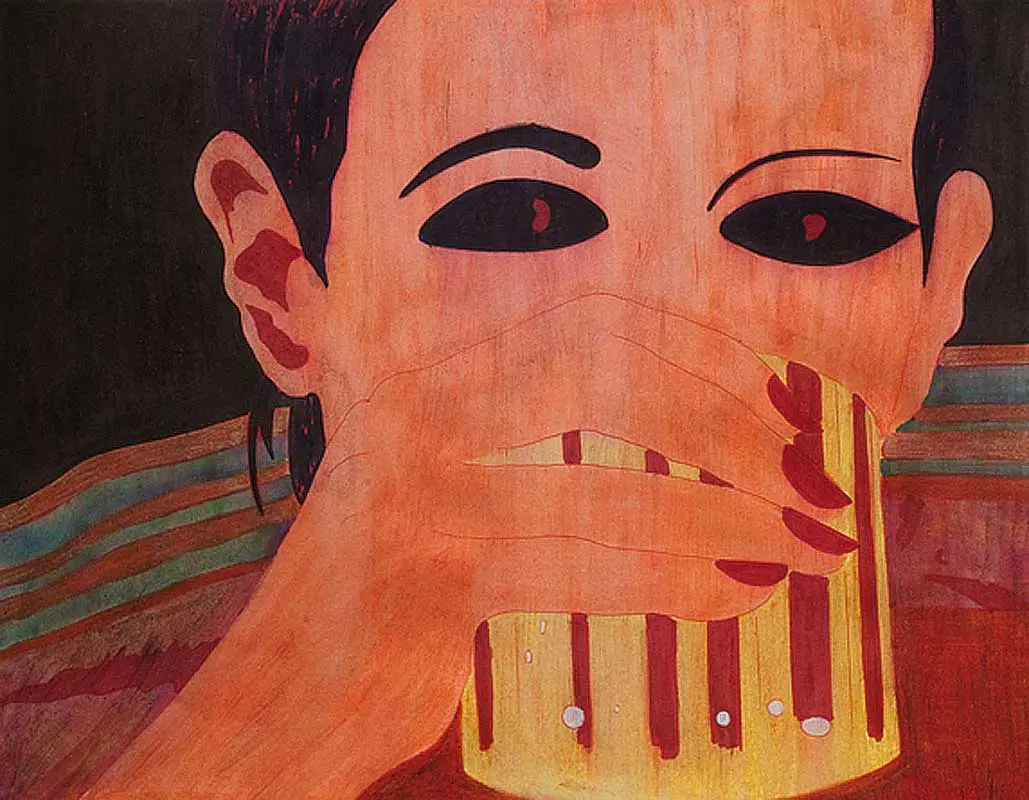
So, as we contemplate this show of Pantoja’s colorful settings, whose poetics calls forth an unfreezing of film memories, we intuit that what at first sight seemed the intervention of a passionate extractor and documenter of images captured in his sensorial cinematheque, is in truth the visible tip of a psycho-social iceberg that brings into coherence an entire generation under common cultural reactions to the phenomenon of the film in recent periods.
While a basic perception that includes the element of nostalgia is not far off what could be the aesthetic purpose here, a second reading helps us link Pantoja’s graphic conceptualization with that phantasmagoric transcendence Derrida finds in film, defined at some point by him as a “ghost-like” quality as he attempted to name the Freudian pathways through which the cinematographic image connects in a subliminal way an individual’s affective memory with the various events of his or her private and social biography. This explains why, beyond the reconstructive intention, vistas and characters lose literalness in Pantoja’s subjective filter, and are expressed as a cultivated reinterpretation that encompasses not only the original film-related theme but also the emotional commentary that flows, subconsciously, from the concomitant atmosphere that accompanied its embrace. This highly personal feature gives the artistic result a definite psychoanalytic identity and quality.
In Cinematheque as a whole, Pantoja processes from his own reserved space the selective information he internalized during the viewing of a film. He revitalizes its intellectual vestige and handles figuration and color according to the energy that emerges from the emotional trace. Compositions and attitudes attempt to involve us in a personal point of view that functions like a steadicam focused on recondite sensibilities, in the end recycling it as a notion of spectacle. In truth, this is an act of love for the photogram, a fascination that ends up being again shared in a collective consensus. Is there in this cinephile exorcism a more or less committed intention to free up pending grievances and complacencies rooted in life experiences that persist still, like ghosts?
By making us participants in his viewfinder, Pantoja assumes the mission of the filmmaker with the pulse of a painter and applies it under revisionist criteria to the capture of images that are empathic for him. For example, the vision of Danny —the boy from The Shining– riding his tricycle that we find in Dèjà vu D.J is much more Pantoja than Kubrik, because, without denying the psychotic essence of the scene, the confiscatory maneuver in the process of recovering fiction is evident here. Such personalization sets the act of aesthetic appropriation apart from the sterile duplicate and gives representation an “other” value. At any rate, at the expense of subjectivism, the memory of the observer-viewer will work involuntarily to complete intangible sequences and recover the historical datum that brings it closer to the original film.
Pantoja has brought together in a balanced way the spontaneity of the storyboard with classic comic book elements, codes from Cuba’s film poster tradition, and even from the design of pop book covers. He has mixed them elegantly in his photograms, and we are surprised by the temperamental chromatism of an artist who had accustomed us to his working in black and white, and who has made use of color pencils, acrylic, and pastel ink to fill this playful recreation of his cinephilia with contrasting intensities. However, the flat composition and the almost cut-out figuration, á la Alex Katz, adopt a taciturn theatricality wherein what is represented seems to extend as an invisible periphery, a factor that reinforces the psychism of Pantoja’s colors. This is a delicate retreat posited in narrative units that work like close-up shots in Uncle 29 and Fortress, medium shots in Undertaste and Capital Variable, or bold vistas like the zenithal high-angle shot of Encounters where a furtive correlation beyond the clean-cut borders of the remake is intuited.
Speculation, abstract distance, is part of the mystery of Pantoja’s “movies within movies.” Its eloquence resides on the alloying of scenic immediacy with the suggestiveness of related presumptions, functioning as a silent threshold for the successive resonance inside us. Be it cathartic or reflective. Definitely, cinephilia always implies an exchange between intellect, experience, and the emotional impact of the received image.
JESÚS ROSADO