A culturally revolutionary iconic figure and refined poet, Juan Luis Martínez (1943-1993) developed, alongside his writing, an object-work that was unknown despite its being groundbreaking. While he had originally exhibited it in Valparaiso at the beginning of the 1970s, it was not until the year 2000 that one part of that work was finally presented in an important art space. Art critic and curator Justo Pastor-Arellano included two pieces by Martínez immediately prior to inaugurating Chile, Cien Años de Artes Visuales (Chile, One Hundred Years of Visual Arts), an exhibition organized by the Museo Nacional de Bellas Artes to bid farewell to the Twentieth Century. According to Pastor-Arellano, the collages – created with pieces of wood, bits of cords, rags, fragments of musical instruments, pieces of texts or photographs from old publications – contributions from Dadaism and Surrealism borrowed as they were, from another time and place, because his works unexpectedly embodied a moment of the 1980s Chilean neo avant-garde – accustomed to creating elaborate games between the visual and the text in works of authors such as Eugenio Dittborn, Raúl Zurita, and Diamela Eltit – was awaited with great anticipation.
Between March and April of this year, the exhibition titled Señales de Ruta (Route Signs) evaluated the relevance of Martínez’ work by showing nearly thirty pieces that had been kept by Martínez’ widow, Eliana Rodríguez, and that dated from 1965-1990. The posthumous publication titled Aproximación del Principio de Incertidumbre a un Proyecto Poético (Approximation of the Principle of Uncertainty to a Poetic Project) was a publication entirely under the curatorship of Ronald Kay, a close member of this poetic, artistic, and intellectual movement.
A mere glance at Martínez’s writing allows us to understand the intersections, mechanisms, and common intentions between both productions. They are indeed an indivisible unit, a single great proposal on language that takes on linguistic aspects, as well as objectuality, materiality, and spin. In the few writings that he published, Juan Luis Martínez also worked with the book-as-object and contributed a tradition marked by Lewis Carroll’s games of logic and the Guillaume Apollinaire calligrams.
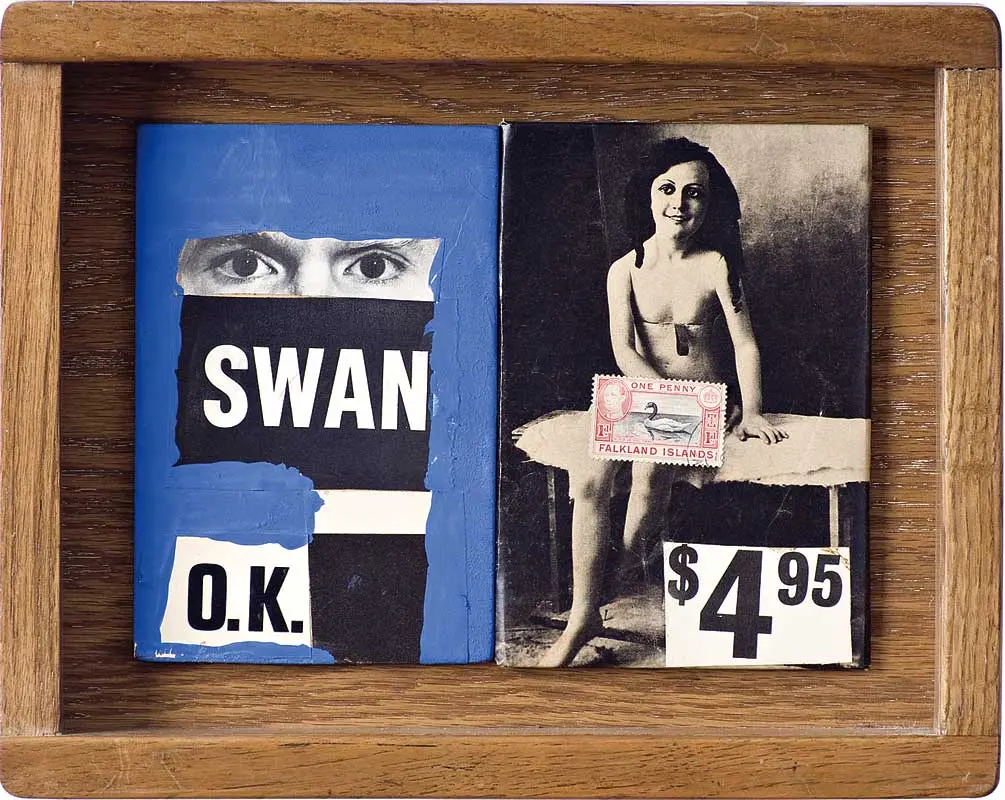
The collages of poetic objects again connect words to images. They are presented as surrealist riddles or visual enigmas in which apparently found and randomly sorted remnants are actually very well-thought-out compositions. This is a strategy that, in the artist’s first published work La Nueva Novela (The New Novel, 1977) represented a complete separation from Chile’s literary history. Integrating quotes and texts of various origins became a way to demystify the concepts of originality and authorship. Fragmentation, the intertext, the multiple voices about to merge into a whole that burst like a game of mirrors are parallel exercises and ones that are akin to the “poetic of the library, of the archive” of Martinez’ assemblages that take us through – in our first approximation – old book libraries, stores selling naval objects, and streets by seaports where ancient glories linger. Valparaíso is where Martínez was born and where he lived during his rebellious youth as he became a legend.
Minimal pieces, multiple unconnected vestiges, and cut-outs acquire an order inside his small frames or displays: intimate corners, starry views of the sky, useless contraptions, and remembered faces turn into the visions that the artist proposes on the walls. In Señales de Ruta (Route Signals), Martínez draws a travel logbook under sepia veiling. Each window permits a look into a past that acquires an erratic relevance. His works are not merely museum pieces – anomalous versions of Joseph Cornell, Duchamp, or Kurt Schwitters – in an extravagant and germinal episode of Chilean conceptual art.
The chronological survey renders this exhibition increasingly enigmatic. In his engravings from the later part of the 1970s and throughout the 1980s, a gap begins to appear in the relationship between image and text, and the end result is Aproximación del Principio de Incertidumbre a un Proyecto Poético. At the center of each large blank page, refined pictograms follow one after the other as they order and reorder diagrams, formulations, and ideas. The circle, the four elements, the Kultrún Mapuche, the I Ching, scientific diagrams, and mathematical conjectures; phrases like the notion of the double, the death of the poets, the book inside the book, the copy as original. This latter idea is embodied by the publication itself as a sort of paradoxical mirror in which photocopies from the 1980s were reassembled and digitized until achieving originals of great visual neatness.
In the precarious constructions of “dirty” objectual remnants, there is also tidiness and thought; in quotations, transferences, and combinations, there are constructions at play of a world in which time and space are reformulated. Certain strategies reverberate in the Chilean art scene of the 1990s and 2000s, when several artists worked – with common urban objects and situations – in recollection operations of consecutive technical and visual transfers and syntactic reorganizations that become critical within the context of great aesthetic asceticism. On viewing these recent proposals by Martínez, we find that he has returned to the poetry he had lost. The remnants are not only evocative and rhetorical graphic arrangements but are also conceptually charged signs activated with secret formulas that suspend contemplation and lead us through the rabbit hole.
CAROLINA LARA B.