
The exhibition of Argentine artist Marta Minujín, MUNUCODEs, held February to April of 2010 at the Americas Society, seems as fresh today as it was in 1968 when it was first created. The work features a series of documentation, photographs, edited footage, and interactive media based on four cocktail parties with 320 participants from the worlds of fashion, politics, business, and art. Curated by Gabriela Rangel and José Blondet, the exhibition filled three separate rooms at the Center for Inter-American Relations (CIAR), in which pre-production and execution of the work were blended together as one and the same.
The happenings involved a series of steps, including a questionnaire for participants, a selection process determined by the artist, and various hands-on activities. To maximize visibility, the artist published the questionnaire in several newspapers, including The New York Times, Village Voice, and Women’s Wear Daily, from which Minujín received one thousand responses. Among the applicants were senators, economists, fashion designers, and models. Against the backdrop of a cocktail party, the work not only enforced the mixing of these professionals but also challenged stereotypes of uptightness and alienation associated with them.
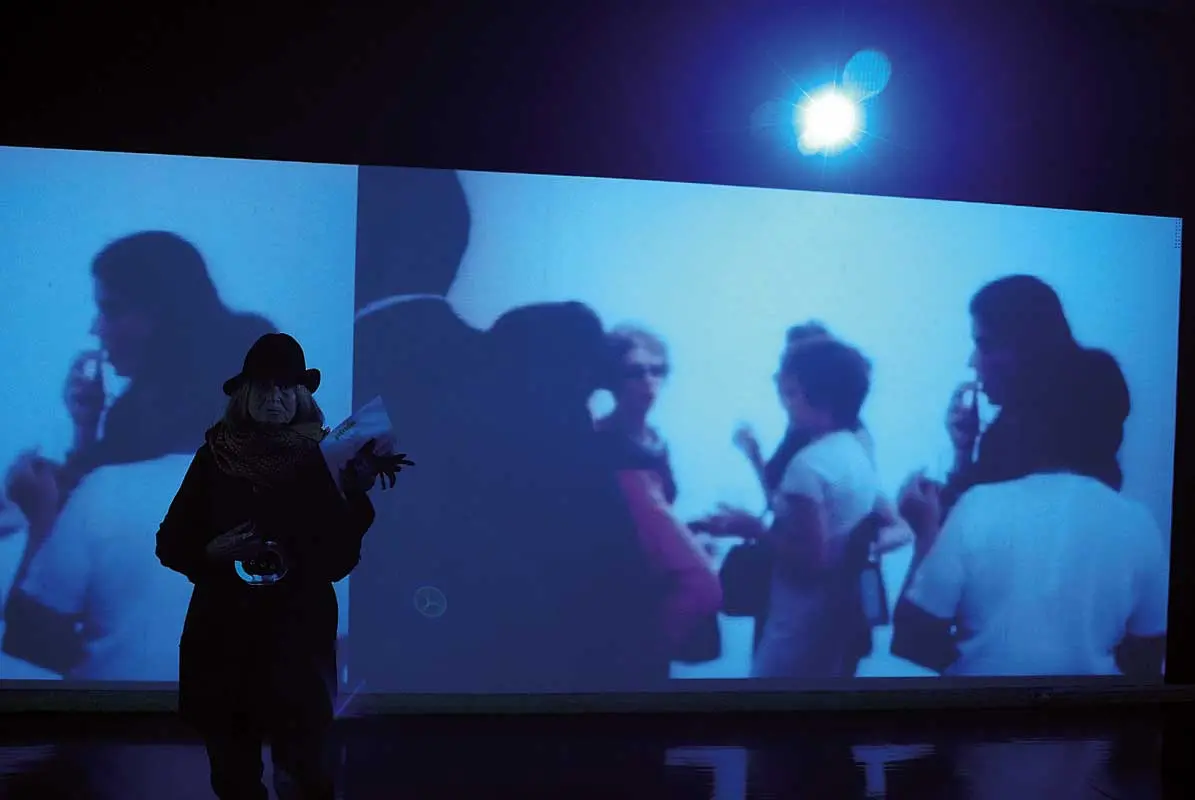
The main room featured looped projections from the cocktail parties, in which participants chatted and flirted with each other, sipping their drinks to psychedelic rock. Always aware of looking and being looked at, protagonists in the video became objects of the gaze, both inside and outside of the footage. Yet the all-round projections engulfed the real viewer in the gallery as an actor in the extension of the event. This expanded field of sight and participation suggests a link between the notion of an ongoing party, typical of the 1960s celebrity culture, and relational aesthetics. An adjacent room contained numerous black and white photographs displayed on walls and glass tables, alongside descriptions and samples of the questionnaire, creating an awkward sense of archival ambiance, given the artificiality of the subject matter. This part of the show enabled one to spot celebrities perusing the photographs, including the cellist Charlotte Moorman, John Perreault, Al Hansen, Veruschka, Diana Vreeland, and others. The artist herself was often detectable, wearing a tiger-print shirt and an oversized hairdo. Dressed as a stereotypical Puerto Rican, she called this outfit translación de clases (translation of classes), a call for the blurring of social distinctions. Finally, a third room uncovered electronic gadgets of the 1960s, with an electronic board containing images and songs to be selected by viewers, allowing the song to be performed while projecting slides on the wall. Like parties from the ‘60s which carried a projection of psychedelic imagery accompanying rock & roll music, with several works created by participants of the project, this room offered a glimpse into the party electronic gadgets of the period.
Like other contemporary artists of her period, Minujín was also involved in expanding the limits of the art scene, especially working to bring visibility to Latin American art. One of her projects was the founding of the magazine Cha Cha Cha, with Juan Downey and Julian Cairol. Her interest in media went far beyond that of a dilettante, as she sat at Oscar Masotta’s lectures and reading groups in Buenos Aires, based on texts by Claude Lévi-Strauss, Ferdinand de Saussure, and Marshall McLuhan, who influenced her ideas and works. In 1966 she created Simultaneidad en simultaneidad (Simultaneity in Simultaneity), a series of simultaneous events originally planned to be included in Three Countries Happening, with Allan Kaprow and Wolf Vostell in New York and Berlin. On the Argentine side of the event, Minujín selected sixty local celebrities to participate, based on the number of mass media reproductions of their faces. This work was also broadcast by radio and television, and watched by groups of celebrities in the theater at the Di Tella Institute. Radio and TV public were selected to receive phone calls and telegrams during the project. In 1967, she was included in the Happenings of Montreal’s Expo 67, presenting Superheterodyne and Circuit, works that also entailed the inclusion of electronic media and participants. These works also included surveys published in major newspapers, asking people to describe their favorite physical features of various celebrities, such as Frank Sinatra and Marilyn Monroe. The responses included those of famous athletes, actors, and writers. In Circuit celebrities sat together chatting inanely while watching themselves being broadcast on the television sets around the room. Minuphone was another multimedia environment in a phone booth, which received reviews in Time and Newsweek.
The rise of celebrity culture over the last forty years, a reversal process of the elitist environment of the late 1960s, was immeasurably important. Minujín’s work was strategic in rethinking the link between art and media culture, then restricted to an elitist milieu. In her articulation of surveys and questionnaires through mass media, she anticipated media mechanisms of public access, participation, and ratings that are indispensable in today’s media culture. In addition, she exposed the vaudevillian characteristic of a narcissist and self-absorbed celebrity culture, not a critique, but as an immersion into a shifting culture at large. Celebrity culture, as well as elitist art, were at the time inaccessible to the impoverished masses in Latin America, in contrast to today’s assimilated immersion of global culture. Although Minujín’s work is quite distinct from other artists of her generation, such as Cildo Meireles, whose concept of circuit, in his Insertions into Ideological Circuits, took a more sociopolitical direction, or the use of the participant as part of the work by Hélio Oiticica and Lygia Clark two decades earlier, her employment of media strategies, such as insertion, circulation, dissemination, and obsolescence in regard to contemporary art in the late 1960s was then pioneering. These concepts clearly influenced artists working with media cultures, as well as collaborative interventions and art collectives since the 1990s and 2000s. Minujín’s work locates new awareness on social differences, redefining the boundaries between media culture and the visual arts.
DENISE CARVALHO