
The arches and balustrades of the Beaux-Arts courtyard at the Newark Museum—where Paul Henry Ramirez recently created an installation titled Blackout—acts as the perfect foil for the exuberant confrontations between rectilinear and biomorphic forms that the artist stages in his paintings. A large, airy space that evokes the ambitions of public buildings of an earlier era, only Ramirez’s bold use of color, especially bright neon and matte black, could intervene in this grand architectural setting to such transformative affect.
Essentially a painting one can inhabit, with Blackout, Ramirez shows us that we can perceive architecture and abstract painting in essentially the same way: as a sensorial experience. Whatever meanings we associate with the abstract syntax of his paintings—Ramirez’s forms suggest female and male, joy and sadness, action and repose, among other pairings—his transformation of the Newark Museum’s courtyard into a large-scale, three-dimensional painting shows how color radically changes our experience of architecture. By applying bright colors and matte black paint to the arches and interior walls of the courtyard, Ramirez proves that we perceive volume, space, and color in architecture and paintings in ways that are surprisingly similar.
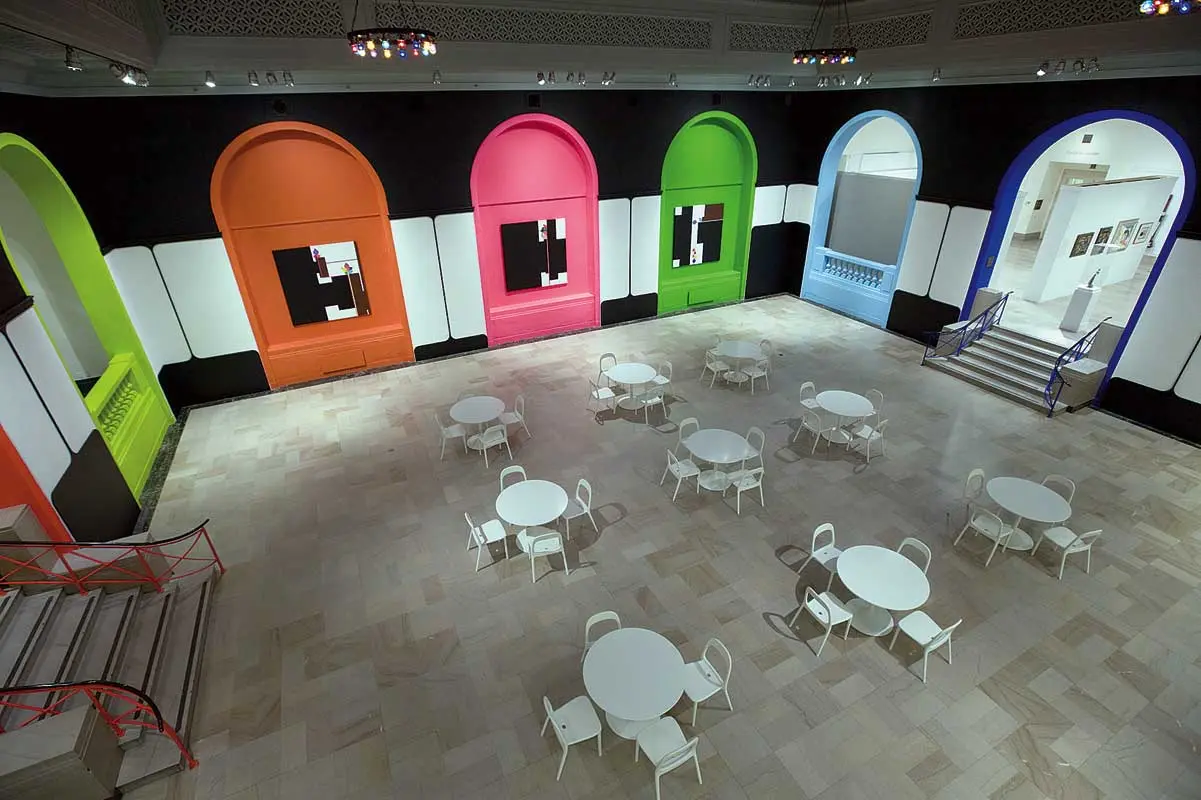
Blackout becomes visible as views accumulated in the process of approaching and occupying the museum’s courtyard, which is encircled by galleries displaying mid-twentieth century abstract paintings from the collection. The visual punch of the sunflower yellow, baby blue, and neon pink Ramirez has painted the arches and balconies draw us into the courtyard’s interior. There we find that the brightly colored arches frame walls Ramirez has painted with a horizontal band of black. We also see that Ramirez has vertically intersected the sections of wall between each arch with a stripe of black paint, which look like drips, pooling into rectangles at varying heights around the courtyard. Because these black rectangles are made of painted plywood laid flush onto the walls, they project ever so slightly. The resulting effect is that these forms, which echo the rounded rectangles that have been present in Ramirez’s paintings for a decade or so, slip between positive and negative readings. Depending on where you are standing, they recede and project into space, as do the white walls above them.
On the one solid wall of the courtyard, where arches form a series of niches, are paintings created especially for this installation. Turning the historical function of these niches on its head in a way—the niches look like they are meant to display portraits of civic leaders—Ramirez has installed three abstract paintings that both constitute a triptych and are integral parts of the installation. Each human in its scale, measuring six by six feet square, and each featuring his signature bulbous forms being squished by large black or brown rectangles, these paintings pit small, soft forms against large, hard ones. Like much of Ramirez’s imagery, these forms are sexually charged. However, this series of paintings feels different because he juxtaposes the lyricism and humor of his biomorphic forms against the heaviness of the hard-edged geometric ones. Ramirez’s juxtapositioning of these two brands of abstraction endows these paintings with a sense of struggle and psychological heaviness that is new to his work, especially in the painting hung in the central niche, the left half of which is entirely painted black.
The forms in Ramirez’s Chunk paintings also, of course, relate to the curved and rectilinear shapes of the courtyard’s Beaux-Arts architecture. The curves of the brightly colored arches echo the bulbous forms in his paintings, and black rectangles are visible on both paintings and walls. The comparison that Blackout compels us to make between these elements speaks to paintings’ desire to escape the confines of two-dimensional space, and transform architecture (for the emphasis is the effect of Ramirez’s painting onto the architecture, and not vice versa). This desire—which reiterates the utopian ambitions of many of the artists in the concurrent exhibition of abstract painting from the 1920s to the 1950s, Constructive Spirit—makes Ramirez’s paintings look historical, another marked difference from previous work.
Blackout also speaks to the centrality of aesthetic experience in so much contemporary art these days and testifies to the fact that issues of identity continue to play a significant role in installation and painting. Even though the paintings incorporated into this installation are less scatological than Ramirez’s previous work, they nonetheless show that subjectivity still motivates his painting, as it does many of his peers who, like him, emerged during the mid-1990s (including Arturo Herrera, Carroll Dunham, and others). Above all else, however, Blackout reminds us that the best painting strives to be a sensorial experience.
HARPER MONTGOMERY