Sobre el Miedo (On Fear) is a recent exhibition by young Puerto Rican artist Quintín Rivera-Toro at the prestigious Museo de las Américas in Old San Juan. It is a powerful retrospective that ensures some of us who have been following the work of this artist – as well as the general public and local and international art critics – realize once and for all that we are in the presence of an extremely talented, original, and provocative artist with very particular interests that continually combine the local realities of a Puerto Rico, a colony replete with contradictions and, at the same time, a globalized country with a society that, while verging on capitalist schizophrenia, also demonstrates exceptional generosity; these are people who live on a beautiful island where concrete is the great enemy, and where they love nature because it is part of who they are.
Through his fascinatingly eclectic artistic production, Quintín Rivera (Caguas, Puerto Rico, 1978) displays great intelligence, talent, professional rigor, originality, and visual and cybernetic resourcefulness in works that range from public art to videos and installations, paintings, and to photographs that can be politically ironic or beautifully innocent. Like Stanley Kubrick, who never made a movie similar to an earlier one, each of Quintín Rivera’s works – like those of other Puerto Rican artists such as Allora & Calzadilla, Ignacio Lang, Michael Linares, Karlo Ibarra, and Charles Juhazs – represents a new and different visual and existential challenge. The aesthetic and ethic conveyed in each of his works are an invitation to complicity. He wants us to be co-authors of his poetic photographs of chairs and armchairs, like those he proposed in the dramatic words, logos, existential screams, and “warnings” (large-format paintings on canvas, wrinkled with great effectiveness), which he presented at the Young Art Contest of the Oriental Bank – in which he was awarded an Honorable Mention, or like the exhibition Sobre el Miedo.
The written word – more predominantly present in his most recent pieces – becomes the element that holds together the unity of his works. Borrowing from the history of art – from Magritte’s This Is Not a Pipe (1928‒1929) to various other contemporary artists who are required to explain their works in the work itself in order for their art to pass muster – and from postmodern philosophers who take it upon themselves to summarize and correct their works in the notes included in the margins of their books (I was a student of Eco and Derrida), Quintín Rivera reveals this attribute from his interpretations of The Little Prince by Saint-Exupéry, to the T-shirts that he transformed into phenomenal photos (Chavista); from his playing with the famous quote attributed to Santillana, “A nation that does not know its history is doomed to repeat it,” which he interpreted through an impressive installation/game in Sobre el Miedo.
Although he had produced important works before, Quintín Rivera finds his voice in the rich Puerto Rican visual art world in 2005, when, as part of a public art project, he presented the work titled Un Espacio Libre (A Free Space): He filled the entire city where he was born – Caguas, an unattractive city from an architectonic point of view, but one that is surrounded by spectacular mountains – with monumental windows, billboards, and blue photographs of the beautiful sky and clouds of Puerto Rico, establishing a dialogue and confusing/fusing the preposterous architecture of the city with the natural beauty that surrounds it. It is then we realize that – whether we are driving in our cars or walking – we usually do not recognize, appreciate, or enjoy our beautiful Caribbean sky. Un Espacio Libre was a truly aesthetic national experience that not only turned Quíntin Rivera into a household name but also made those of us who love the visual arts immediately stand behind this daring and controversial – but always ingenious and provocative – artist.
The impact of Un Espacio Libre was followed by an enigmatic, but attractive, photographic work, and most importantly, by his meaningful participation in and commitment to promoting the arts as Director of the Área – Lugar de Proyectos – cultural project, an alternative space where many emerging and nationally and internationally prominent artists and intellectuals presented installations, performance, exhibitions, conferences, talks, symposiums, movies, videos, etc. His participation in the 2007, 2008, and 2009 editions of Circa – with paintings, drawings, and photographs – solidified Quintín Rivera’s position as one of the leading artists of his generation. Nevertheless, the great problem with Quintín – shared by many other Puerto Rican artists such as Michael Lunares, Rito, and Karlo Ibarra, to name a few – is that he wants to arrive too soon to where Allora & Calzadilla are, and he sometimes is perceived as a self-destructive, cocky artist who demands too much recognition too soon.
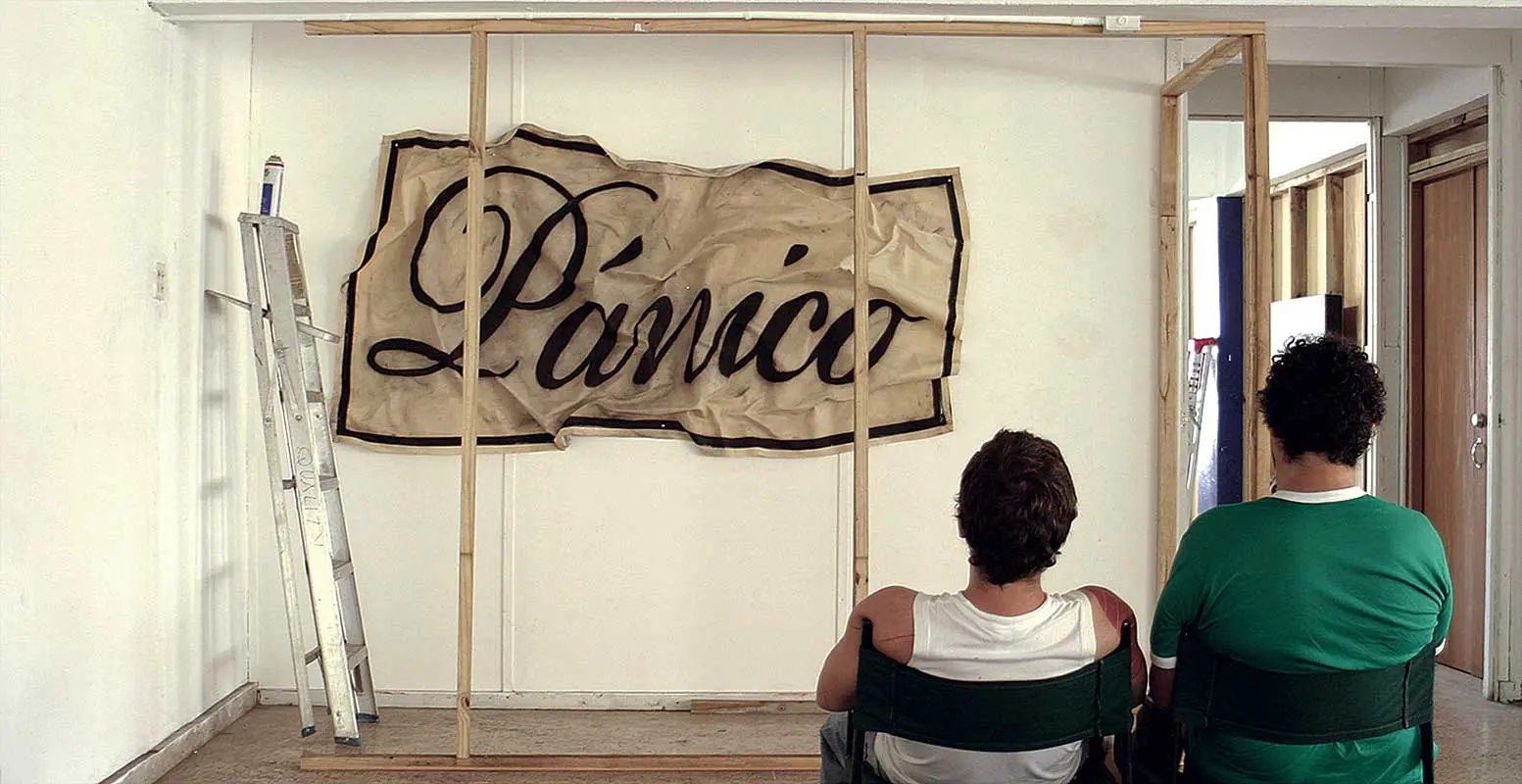
In Sobre el Miedo, the public saw minimalist works such as Off Signal, The Relentless Pursuit of Perfection, a demonstration of flawless typography; Repetitions, in which he writes in English and Spanish the famous quote, attributed to Santallana, on several envelopes that he sends to various people through the U.S. Postal Service; Vulnerabilizaciones/Vulnerabilizations, a monumental, wrinkled canvas containing very provocative words/phrases/sentences – like, for example, panic, the people have spoken, ire, international chaos, collective rage, euphoria, the happiest country in the world, among others– and interesting photographs of people looking at them; Ghavista, a brilliant photo that plays with the images of Superman and Clark Kent; a truly poetic photo of an armchair, and his adorable but brutal El principito (Little Princes), with their surprising quotes; among other works, as each of his works prompts our immediate reaction and invites us to engage in future reflections.
The connecting thread in Quintín Rivera’s works –and this is very clear in Sobre el Miedo– is the intelligent and original construction of a healthily narcissistic autobiographical self, as well as a profound and sharp criticism of the bourgeois society –to which he and his family belong– that controls everyday life in Puerto Rico. The construction of this self is something we can clearly observe in his “submarine” photographs, in which he becomes the model to admire, the object of desire that, even as it is surrounded by other kinds of beauty, it becomes one. Nevertheless, in this instance, Quintín Rivera was not sufficiently daring: if he had chosen to show himself naked in these monumental photographs, these would have been closer to the mysteries of Eros than to the advertising photos published in any magazine dedicated to swimming or submarine activities.
In Vulnerabilizaciones/Vulnerabilizations – in my opinion, the best this exhibition has to offer – the “paintings” could easily participate in any respectable biennial along with the works by Lorenzo Homar and Antonio Martorell – we already observe an artist who is much freer and more mature in the sense that currently, all of the art now produced by Quintín Rivera addresses our political life (de polis from Plato and Aristotle). Through his works, this artist reminds us that we are social beings, that our goal is to ensure our individual and collective well-being, and that we must repudiate any injustice. Thus, his fear is that we will become “wolves of the steppes,” only interested in our own survival/well-being (Hobbes), and therein lies the importance of the exhibition: Sobre el miedo y otros problemas del subconsciente colectivo (On Fear – and Other Problems of the Collective Subconscious).
MANUEL ÁLVAREZ LEZAMA