The history of art has been a rich well for the work that Rubén Alpízar has been creating for the last two decades, a time marked by the modulations of a discourse described by the art critics as neo-historicist, but most importantly, one that is influenced by the postmodern spirit that elevates the hybrid. Resorting to quotations and appropriations, the artist formulated a devastating, ironic, sarcastic, and parodic commentary on the power of totalitarianistic stories. Alpízar’s work has resulted in a (re)construction or (re)positioning of the mythic from a contemporary perspective, in the sense that his arguments have range from the sacred to the profane and have now settled into their contextual surroundings – after a gradual transformation that began in 2003 – as is thoroughly evident in his most recent exhibit titled Cenizas del Paraíso (Ashes of Paradise) at the Villa Manuela Gallery in Havana.
Relying on the title that he gave to his parody La Creación (The Creation), Alpízar created a group of ten pieces from which he drew a transition that began with the universal proposal of his parable on human irrationality, and that then centered on an – increasingly ascending and consolidating – self-referentiality, which he has used to convey an insular spirit that is, nevertheless, also global in appeal. Such an evolution established a more diaphanous (immediate) cause and effect relationship between being and time, which he apparently utilized to respond to an inquiry similar to that undertaken by Antonio Gramsci concerning what the human being is – or more precisely – what could a human being aspire to be, this having been defined by Gramsci as the process of his actions, a thought that is present throughout the entire exhibition.
A long line simulated the cars of a train in Mi Arca (My Ark). Here, Alpízar placed a good part of what he would wish to save – as a sort of declaration of faith. The metaphorical impulse of a locomotive allowed viewers to observe several paradigmatic characters peering through the train’s windows – perfect frames of tiny and masterfully executed portraits – such as Christ, Da Vinci, Velázquez, Goya, Van Gogh, Duchamp, Warhol, Kahlo, Fernando Ortiz, Lezama-Lima, Martin Luther King, Virgilio Piñera, Gandhi, and Gutiérrez-Alea, among others, who represent Alpízar’s artistic and ethical inheritance.
A daytime, gimmicky atmosphere expanded in panoramic views in the series titled Donaciones con Intriga (Donations with Intrigue). What was earlier perceived as a phantasmagorical and strange city in this instance became the familiar and beloved Havana. And although the representation diluted and misplaced the cardinal signs of this city, it was nonetheless possible to recognize it amid the immensity of sand, where its Trojan horses grazed suspiciously, with equally suspicious hidden offerings inside of them.
Clearly, each of the works in the exhibition was a compartment filled with faith or anguish, fruitfulness or sterility, mocking, or freedom. After all, these are spaces in which the artist vented the parts of his identity that he wanted to share. As a consequence, Icarus became the artist himself. The pullover sweater worn during his ironic and yet lyrical falls is the same garment that Alpízar wore in his singular portraits. A simple item of clothing brought the desire up to date and gave continuity to the flight and to the fall. This personalization enabled a more direct connection with everyday life, with ordinary existence.
However, the transfigurations that have gradually been discovered in Alpízar’s discourse speak to the persistence of his playful interaction with history, an interaction that has come to be instrumented from new tactical spaces: atypical landscapes, and several self-representational forms. The landscapes are mainly urban, the central theatre inhabited by the forces that the artist pointedly examines.
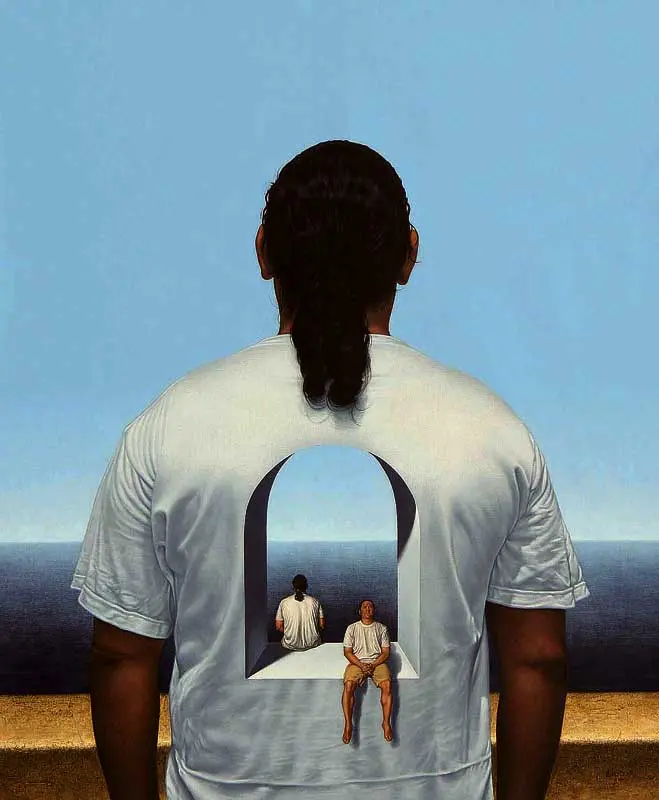
It is interesting how Alpízar has become an entity after testifying to the tensions of a period from his allegoricalized corporal space. In the five pieces of the series titled El Sabor de las Lágrimas (The Taste of Tears), he renders self-portraits in which he is shown time and again at the ocean with his back to the viewer. It is an open back that allows the blue from the sky and the blue from the ocean to converge. In these horizon or limit lines reside the gravitas of a drama, and as we gaze upon each scene. We witness the social steadfastness of an idea and of the artist’s own introspections. His gaps are spaces for freedom that allow the mind to expand. Jumping, flying, or staying represent the available choices available in the middle of the rocking social crossroads that Alpízar has been able to condense. Hopefully, the denouncement of this trap on an apparently one-way road, of the many, everyday acts of violence that also turned him into Saint Sebastian, will allow for elucidation and reversion of the processes that led to the parables built by Rubén Alpízar about a localized present that is ours.
CARIDAD BLANCO DE LA CRUZ