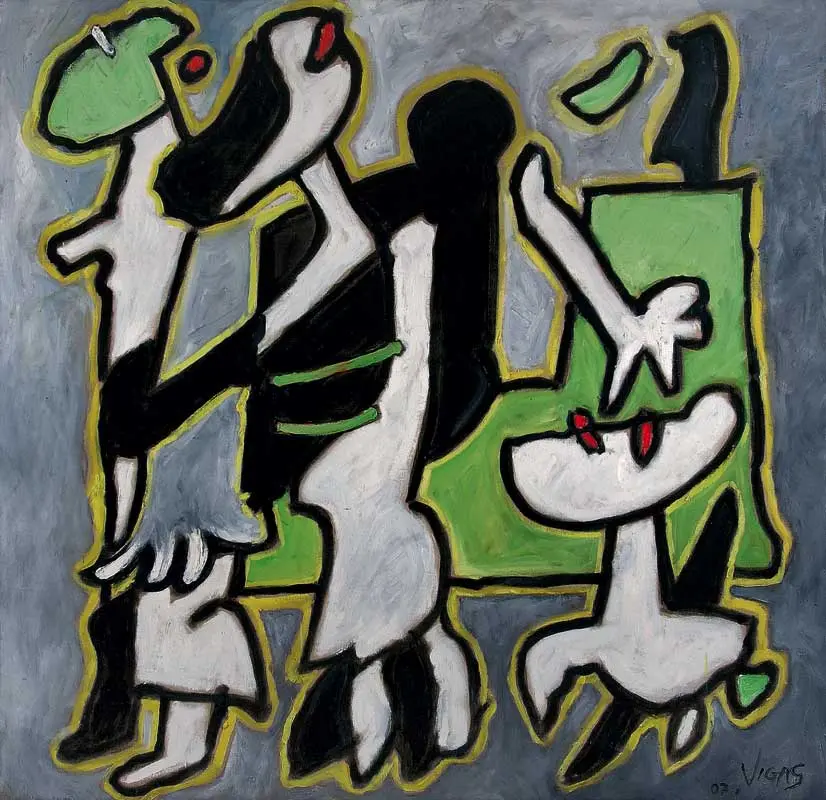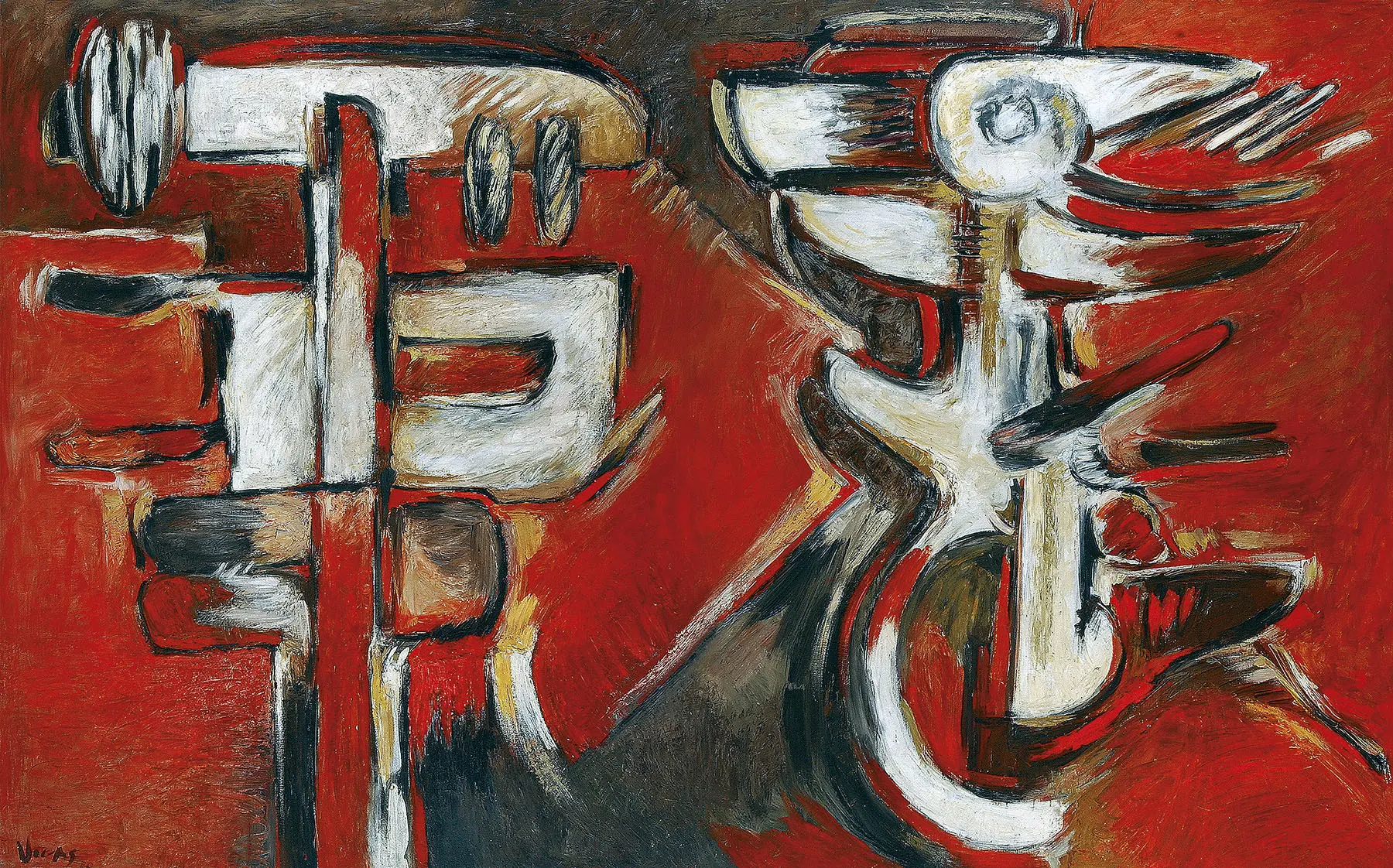
Oswaldo Vigas is one of the most important artists in Venezuela. His work is strongly rooted in Latin America both in terms of its sense of belonging and of its invention of a personal cosmogony that identifies him as an artist. The cultural referents derived therein are many and are suggested through the various periods of his career. Yet Vigas’ oeuvre, being profoundly of the Americas, has unprecedented universal reach, as it crosses cultural boundaries. It should suffice to mention the very high honors Vigas has garnered over the years: The Grand Prix SAS Prince Rainier III of Monaco in 1992; the Medaille Vermeil of the city of Paris; his investiture as Chevalier de l’Ordre des Arts et des Lettres de France in 1993; the Premio de la Latinidad in 2004; and his naming as Commandeur de l’Ordre des Arts et des Lettres, the highest distinction offered by France’s Ministry of Culture, in 2008. This besides the fact that at a very young age, in 1952, he won, among others, the three most important prizes given at the time in Venezuela: the Premio Nacional de Artes Plásticas, the Premio John Boulton, and the Premio Arturo Michelena. Thus began Oswaldo Vigas’ career in art. He was 26 years old.
The 1940s and 50s
Vigas never followed any academic norm. Since very young he explored a variety of expressive forms in order to consolidate a personal pictorial language. He went through experimental periods, even coming close to abstraction, but always seeking to build his unique mythology with reference to our ancestral origins. For this reason, his oeuvre acquired an imposing presence: because of its expressive force and its commitment to its fictional context and its own identity.
These qualities are present since the 1940s. At that time, Vigas let loose the reins of his imagination, painting flowers and fantastic motifs. In Mérida, where he was a medical student, he developed an interest in pre-Columbian ceramics and in the female figure. This spiritual empathy evolved unconsciously and has lasted throughout his career. Starting in 1945, Vigas’ figures become increasingly more synthetic, his colors more austere, and a strong line marks all contours. An example of this is Figura en amarillo, of 1949.
In the 1950s, two radically opposing lines polarized the artistic scene in Venezuela: geometric abstraction and kinetic art on one side, and figurativism, with several variants, on the other. Vigas followed the second path, with some momentary detours into abstraction. The first of these took place in Caracas, after he left Mérida for political reasons. With the members of the Taller Libre de Arte, Vigas shared a search for knowledge of our autochthonous roots and our identity. Later, journeys to Barlovento, Yare, Siruma, Paraguaipoa, and la Guajira reinforced his interest in cultural traditions and his passion for pre-Columbian ceramics and petroglyphs, consolidating his personal iconography and symbolism.
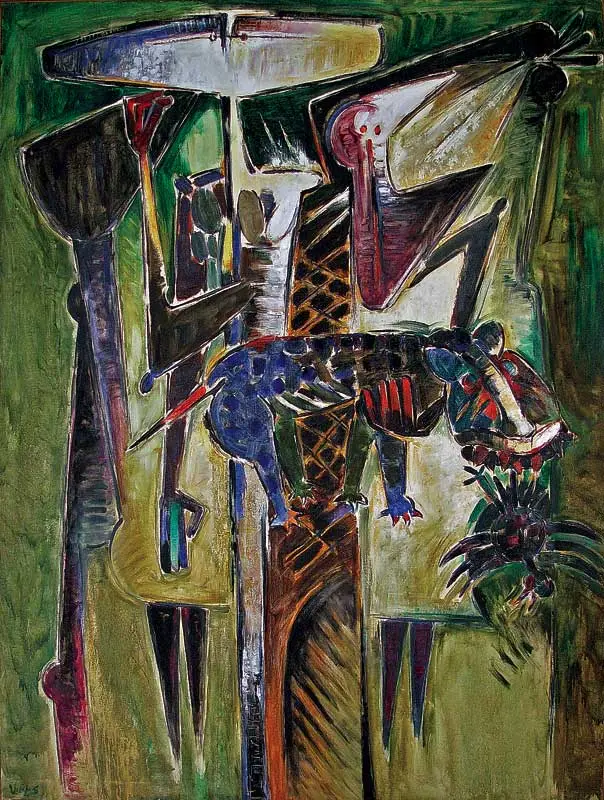
It is in this context that Vigas created his Brujas series. Thus named by writer Oswaldo Trejo, this series combines a modern and universal pictorial practice with the presence of female figures taken from local mythologies. The topic of witchcraft adds a magical-religious element to Vigas’ work and we see, for instance, witches suspended in space as objects around them shift and are transfigured: a plant becomes a snake, or a woman is also a plant. With Gran Bruja, of 1952, Vigas won the Premio Nacional de Artes Plásticas. This fictional universe acquires American connotations through Vigas’ allusions to the pre-Columbian world (elongated, flattened heads, some with markings that resemble tattooings inspired in guajiro designs), or alternatively through his inclusion of signs and symbols appearing, in a synthetic yet organic way, in the background of his works.
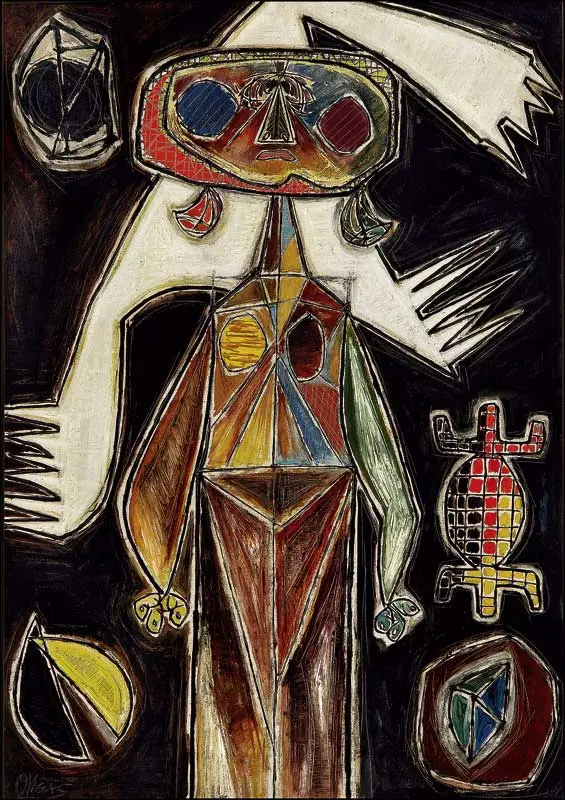
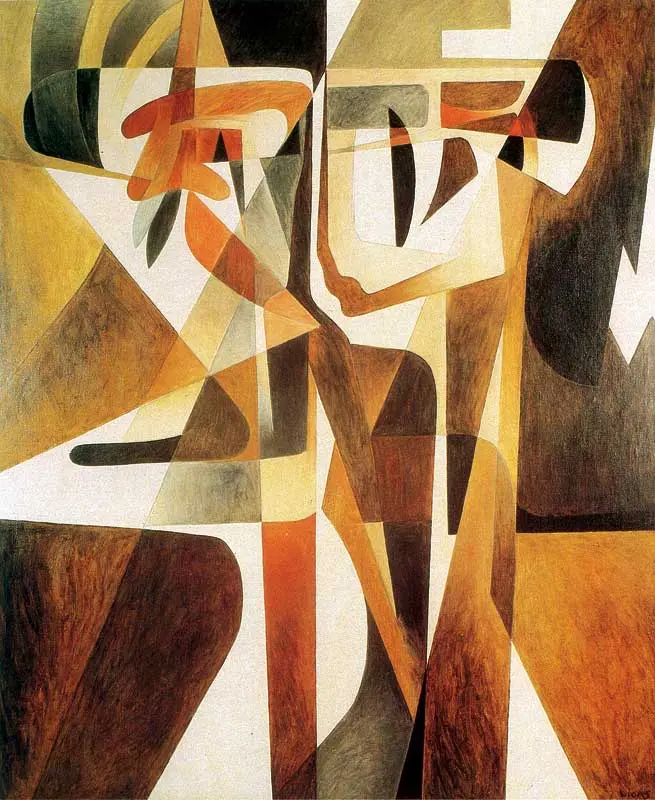
As he was creating the Brujas, Vigas also developed works whose lineal structure signals defining thematic motifs for his oeuvre, as we see in Yare, an emblematic work that resulted from a major process of synthesis of form and retained, within that structure, a continued reference to nature. Plant leaves and sharp shapes like toothed mandibles dynamize the image with their heavy dose of violence. Works like these, dominated by bugs, vermin and insects will appear regularly in Oswaldo Vigas’ pictorial production. In 1952, already settled in Paris, Vigas maintained this constructive sense for the five murals commissioned by architect Carlos Raúl Villanueva for Caracas’ University City. The result of this project is paintings that retain a similar synthesis of form and structural treatment above and beyond the symbolic content.
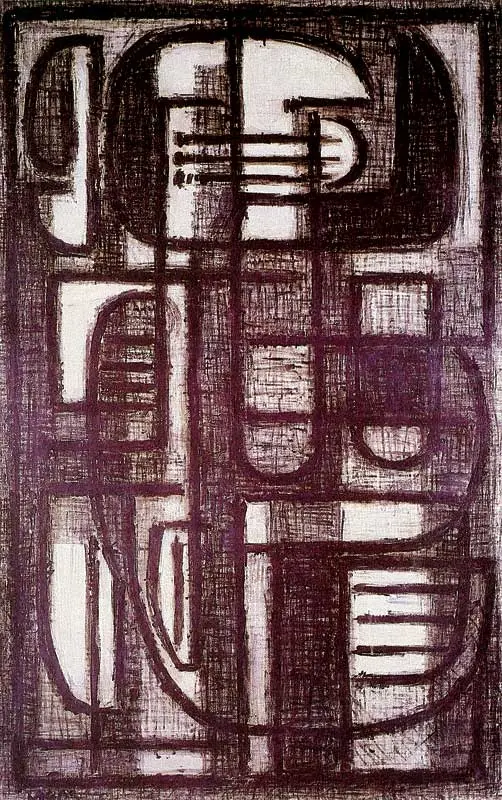
Following this experience came the series Objetos, developed between 1954 and 1956. Drawing continues to be the image’s structural and compositional element. Integrated here we find the schematic organic elements that characterize Vigas’ iconography. Color plays a compositional role in the earlier works of the series, differentiating plane and constructive elements, but it is gradually eliminated. This process derives in the Objetos negros, whose signs are clustered and simplified to focus on the plot as the constructive element (Objeto negro, 1956).
There is a break with this pictorial sequence in 1957, after Vigas’ show at Sala Mendoza. He leaves behind the plot and develops an interest on matter and texture. This radical shift coincides with the political crisis in the country against the government of Marcos Pérez Jiménez. Vigas took part in the writing of the Manifiesto de los Intelectuales against the dictatorship. This fostered a need to reengage his origins and express his attachment to the land through informal abstract works where matter is the central expressive element. La tierra se remueve (1961) and other works comprise a pictorial geography dominated above all by the feelings and the tangible, visible manifestation of an “inner” landscape.
The 1960s
During this decade, Informalism was the fashion in Europe and the Americas, characterized by experimentation with materials and the creation of unexpected textures. Vigas’ gesturalism, began in 1957, became more violent and spontaneous, coinciding in turn with a newfound interest in Zen Buddhism. 1962 saw the emergence of the series Signos, works on paper that return to an expressionism very much in tune with Vigas’ temperament. These compositions are built on quick brushstrokes that suggest, through their free-hand style and their color, the demarcation of territories seen in an abstract way. In all of them prevails the spirit that cloaks a region.
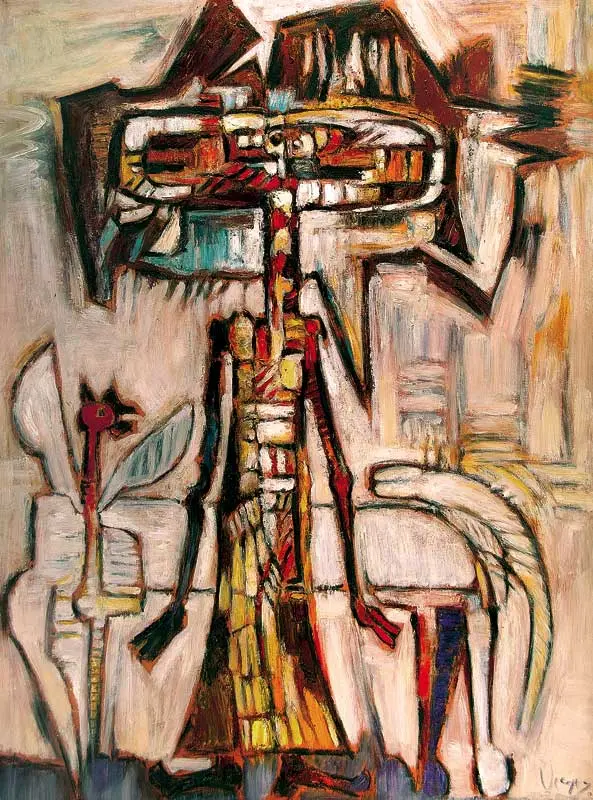
Vigas’ spontaneity grows increasingly more intense. In the series Personagrestes (1963-1964), he oscillates between an explosive abstraction and an equally explosive figurativism. A variety of fable-like beings form his visual lexicon: bestiaries, earthlings, augur birds, as well as the personagrestes themselves —an invented term that combines persona and agreste (rough-hewn). Pictorially, these works retain a spontaneous dynamic, outlined with dark lines and rough tracings (Aves agoreras, 1963).
Vigas’ phantasmagoric universe, populated with witches and monsters that will gain in presence in the following periods, reappears with this return to figurativism. The series María Lionza, Señoras, and other works of 1964, contain essential elements of his previous paintings: the female archetype as a topic, as well as the free-hand and feral style that fuses the human and the animal with unbound imagination. By then, Vigas was back living in Mérida.
The María Lionza paintings and the Señoras feature a flattened face, with bodies and head that are half human and half insect. At the same time, they appear to be changing into plants. It is a symbiosis of beings and organic varieties fused into one. Vigas returns to the idea of the origin of life: the point at which all species derive from a single living organism. This cosmogony is directly related to the female figure, to maternity, to the beginning of things. María Lionza, on its part, sets in motion feelings regarding Venezuela’s idiosyncrasy, like a local autochthonous goddess, representing the syncretism of races the force of nature, love, and unity (Solariega, 1967)
In 1966 Vigas painted the series Lúdicas, formal games based on the relationship form/color. Here, his phantasmagoric and bestial figurations are resolved in a flat, geometric way. However, each figure has a conceptual background based on the performative role that represents them. Such an “animation” of the figures according to the role that identifies them was to appear continuously in Vigas’ oeuvre from the 1960s on. The characters come to life and acquire personalities. We see the enigmadora, the pasante, the hierática, or the gestante, and of course the lúdicas (Hierática II, 1971). This resource allows Vigas to express various facets of the human soul with great vitality and humor.
The 1970s and 1980s
Starting in 1973, already in Caracas, Vigas returned to expressive figurativism and creates his Ancestros. He now paints with the conviction that his aesthetics finds support in a deeply American spirit. Coherent with these roots, he gives free rein to an imagination assumed as an inner process that allows him to transit from objective reality to fictional reality (Mi animal de costumbre, 1977). In that sense, Vigas expresses visually what he calls “anguish and longing,” which are nothing more than the ghosts incarnated in those ancestors. The ancient past returns in his iconography as a present reality.
Vigas’ creative process is not linear. He constantly returns to ideas he’d come up with years before. Because of this, in the 1980s he continues to paint fable-like beings in conjunction with nature and its organic vitality (Génesis, 1980, and Litúrgica, 1989). There is greater thematic variety: He paints offerings, allegories of peace, images of the Libertador, crucifixions, and other mythical representations. He repurposes sketches and drawings, transferring them to the canvas. He paints these images with a boldness and energy similar to nature’s wild drive, generator of life and transformer of bodies. He transfers such vitality to tapestry, ceramics, glassworks, and sculpture, explorations that will allow him to resize his particular iconography at a new scale.
The 1990s and Today
Since the 1970s, Vigas’ work is conceived as a visual project in progress. Each period emerges from the previous one, as the result of a constant revision of topics and situations. This is why in the 1990s he continued to develop a figuration closely linked, from the thematic and formal standpoints, to primitivism and naïf art. There appear the high-wire artist, the little devil, the beats, the prostitute, the birds, figures connected to the popular imaginary (Ese deseo de encantamiento… Homenaje a Gastón Diehl, 1999). This painting, austere in color, is supported in drawing, not only as the structuring element of the work but as a means for the animation of the image.
Drawing acquires greater centrality in Vigas’ pictorial work in the 1990s, and continues to have it today. He draws in his sketches and later in the canvas. The sketches allow him to capture the pictorial motifs he wants to achieve in an impulsive and at the same time meditated way. In this fashion, he explores the shapes and the themes that will inform his pictorial universe. The greater his commitment to his own thought, the more figurations he extracts from his imaginative wealth (De paseo con la mascota, 2007).
Over time, Vigas has deepened his knowledge of the human soul. Besides the mythical creatures, the solar figures and other fabulations, he works with human types. This gives his work an organic, almost animal quality. Thus the passions it arouses. Bodies are drawn expressing the animal and irrational soul contained in every human being. Vigas speaks from the emotional, primitive universe of Man, generally incarnated in the sexual presence of female figures. The line around the bodies is firm. The bodies are presented almost always in frontal view, with totemic presence, and at the same time they possess an almost baroque formal spiritedness. Just like, as it were, the soul of the Americas.
The Well-Rounded Artist
While Vigas is above all a painter, his vitality and his restless spirit have incited him to explore other media. Sculpture, ceramics, and textiles play an important role in his work. His sculpture projects began in 1970, but it was his exploration of ceramics in the 1980s that motivated him to explore sculpture in greater detail (Mantuana, 1985). The result is a set of works of enigmatic presence, witches, goddesses, and other contorted and baroquely shaped creatures that express the animal/plant syncretism also present in Vigas’ paintings.
Vigas’ tapestries, on the other hand, emerge from original gouache works that served as models. He developed them in the 1970s in a variety of workshops in Portugal, Spain, and Mexico. Collaborating with textile masters, Vigas was able to connect painting and tapestry in a common project. The force of his figures, his contrasting treatment of color, the quick and rough gesture of his brushstrokes, are clearly maintained in this medium (Bruja azul, 1972).
Vigas’ imaginary beings also appear in ceramics. He adopted this format and material to further his proposal. For that purpose, he drew on clay or gres as he does in his canvases, using sketches, the primary source of all his ideas. Despite the uniformity of the mold, each work is unique. Vigas particularizes them through modeling, color, and touch, inventing his own technical solutions (Personaje retoño insecto, 1981, based on a theme from 1953).
All of this makes Oswaldo Vigas a well-rounded artist, firm and referential column of Latin American figurative art in the second half of the Twentieth Century, still active today.
Art researcher and museologist. Member of AICA and Editorial Advisor for ArtNexus magazine.